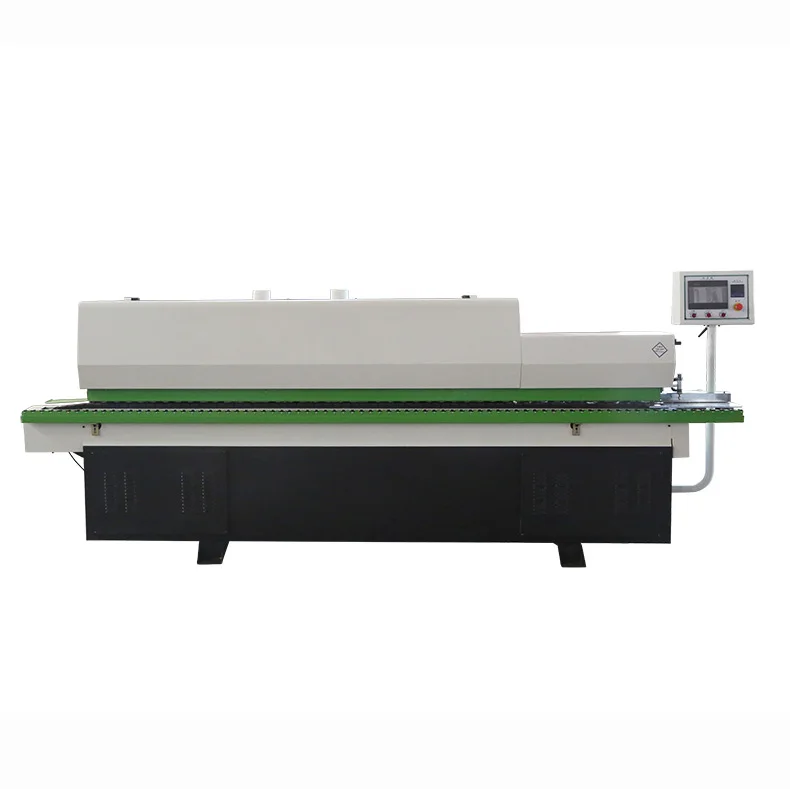
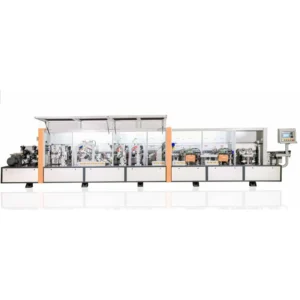
Precision Assembly — Every ZDS368A undergoes incoming, in-process, finished, and pre-shipment inspection before leaving the facility, with electrical schematics verified against the buyer’s confirmed voltage and frequency.
Technical Specifications
| Parameter |
Value |
| Model |
ZDS368A |
| Product Type |
Automatic Edge Banding Machine |
| Process Stations |
Gluing, End Trimming, Rough Trimming, Fine Trimming, Scraping, Buffing |
| Working Pressure |
0.6–0.8 MPa |
| Panel Thickness Range |
10–55 mm |
| Edge Thickness Range |
0.3–3.5 mm |
| Conveyor Feed Speed |
18 m/min |
| Minimum Panel Width |
40 mm |
| Minimum Panel Length |
60 mm |
| Voltage & Frequency |
380V / 3-Phase (50Hz or 60Hz to confirm) |
| Rated Power |
8.5 kW |
| Net Weight |
1500 kg |
| Overall Dimensions (L×W×H) |
4200 × 1000 × 1500 mm |
| Control System |
Taiwan Delta PLC with touch screen |
| Pneumatic Components |
Taiwan AirTAC cylinder and safety valve |
| Electrical Components |
Delixi/Chint air switch and contactor; Japanese Omron travel switch |
| Inverter |
Switzerland JORAL |
| Compatible Edge Banding Materials |
PVC, Veneer |
| Key Features |
CE and ISO 9001 manufacturing standards; OEM and private label customization available |
Application Suitability
| Application |
Material or Output |
| Cabinet door and carcass edge banding |
Particleboard and MDF with PVC edge tape |
| Wardrobe panel finishing |
Melamine-faced board with PVC or veneer banding |
| Learning desk and office furniture panels |
Plywood and MDF with 0.3–3.5 mm edge material |
| Custom furniture batch production |
Solid wood panels with veneer edge banding |
| Component rework and small-batch runs |
Mixed panel substrates requiring quick changeover |
Why the Voltage Question Comes Before the Price on Any Automatic Edge Banding Machine Factory Order
A machine that cannot match local power infrastructure is dead weight on the dock, regardless of how attractive the quote looked.
I spent years in the Pearl River Delta coordinating technical handoffs for woodworking lines destined for export. One MDF edge bander sat idle for three weeks after arriving overseas because the frequency mismatch was never confirmed at the quotation stage. The buyer had to source a local transformer and reconfigure motor wiring on site. When sourcing from an automatic edge banding machine factory, the electrical specification conversation must happen before the configuration is locked — not after the container ships. [NEED_CITE: voltage and frequency standards by export market]
Verifiable Component Sourcing at the Factory Level
Distributors evaluating an OEM edge banding machine manufacturer need to see past the nameplate. On the ZDS368A, pneumatic actuation is handled by Taiwan AirTAC cylinders, the PLC logic runs on a Delta touch-screen controller, and travel switches are Japanese Omron units. The inverter is a Switzerland JORAL component. Each of these is specified on the electrical schematic you receive before production starts, and each is visible during a factory visit.
Private Label Capability Without Compromising Build Integrity
An automatic edge banding machine factory must deliver more than a different badge on the enclosure. The ZDS368A supports custom color schemes, logo placement, multilingual control panel configuration, and voltage customization from 110V to 440V. The underlying frame grinding, assembly torque specifications, and four-stage inspection protocol remain constant regardless of surface branding. This is the distinction between a relabelled unit and a genuinely manufactured one. [NEED_CITE: CE machinery directive requirements for industrial equipment]
How Trim Station Count Affects Panel Edge Quality
The ZDS368A runs a six-station sequence: gluing, end trimming, rough trimming, fine trimming, scraping, and buffing. Each station addresses a specific stage of edge finish. Rough trimming removes the bulk of excess banding, fine trimming brings the edge flush with the panel face, and scraping eliminates the tool marks left by the trimming cutters. Buffing then polishes the transition between panel and band. Fewer stations force individual cutters to do more work per pass, which increases chatter and leaves visible witness lines on PVC surfaces.
Panel Thickness Range and Feed Speed Interaction

The 10–55 mm panel thickness window and the 18 m/min conveyor speed must be evaluated together. Thicker panels carry more mass and create higher lateral forces on the trimming cutters at the same feed rate. The JORAL inverter manages conveyor acceleration to prevent sudden load spikes on the cutter motors. For workshops running mixed panel stocks — say 16 mm particleboard for carcasses and 25 mm MDF for door fronts — the PLC stores process recipes so operators can switch without manual recalibration of each station. [NEED_CITE: woodworking panel thickness tolerances for furniture assembly]
What Happens When Configuration Details Are Skipped
A distributor once ordered a batch of edge banders for a Southeast Asian market without specifying the control panel language. The machines shipped with Chinese interface text. The end-user operators could not navigate the fault diagnostics, which turned a five-minute sensor reset into a half-day troubleshooting event. Beyond language, unconfirmed conveyor height relative to upstream roller tables creates panel tilt at the infeed, causing the edge band to track high or low on the panel face. These are not warranty claims — they are configuration failures that the buyer absorbs.
What This Automatic Edge Banding Machine Factory Puts Behind Every Shipment
The ZDS368A is built on a 10,000㎡ facility with in-house frame machining and assembly. Patented cutting mechanisms deliver consistent trim accuracy verified during the pre-shipment test. Every unit ships with documented inspection records across all four QC stages. Voltage, language, and cosmetic customization are confirmed in writing before production begins — not improvised on the line. Factory visits are open for buyers who want to see component inventory and assembly benches firsthand. Engineer-led configuration review with a formal quotation is provided within 24 hours of inquiry.
Documentation & Verification
- CE declaration of conformity issued for the ZDS368A configuration shipped
- ISO 9001 certificate covering the manufacturing process
- Electrical schematic with confirmed voltage, frequency, and breaker sizing
- Factory test record running your specified panel thickness and edge material
- Operation and maintenance manual translated into the agreed language
- Spare parts list with OEM part numbers for consumables and wear items
Installation, Commissioning & Support
- 4200 × 1000 mm footprint requires level concrete floor with anchor bolt provisions
- 8.5 kW rated power demands a dedicated 3-phase circuit with proper grounding
- Machine ships as a single assembly — conveyor and station frames pre-aligned
- Delta PLC touch screen calibrated on site for your local language and units
- Initial run tests performed across your full panel thickness range before handover
- Wear parts inventory reviewed and reorder schedule established at commissioning
Preparing Your OEM Edge Banding Machine Manufacturer Inquiry
To get a configuration recommendation and formal quotation on the ZDS368A, provide your target panel materials and edge banding types, the voltage and frequency at the installation site, and the preferred control panel language. If you are evaluating this unit for distributor stock or private label, include your territory requirements and any cosmetic or branding specifications. Sample processing tests on your actual panel stock can be arranged before order confirmation.
Frequently Asked Questions
Q: What OEM and private label options does the ZDS368A support?
A: The ZDS368A can be configured with custom logo placement, enclosure color, multilingual touch-screen interface, and voltage settings from 110V to 440V. All customizations are documented in the pre-production specification sheet and verified during the pre-shipment inspection. The manufacturing process and QC protocol remain identical regardless of branding.
Q: How is manufacturing quality documented before the machine ships?
A: Four inspection stages produce records: incoming material checks on components, in-process measurements during assembly, finished product functional testing, and pre-shipment verification with photographs. Each ZDS368A ships with a factory test record showing it ran on the buyer’s specified panel thickness and edge material before crating.
Q: Can the factory support a distributor’s model mix for a regional market?
A: The product range spans entry-level to full-function edge banding machines within one product family. Distributors can configure a model mix that covers small workshops and mid-volume factories without sourcing from multiple manufacturers. Territory-specific configurations, including voltage and documentation language, are confirmed per order.
Q: What spare parts and technical training are provided for distributor service teams?
A: Every ZDS368A ships with a spare parts list identifying consumables and wear items by OEM part number. Distributor service teams can receive technical training covering station adjustment, PLC fault diagnostics, and preventive maintenance intervals. Training content and format are agreed during the order confirmation stage.
Q: Can the buyer witness or receive verification of pre-shipment testing?
A: Pre-shipment testing includes running the ZDS368A on panel material matching the buyer’s specification. Buyers may attend the test in person at the factory or receive video documentation showing the machine operating through its full station sequence, along with measured edge finish results and electrical parameter verification.