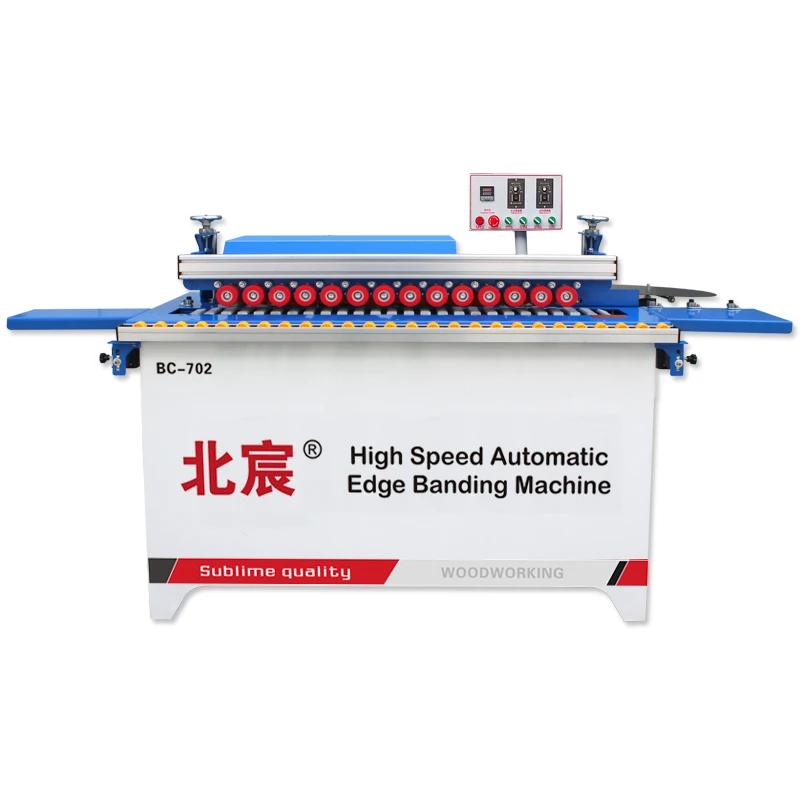
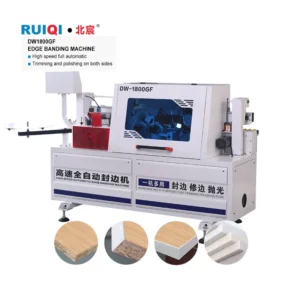
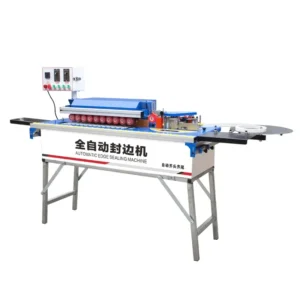
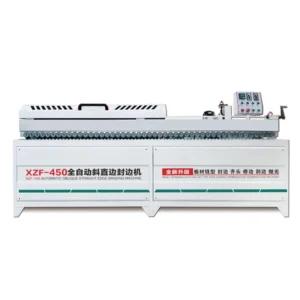
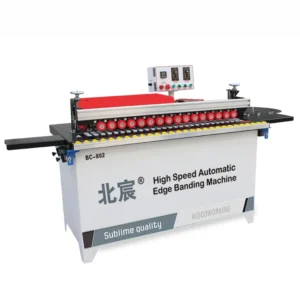
OEM Partner Manufacturing — DW702 edge bander built with full private-label capability, backed by four-stage QC and pre-shipment verification before it leaves the factory floor.
Technical Specifications
| Parameter |
Value |
| Model |
DW702 |
| Product Type |
Automatic Edge Banding Machine |
| Total Power |
3800W |
| Voltage |
220V / 380V / Customizable |
| Edge Banding Height |
0-50mm |
| Edge Banding Thickness |
0.3-3mm |
| Minimum Sheet Length |
250mm |
| Minimum Sheet Width |
100mm |
| Trimming Power |
800W × 2 |
| Polishing Power |
180W × 2 |
| Vacuum Power |
1200W |
| Glue Pot Capacity |
1000ml |
| Air Source Pressure |
0.4-0.8 MPa |
| Product Dimensions |
1200 × 550 × 1100 mm |
| Product Weight |
105 kg |
| Key Features |
Edge banding, trimming, polishing, automatic head/tail cutting, vacuum extraction |
Application Suitability
| Application |
Material or Output |
| Custom cabinet production |
MDF, particleboard, melamine-faced panels |
| Furniture panel edge finishing |
Plywood, blockboard, solid wood panels |
| Polymer door manufacturing |
PVC and polymer composite substrates |
| Medium-volume workshop output |
Finished edges on standard sheet goods |
Why the Voltage Question Must Be Settled Before the Machine Ships
Every DW702 leaves the factory only after a signed electrical schematic confirming the exact voltage and frequency of the destination site.
I spent years on assembly floors watching machines get wired for the wrong grid. One edge bander built for 380V landed at a customer running 415V three-phase; the motor would not even start. A transformer had to be shipped by sea, and the entire line sat idle for weeks. That failure was entirely preventable. When sourcing an edge banding machine factory for OEM or distribution, the electrical configuration is not an afterthought — it is the first line of the specification sheet [NEED_CITE: voltage and frequency standards by export market].
Private-Label Build Depth for Regional Distributors
An edge banding machine factory worth partnering with should let you control more than just the logo plate. The DW702 supports custom branding on the machine body, control panel faceplate, and packing materials. Voltage is configurable from 220V to 380V and beyond, so the same platform serves markets running different grid standards without requiring a separate production run. This matters when you are stocking machines for a territory with mixed electrical infrastructure.
Precision-Ground Components and Four-Stage QC
Manufacturing quality is not something you can verify from a brochure. The DW702 moves through four inspection gates: incoming material check, in-process assembly audit, finished-product functional test, and pre-shipment verification with a documented test record. Precision-ground guide rails and feed chains are measured at multiple stages, so tolerance claims are backed by actual readings rather than factory-floor promises [NEED_CITE: ISO 9001 quality management requirements for machinery manufacturing].
How Core Parameters Shape Edge Quality
The 1000ml glue pot on the DW702 provides enough adhesive volume to maintain stable temperature across extended runs, which matters when switching between PVC and melamine edge banding — each demands a different glue behaviour at the application point. The dual 800W trimming motors handle head, tail, and flush trimming in one pass, removing the need for a separate trimming station downstream. Polishing at 180W × 2 smooths the trimmed edge to a finish suitable for visible cabinet fronts. The 1200W vacuum system pulls chips and glue residue at the cutting zone, keeping the feed track clear and reducing the cleaning intervals that eat into a shift.

The Hidden Cost of Skipping Pre-Shipment Verification
Distributors who accept machines without a factory test record often discover problems only after container opening. Glue distribution that looked even on the test bench may streak on your specific board stock. A control panel shipped in a language your technicians cannot read delays commissioning by days. Trimming motors that were never run against your edge banding thickness range may chatter on 3mm PVC, leaving visible lines on panels destined for high-end kitchens [NEED_CITE: common commissioning delays in imported woodworking machinery].
What Makes This Factory a Viable OEM Source
In-house precision grinding means critical components are finished on-site, not outsourced to third-party machine shops where tolerance drift is harder to control. The DW702 platform shares its product family with higher-tier models, so a distributor can offer a range from entry-level to full-function pre-milling under one manufacturing partner. Voltage, plug type, and control panel language are treated as standard configuration choices, not special requests. Every unit ships with packing photographs and a pre-shipment test record documenting performance against the agreed specification.
Documentation & Verification
- CE declaration of conformity referencing the DW702 machine category
- ISO 9001 certificate covering the manufacturing process for this unit
- Electrical schematic with confirmed voltage and frequency for the destination market
- Factory test record showing edge quality on your specified panel material and thickness
- Packing photographs documenting machine condition before container loading
Installation, Commissioning & Support
- Floor space of approximately 1200 × 550mm required with clearance for panel infeed and outfeed
- Dedicated 220V or 380V circuit matching the confirmed electrical schematic before machine arrival
- Machine ships fully assembled; position, level, and connect air supply at 0.4-0.8 MPa
- Glue pot filled and heated to operating temperature; first test run on sample panels included in shipment
- Spare wear parts list covering trimmer blades, polishing wheels, and feed chain shoes provided at dispatch
How to Start a Sourcing Conversation
Share the panel materials and edge banding thickness you plan to run most often, along with your local voltage and frequency standard. Specify the control panel language your operators need and whether you require private-label branding on the machine body and documentation. If you are evaluating multiple configurations for a regional product range, indicate which tier models you want quoted alongside the DW702.
Frequently Asked Questions
Q: What OEM and private-label options are available on the DW702?
A: Custom logo placement on the machine body, control panel faceplate, and packing materials is standard for OEM orders. Voltage, plug type, and control panel language are all configurable per destination market. Minimum order quantities vary depending on the scope of customisation, and sample units can be produced for approval before a full production run begins.
Q: How is manufacturing quality verified before the machine ships?
A: Each DW702 passes through four inspection stages covering incoming materials, assembly, functional testing, and pre-shipment verification. A factory test record documenting edge banding performance on your specified panel material and thickness is included with every unit, along with packing photographs taken before container loading.
Q: Which voltage and plug configurations can be built for different markets?
A: The DW702 is configurable for 220V, 380V, and other voltage standards depending on the destination grid. Plug options include EU, USA, AU, and UK types. A confirmed electrical schematic is signed off before production begins, ensuring the machine matches the site power supply on arrival.
Q: Can the control panel language be set for our local operators?
A: Chinese and English are standard language options. Spanish and other languages can be configured based on the end user market. The language selection is confirmed during the specification review stage so the control interface matches operator requirements at commissioning.
Q: What documentation comes with the machine for customs and compliance?
A: Each shipment includes a CE declaration of conformity, ISO 9001 certificate, machine specification sheet, electrical schematic, operation and maintenance manual in the agreed language, spare parts list, and packing photographs. These documents support customs clearance and local regulatory compliance in the destination country.