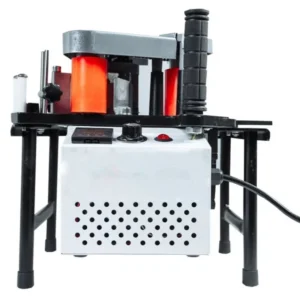
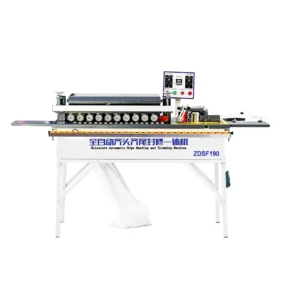
Patented Cutting Mechanisms — every portable curved edge banding machine leaving our Ningjin facility carries verified ±0.02mm tolerance backed by factory test records, giving OEM partners a defensible specification when reselling under their own brand.
Technical Specifications
| Parameter |
Value |
| Product Type |
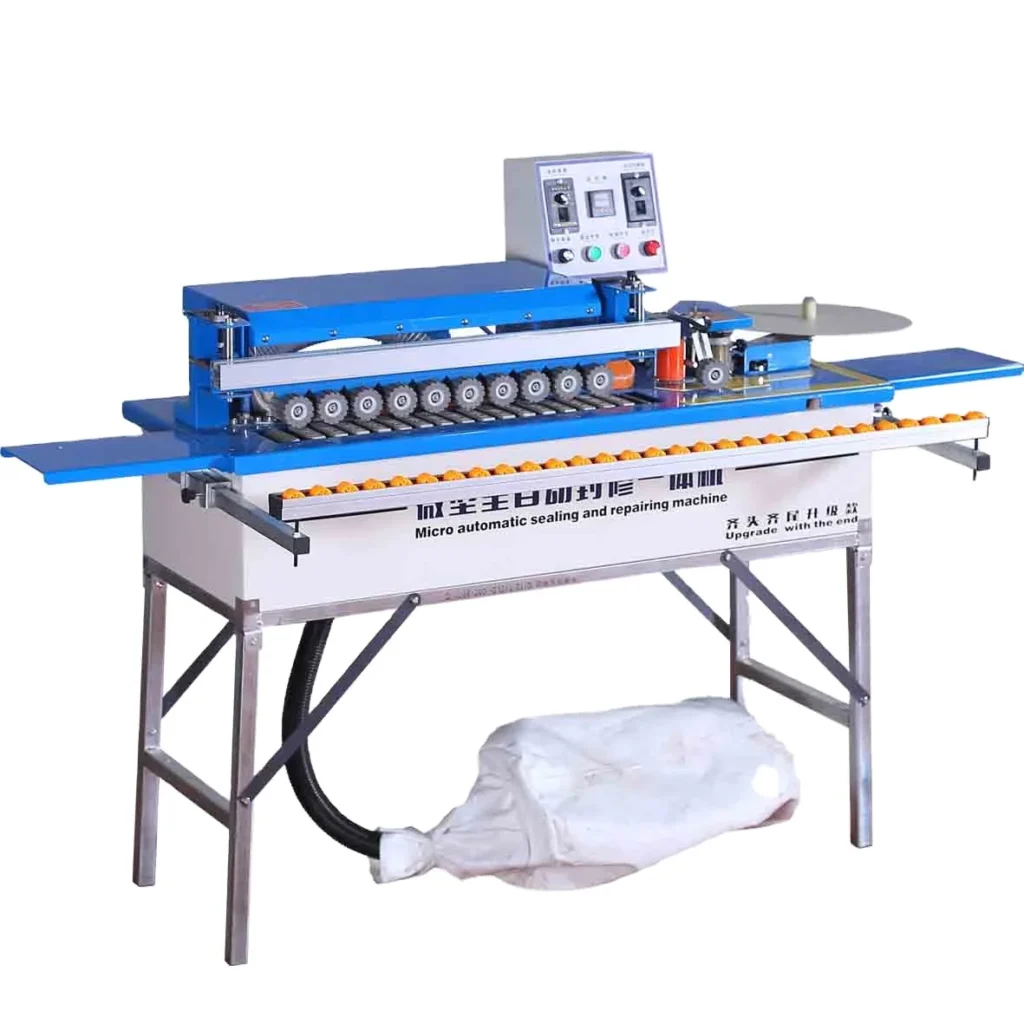
Portable Curved Edge Banding Machine |
| Voltage |
220V (configurable from 110V to 440V for OEM orders) |
| Suction Power |
1200W |
| Belt Power |
25W |
| Transmission Power |
60W |
| Polishing Power |
180W × 2 |
| Trimming Power |
800W × 2 |
| Conveying Speed |
0–15 m/min |
| Edging Speed |
0–6 m/min |
| Edge Height Range |
10–60 mm |
| Edge Thickness Range |
0.3–3 mm |
| Overall Dimensions |
120 × 54 × 72 cm |
| Net Weight |
81 kg (source value — verify against manufacturer catalog) |
| Control System |
Manual control panel with separate function switches |
| Gluing Method |
Double-sided adhesive |
| Gluing Device Rotation |
180° for curved edge banding |
| Trimming Stations |
Up and down trimming with dust suction device |
| Polishing Stations |
Up and down cross polishing |
| Feed Mechanism |
Double-row rubber pressure wheels |
| Key Features |
Automatic feeding, automatic head and tail cutting, curved and straight dual-purpose, vacuuming |
Application Suitability
| Application |
Material or Output |
| Custom furniture panel edge banding |
MDF, particleboard, plywood panels with PVC edge banding |
| On-site joinery and cabinet installation |
Solid wood panels and veneer edge banding in confined workshops |
| Small-batch curved furniture components |
Shaped MDF and plywood edges with 0.3–3 mm PVC or veneer strips |
| Prototype and sample production runs |
Mixed panel substrates requiring quick changeover between straight and curved profiles |
Why Voltage Confirmation Must Precede Every OEM Shipment
A portable curved edge banding machine specified at the wrong frequency will overheat its trimming motors before the first container is unpacked.
When a Southeast Asian distributor took delivery of a curved edge bander without confirming local 50 Hz versus 60 Hz supply, the 800W trimming motors ran hot within the first week, and the adhesive curing behaviour drifted because the heating cycle was calibrated for a different grid. The operator control panel was also in a language the local technicians could not read, stalling commissioning further. These are the failures that erode a reseller’s reputation before the second reorder [NEED_CITE: voltage and frequency standards by export market].

Component Sourcing and Assembly Depth for Private Label Partners
An OEM partner needs to know what is built in-house versus bought in. On this portable curved edge banding machine, the trimming and polishing stations use proprietary cutting mechanisms that are precision-ground on our own equipment, not sourced from a third-party catalogue. The double-row rubber pressure wheels are matched to the 0–6 m/min edging speed so that feed pressure stays even across curved profiles, which matters when a distributor is putting their own nameplate on the unit and fielding the warranty calls.
Four-Stage Quality Control Before Your Logo Goes On
Incoming material inspection checks motor windings and adhesive-channel castings before they enter assembly. In-process verification covers the 180° rotation mechanism for the gluing device and the alignment of the up-and-down trimming heads. Finished-product testing runs actual MDF and plywood panels through both straight and curved cycles, and the pre-shipment verification records every measured edge tolerance before crating [NEED_CITE: CE machinery directive requirements for industrial equipment]. OEM partners receive the full four-stage dossier so they can show their own buyers that the portable curved edge banding machine they are reselling was verified, not just assembled.
Reading the Spec Sheet Against Real Workshop Conditions
The 0–15 m/min conveying speed and 0–6 m/min edging speed define the throughput envelope, but the practical output depends on panel thickness and edge material. Running 3 mm PVC on a 60 mm tall MDF panel at maximum edging speed will stress the double-sided adhesive bonding differently than 0.3 mm veneer on 10 mm plywood, so the speed dial exists for a reason. The 800W × 2 trimming motors must hold consistent RPM under varying load to keep the edge flush, while the 180W × 2 polishing stations remove the micro-scratches left by trimming. The 1200W suction unit connects to the integrated dust port so that PVC trimmings and adhesive residue do not accumulate around the feed wheels, which would otherwise cause panel drift on curved sections. Buyers specifying this portable curved edge banding machine for a regional market should match the edge thickness range and panel height to the dominant substrate their end-users process.
What Happens When OEM Buyers Skip the Configuration Step
Distributors who order a standard voltage unit and relabel it locally often discover that the control panel language, the plug type, and the adhesive curing parameters are all wrong for the destination market. The result is a machine sitting idle while the importer sources a step-down transformer and reprints an operation manual, burning through the margin on the first batch and shaking the confidence of every workshop that saw the demo [NEED_CITE: common causes of commissioning delay in imported woodworking machinery].
Why OEM and Distributor Partners Source From This Facility
In-house manufacturing of the patented cutting mechanism means tolerance claims are traceable to the grinding log, not a supplier’s data sheet. The full product family — from entry-level straight banders to this curved-and-straight dual-purpose unit — lets a distributor standardise on one factory while covering every workshop tier in their territory. Voltage, control-panel language, and packaging are configured per order rather than retrofitted after arrival. Four-stage QC with pre-shipment verification gives the importer a test record they can hand to their own customer. Engineer-led configuration recommendations with a formal quotation within 24 hours keep the sales cycle moving while competitors are still waiting for a generic price list.
Documentation & Verification
- CE declaration of conformity covering the portable curved edge banding machine and its electrical safety category
- Factory test record showing edge tolerance on your specified panel thickness and edge material
- Electrical schematic confirming voltage, frequency, and circuit protection for your destination market
- Operation and maintenance manual translated into the language your technicians actually read
- Spare parts list cross-referenced to OEM part numbers for your local inventory planning
Installation, Commissioning & Support
- Requires a dedicated 220V circuit with appropriate breaker rating for the combined 1200W suction and 1600W trimming load
- Compact 120 × 54 × 72 cm footprint fits standard workshop doorways and service vans for on-site use
- Arrives fully assembled; connect power and dust extraction hose before first panel run
- Initial calibration covers adhesive temperature, trimming head alignment, and pressure-wheel tension for your target material
- Manual control panel with separate function switches simplifies operator training without software dependencies
- Double-row rubber pressure wheels and polishing belts are the primary wear items stocked for rapid dispatch
Structuring Your OEM Inquiry
To move from initial inquiry to a formal quotation, share the destination country’s voltage and frequency, the primary panel substrates your end-users process, and the edge banding materials most common in your market. Specify the control-panel language, the logo and packaging requirements for your private label, and whether you want to schedule a factory visit or request sample panels processed on this machine before committing to a production run.
Frequently Asked Questions
Q: What OEM customisation options are available for private label orders?
A: Logo silk-screening on the machine body, voltage configuration from 110V to 440V, control-panel text in your chosen language, and custom packaging with your branding are all standard OEM options. We confirm each detail in writing before production begins, and pre-shipment photos document the final result.
Q: Can we visit the factory to see assembly and run sample panels?
A: Factory visits are welcomed at our Ningjin facility. You can walk the assembly line, inspect the precision-grinding stage for the cutting mechanisms, and run your own panel samples through the machine to verify edge quality, trimming accuracy, and polishing finish before placing a bulk order.
Q: What does the factory test record include for each machine?
A: Every portable curved edge banding machine ships with a test record covering adhesive bond strength on the specified edge material, trimming flush tolerance measured with a dial gauge, and polishing surface finish. The record is signed off at the pre-shipment verification stage and included in the documentation package.
Q: How are spare parts and technical training handled for distributors?
A: A detailed spare parts list with OEM part numbers is included so you can stock high-wear items like pressure wheels and polishing belts locally. Technical training covers trimming-head adjustment, adhesive temperature calibration, and fault diagnosis, delivered either during a factory visit or via remote video session.
Q: How are CE and ISO certification documents provided with OEM shipments?
A: The CE declaration of conformity and ISO 9001 certificate are included in the shipping documentation for every order. For OEM partners, these documents can be issued referencing your company as the importer of record, supporting your own compliance requirements in the destination market.