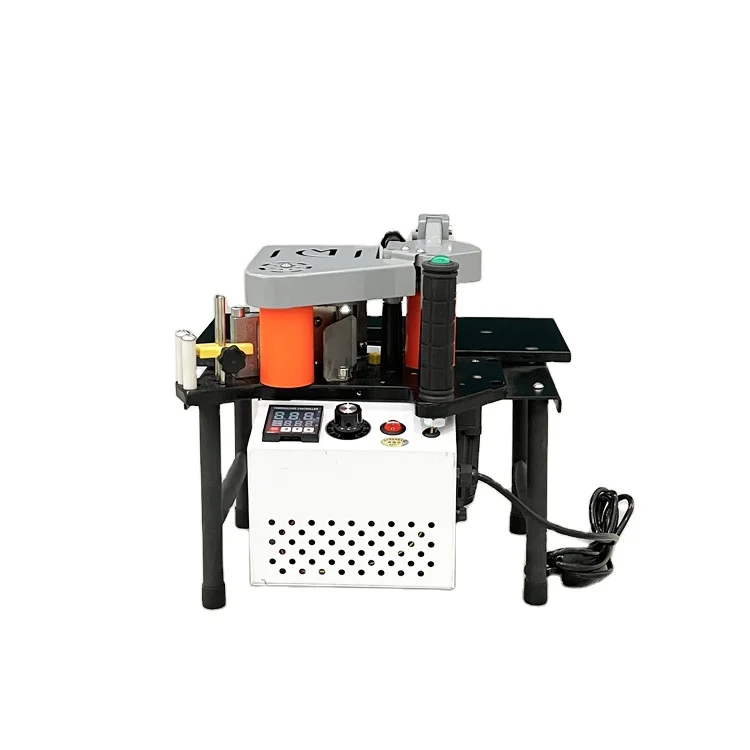
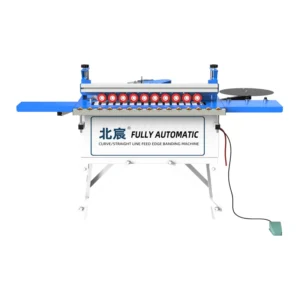
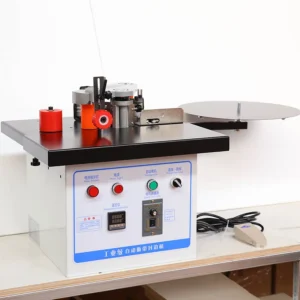
Dual-Sided Adhesion Control — A portable edge banding machine engineered with double-sided gluing and an 800ml glue pot, delivering consistent bond quality on both curved and straight profiles without repositioning the panel.
Technical Specifications
| Parameter |
Value |
| Product Type |
Portable Edge Banding Machine |
| Rated Power |
1000W |
| Voltage & Frequency |
220V (frequency to be confirmed for target market) |
| Control System |
Manual handheld operation |
| Net Weight |
14kg |
| Edge Banding Thickness Range |
0.3-3mm |
| Board Thickness Range |
7-60mm |
| Gluing Method |
Double-sided gluing |
| Glue Pot Capacity |
800ml |
| Shape Compatibility |
Curved & Straight plates |
| Plug Options |
EU/AU/UK/USA/CN available |
| Logo Customization |
Available |
| Feed Speed |
(basis not stated in source) |
| Tolerance |
(basis to be confirmed for portable unit) |
| Assembly State |
Portable handheld unit |
Application Suitability
| Application |
Material or Output |
| Small joinery workshops |
MDF, particleboard, and plywood panels for custom cabinetry |
| On-site furniture installation |
Curved and straight edge finishing on pre-cut solid wood and veneered components |
| Prototyping and sample making |
PVC and veneer edge banding on test panels before full production runs |
| Low-volume custom production |
Furniture modification and repair requiring flexible edge profiles |
Why the Voltage Question Should Come Before the Price
A portable edge banding machine arriving with mismatched frequency or plug type becomes dead weight on the workshop floor until the correct transformer or adapter is sourced.
I remember a batch of edge banders shipped to Mexico without final confirmation on local grid frequency. The motors ran in reverse, the inverters tripped immediately, and the entire line sat idle while we air-freighted the correct transformers. That two-week delay cost the installer far more than any price negotiation could have saved. When you source a Portable Edge Banding Machine manufacturer, the first question should always be about your local voltage and frequency, not the unit cost [NEED_CITE: voltage and frequency standards by export market]. A 220V specification means nothing if the 50Hz or 60Hz requirement is ignored, and a handheld unit is no exception to this rule.

Matching the Unit to Your Workshop Reality
This portable edge banding machine sits in the workflow of a small joinery shop that cannot justify floor space for a full-size automatic bander. The 14kg weight means a single operator can carry it to the panel rather than wrestling a large sheet onto a feed table. The manual handheld operation trades feed speed for flexibility, allowing the operator to slow down on tight curves and speed up on long straight runs.
Double-Sided Gluing and Edge Adhesion
The double-sided gluing method applies adhesive to both the panel edge and the banding material simultaneously. This approach reduces the risk of starved glue joints that leave visible lines, particularly on porous substrates like particleboard. The 800ml glue pot provides extended operation before requiring a refill, which matters when you are working through a batch of curved cabinet doors where stopping mid-run creates a weak spot in the bond [NEED_CITE: edge banding adhesion standards for furniture substrates].
Reading the Specs Against Your Panel Range
The 7-60mm board thickness range covers the majority of furniture-grade panels, from thin MDF backs to thick solid-wood worktops. However, the edge banding thickness range of 0.3-3mm requires the operator to select the correct pressure and feed rate manually, as the portable unit lacks the automated pressure zones of a stationary machine. For 3mm solid wood edging on a 40mm worktop, the operator must maintain steady downward pressure throughout the pass. The tolerance specification for this class of portable unit should be verified against your assembly requirements, as handheld application introduces more variability than a fully guided feed system.
The Hidden Cost of Skipping Voltage Confirmation
Ordering a portable unit without confirming the destination frequency leads to motor overheating and premature failure. A 220V/50Hz motor running on a 60Hz supply will overspeed, generating excess heat in the windings. The 1000W rated power assumes the correct frequency; running outside that assumption voids the thermal protection margin. I have seen handheld edge banders of this class fail within the first week because the operator assumed voltage was the only electrical parameter that mattered [NEED_CITE: CE machinery directive requirements for industrial equipment]. The plug options (EU/AU/UK/USA/CN) solve the physical connection, but they do not solve the underlying frequency mismatch.
Why Source This Portable Unit Through a Manufacturing Partner
The four-stage QC process covers incoming material, in-process assembly, finished product testing, and pre-shipment verification, which matters for a portable unit that will be handled roughly on job sites. The patented cutting mechanisms used in the full-size edge bander family inform the trimming approach for this portable model, ensuring the design accounts for real-world edge quality demands. Voltage and plug customization is treated as a standard configuration step rather than a special request, reducing the risk of the mismatch described earlier. Factory test records on your specific panel material and edge thickness are available before dispatch, giving you evidence rather than promises. OEM logo placement and multilingual documentation are supported for distributors building a regional brand around this Portable Edge Banding Machine manufacturer.
Documentation & Verification
- CE declaration of conformity applicable to portable woodworking machinery
- Electrical schematic confirming voltage and frequency for your destination market
- Factory test record using your specified panel thickness and edge material
- Operation manual in the agreed language with handheld safety procedures
- Spare parts list covering glue pot seals, heating elements, and pressure rollers
Installation, Commissioning & Support
- Standard single-phase 220V circuit required; verify dedicated breaker for 1000W continuous draw
- No floor mounting needed; 14kg unit operates on any stable workbench surface
- First-run glue temperature calibration required based on ambient workshop conditions
- Operator training covers pressure technique for transitions between curved and straight profiles
- Glue pot cleaning cycle documented for 800ml capacity to prevent adhesive degradation
Requesting a Configuration Proposal
To receive an accurate quotation for this portable edge banding machine, provide your local voltage and frequency, the panel materials and edge thicknesses you process most often, and whether you require OEM branding or specific plug configurations. If you are evaluating this unit as part of a broader equipment line, mention your existing stationary machines so the configuration can account for compatibility in glue type and banding material inventory.
Frequently Asked Questions
Q: What voltage and frequency configurations are available for different export markets?
A: The unit supports 220V single-phase power with plug options for EU, AU, UK, USA, and CN markets. Frequency must be confirmed as 50Hz or 60Hz based on your local grid standard before production begins, as this affects motor winding and thermal protection settings.
Q: How does the portable unit maintain edge quality on curved versus straight profiles?
A: The manual handheld operation allows the operator to adjust feed speed and pressure in real time. On tight curves, the operator slows down and increases inward pressure; on straight runs, a steady pace produces a consistent bond line across the full board thickness range.
Q: What glue types and edge banding materials are compatible with the double-sided system?
A: The 800ml glue pot is designed for standard hot-melt EVA adhesives used in furniture edge banding. Compatible materials include PVC, ABS, melamine, and wood veneer within the 0.3-3mm thickness range specified for this portable unit.
Q: Can this machine handle daily production volumes or is it limited to repair work?
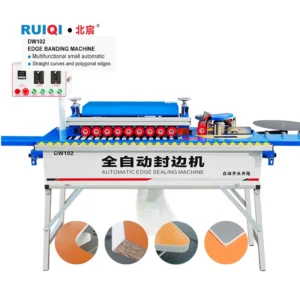
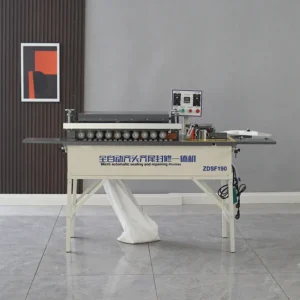
A: The portable unit is designed for small workshops, on-site installation, and prototyping rather than high-volume continuous production. For daily production runs requiring sustained feed speed and automated trimming, a stationary edge bander from the same product family is the appropriate configuration.