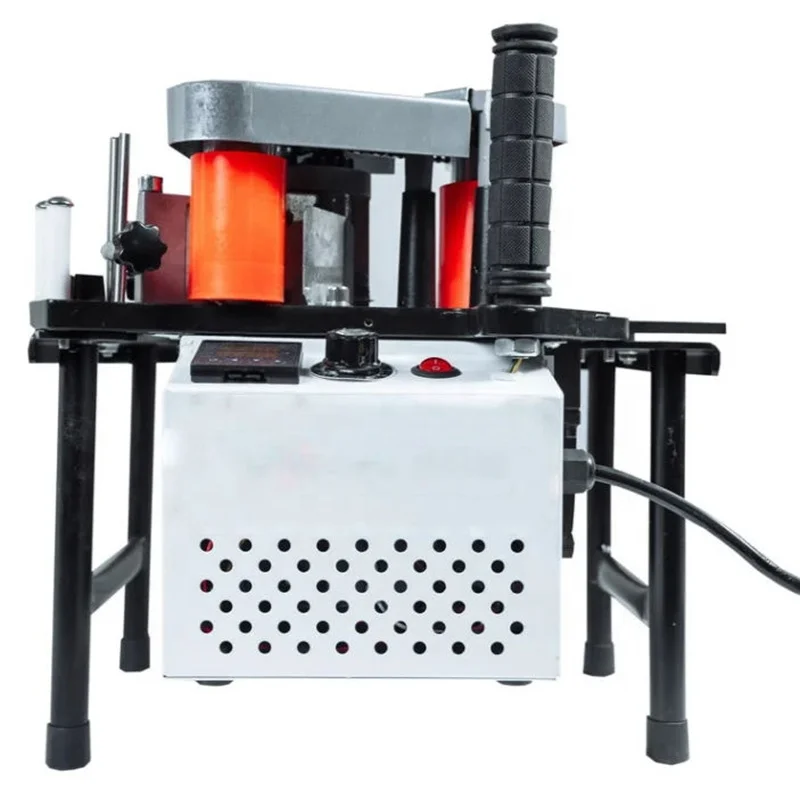
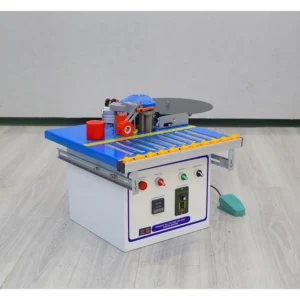
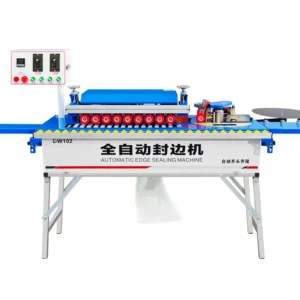
Four-stage QC with documented test records — every portable edge bander leaves our 10,000㎡ facility with a factory test record matched to your specified edge thickness and panel material, not just a generic pass sticker.
Technical Specifications
| Parameter |
Value |
| Product Type |
Manual Portable Edge Banding Machine |
| Shape of Edge-Banding Plates |
Curved, Straight and Special-shaped Sheet |
| Edge Thickness Range |
0.3–3mm |
| Edge Sealing Speed |
0–6 m/min |
| Panel Thickness Range |
7–60mm |
| Gluing Method |
Double-sided gluing |
| Glue Pot Volume |
1000ml |
| Machine Weight (Net) |
14kg |
| Assembly State |
Portable / Handheld operation |
| Customization |
Logo customization; EU/AU/UK/USA/CN plug options |
| Standards |
CE, ISO 9001 |
Application Suitability
| Application |
Material or Output |
| Custom curved cabinet door production |
MDF and plywood panels with PVC or veneer banding |
| Small-batch shaped shelving fabrication |
Particleboard with 0.3–3mm melamine or PVC edge strips |
| Joinery workshop transition from hand trimming |
Solid wood panels with veneer edge banding on curved profiles |
| Regional distributor private-label stock |
Straight and curved board edging for resale markets |
Why the Glue Compatibility Question Matters Before the Order
Most edge banding failures on portable machines trace back to glue and material mismatches discovered after arrival, not machine defects.
I once spent three full days on video call with a buyer in the Middle East who had ordered a portable bander based on our standard PVC test run. When the machine arrived, they switched to a locally sourced low-grade edge strip with completely different adhesive activation requirements. The gluing parameters needed full recalibration — temperature, feed pressure, and open time all shifted. This is not uncommon across export markets where edge banding consumables vary widely from what the factory tests with [NEED_CITE: adhesive activation temperatures across PVC and veneer banding materials]. When sourcing a Portable Edge Banding Machine OEM factory, confirming the exact edge material, adhesive type, and substrate before production prevents weeks of commissioning delays.

Manufacturing Depth Behind Each Handheld Bander
Our Shandong facility handles component sourcing, precision grinding, and assembly under one roof. The cutting mechanism in this portable edge bander uses a proprietary design with verified tolerance, meaning the trim finish on curved profiles does not depend on operator guesswork. For OEM partners, this manufacturing control allows logo application, custom packaging, and voltage configuration to be specified at order stage without re-engineering the core assembly. The Portable Edge Banding Machine OEM factory capability here means private-label units carry the same internal components as our branded machines — no separate production line or diluted specification.
How Four-Stage QC Catches Problems Before Crating
Incoming material inspection verifies glue pot seals and motor windings before assembly begins. In-process checks confirm the double-sided gluing mechanism distributes adhesive evenly across the full 60mm panel height range. Finished product testing runs actual edge banding on curved and straight profiles at the 0–6 m/min speed range to validate adhesion. Pre-shipment verification generates a documented test record that travels with the machine [NEED_CITE: pre-shipment inspection protocols for woodworking machinery exports]. This sequence matters because a portable bander that passes static inspection can still produce inconsistent glue lines under actual feed conditions — running the machine on real material is the only meaningful check.
Edge Thickness and Panel Range: What the Numbers Mean in Practice
The 0.3–3mm edge thickness range covers thin melamine strips for particleboard shelving through thicker PVC profiles used on MDF cabinet doors. Double-sided gluing ensures adhesive contacts both the panel edge and the back of the strip, which is critical when banding curved profiles where contact pressure varies along the radius. The 7–60mm panel thickness handling accommodates everything from thin partition boards to thick workbench tops without requiring spacer changes. At the 14kg net weight, the unit is light enough for one operator to reposition between workstations yet stable enough to maintain consistent feed contact. The 1000ml glue pot volume supports continuous runs through typical batch sizes without mid-job refills that interrupt adhesion consistency.
The Hidden Cost of Skipping Voltage Confirmation
Arriving at a job site to find the machine motor hums but will not start is a recurring issue across export markets. A portable bander specified for 220V/50Hz running on a 110V/60Hz supply will underperform or fail within the first shift [NEED_CITE: voltage and frequency standards by export market]. This is not a warranty issue — it is a specification gap at the quotation stage. When the plug type and local grid frequency are not confirmed before production, the buyer faces either a transformer purchase or a motor rewind, both of which delay workshop commissioning and erode trust in the supplier.
Why Distributors Source This Line from Shandong
In-house manufacturing with patented cutting mechanisms means component quality is traceable to the production floor, not to a trading company’s warehouse. The full product range from entry-level manual banders to full-function pre-milling models allows a distributor to serve workshop clients at every scale without adding suppliers. Voltage and plug customization from EU through USA standards ships as a standard option, reducing the number of SKU variants a distributor must stock. Four-stage QC with pre-shipment verification means each container loads with documented test records, cutting down on arrival disputes. Engineer-led configuration recommendations arrive within 24 hours of inquiry, supporting fast quotation cycles for distributor sales teams.
Documentation & Verification
- CE declaration of conformity matched to portable bander machinery directive category
- ISO 9001 certificate covering manufacturing process for handheld edge banding equipment
- Factory test record run on your specified edge thickness and panel material before dispatch
- Electrical schematic with voltage and plug type confirmed for your destination market
- Operation manual in your operator’s language with curved-profile banding setup procedures
- Spare parts list with glue pot, feed roller, and trimming blade part numbers for reorder
Installation, Commissioning & Support
- Portable 14kg unit requires a stable workbench at comfortable operator height — no foundation work
- Plug configuration matched to your local grid (EU/AU/UK/USA/CN) before shipment
- Arrives fully assembled; operator mounts the unit on workbench and loads glue into the 1000ml pot
- First-run parameter setting covers glue temperature and feed speed for your specific edge material
- Spare trimming blades and replacement feed rollers ship with initial order for early-stage coverage
- Glue pot cleaning schedule provided in manual to prevent adhesive buildup on curved-profile runs
Before You Request a Quote
To match the right configuration to your workshop, we need to know the edge banding material you actually use — PVC, melamine, or veneer — and the typical panel thickness range across your product mix. Share your local voltage and frequency so the motor and plug are built for your grid from the start. If you are evaluating this as a private-label product line, specify your branding requirements and target market regions so packaging and documentation align with your distribution channels.
Frequently Asked Questions
Q: What OEM and private-label options are available for this portable bander?
A: Logo application on the machine body, custom packaging design, and plug type selection from EU, AU, UK, USA, or CN standards are all available. Voltage is configured to your market specification before production. Each private-label unit carries the same internal components and four-stage QC documentation as our branded machines, so your end customers receive identical build quality.
Q: How is edge banding quality verified before the machine ships?
A: Our four-stage QC covers incoming material, in-process assembly, finished product testing, and pre-shipment verification. The final stage runs actual edge banding on your specified panel thickness and edge material at the machine’s operating speed. A factory test record documenting adhesion results and trim finish travels with the machine inside the crate.
Q: Can I visit the factory to inspect how the portable bander is built?
A: Factory visits are welcomed at our Shandong facility. You can inspect precision-ground components, observe the four-stage QC process on the production floor, and run sample edge banding tests with your own material. Advance scheduling allows us to prepare sample panels matching your typical workshop specifications.
Q: What spare parts and consumables ship with the machine?
A: The initial package includes spare trimming blades, replacement feed rollers, and a maintenance schedule for the glue pot. A full spare parts list with part numbers is included so reorders can be placed directly. Consumable glue compatible with your edge banding material is specified during the quotation stage to ensure correct adhesive selection.
Q: How does this portable bander fit into a small workshop production line?
A: The 14kg handheld unit sits between your panel saw and any downstream trimming or polishing stations. Its 7–60mm panel range handles output from standard cutting operations without additional setup. For workshops scaling up, the same product family includes semi-automatic and full-function models so you can increase throughput without switching suppliers.