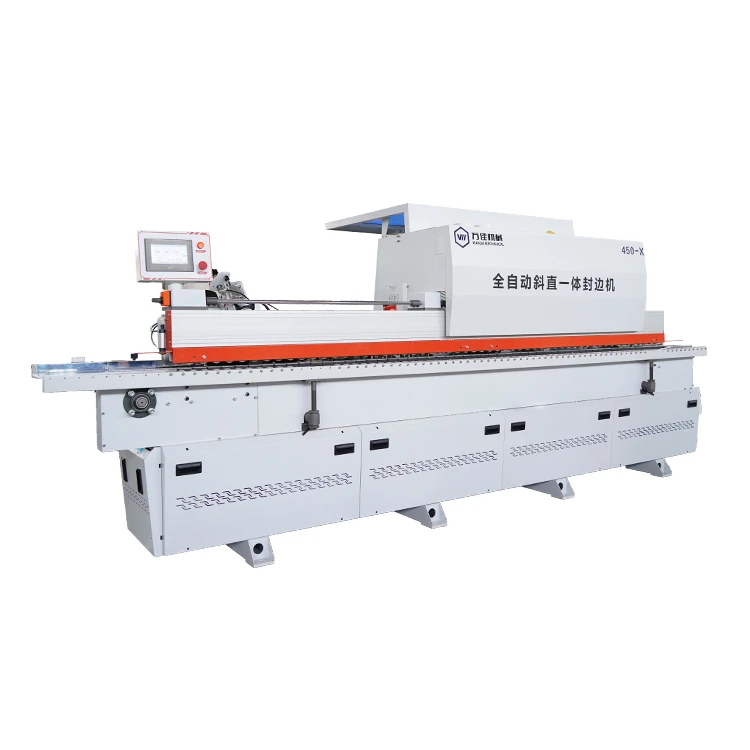
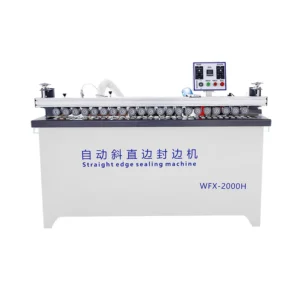
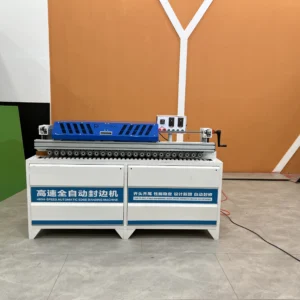
In-House Precision Manufacturing — every trimmer and feed component is ground and inspected on our own floor before assembly, ensuring the ±0.02 mm tolerance is built into the machine rather than merely promised on paper.
Technical Specifications
| Parameter |
Value |
| Product Type |
Automatic Edge Banding Machine |
| Overall Dimensions (L×W×H) |
4350 × 920 × 1650 mm |
| Total Installed Power |
17.5 kW |
| Voltage & Frequency |
380V / three-phase five-wire / 50Hz (configurable 110V–440V) |
| Conveying Motor |
2.2 kW with frequency converter |
| Feed Speed |
0–12 m/min, variable speed for inclined straight edge |
| Panel Thickness Range |
18 / 22 / 25 mm (source value — verify against manufacturer catalog) |
| Minimum Panel Width |
>100 mm |
| Minimum Panel Length |
>250 mm |
| Edge Banding Thickness |
Up to 1.2 mm, material-dependent |
| Edge Banding Width |
20–50 mm |
| Compatible Banding Material |
PVC |
| Glue Pot Capacity |
2000 ml |
| Glue Pot Heating Power |
1.2 kW |
| Glue Pot Operating Temperature |
150–170°C |
| End Trimming Motors |
0.37 kW × 2 |
| Rough & Fine Trimming Motors |
0.75 kW × 2 |
| Polishing Motors |
0.37 kW × 2 |
| Control System |
Xinjie industrial touch screen with Xinjie inverter |
| Air Source Pressure |
0.6–0.8 MPa |
| Air Storage Tank Volume |
5 L |
| Dust Extraction Port |
100 mm diameter |
| Assembly State |
KD packing, partial assembly required |
Application Suitability
| Application |
Material or Output |
| Cabinet door edge banding |
PVC on 18 mm MDF and particleboard panels |
| Wardrobe side panel finishing |
PVC banding on 22 mm plywood and melamine-faced chipboard |
| Office furniture component edging |
PVC strips on 25 mm particleboard shelving |
| Custom kitchen carcass production |
Straight-edge PVC banding for base and wall unit panels |
| Small-batch joinery runs |
Mixed-thickness panels in batch sizes above minimum length |
Why Voltage Mismatch Stops a Production Line Before It Starts
An automatic edge banding machine factory shipment that ignores the buyer’s local grid turns a productive asset into a dead weight on the workshop floor. Voltage and frequency confirmation must be locked in before production begins, not discovered at the crate.
I once supported a distributor in Southeast Asia who received a 380V/50Hz unit for a facility running 220V/60Hz. The conveying motor stuttered at low speed, the glue pot never reached stable temperature, and the entire commissioning schedule collapsed. The cost was not the rewinding alone — it was the idle panel saw upstream and the bored operators downstream waiting two weeks for a replacement transformer [NEED_CITE: voltage and frequency standards by export market]. With this machine, the electrical schematic is confirmed at quotation stage, and the motor winding, heater element, and control transformer are all matched to the destination grid before the frame leaves the assembly bay.

Component Sourcing Depth for Private-Label Partners
Distributors building a woodworking machinery brand need more than a logo swap. This automatic edge banding machine is assembled from components that are sourced, tested, and documented at the factory level — the Xinjie touch screen and inverter are specified as a matched pair so that feed speed ramp-up curves remain consistent across every unit carrying your brand. When an OEM partner requests a custom colour on the machine housing or a specific language file loaded onto the HMI, those changes are integrated into the build sheet rather than applied as afterthoughts. The result is a private-label product line that behaves identically from first unit to hundredth, which matters when your own service team is diagnosing faults remotely.
Four-Stage Quality Control as an OEM Selling Point
Every unit passes through incoming material inspection, in-process assembly checks, finished-product running tests, and pre-shipment verification before it is crated. For an OEM buyer, this is not just internal hygiene — it is documentation you can hand to your own customers as evidence of manufacturing rigour [NEED_CITE: CE machinery directive requirements for industrial equipment]. The factory test record includes actual panel runs at the thicknesses you specify, with edge trim samples retained and photographed. When a distributor in Latin America faced a warranty claim on glue-line adhesion, the retained test samples and temperature logs from the pre-shipment run settled the question within a day, because the QC file travelled with the machine.
How Feed Speed, Glue Temperature, and Trim Stations Interact
The variable feed speed of 0–12 m/min is not simply a throughput dial — it determines how long the PVC strip dwells under each trimming and polishing head. At lower speeds on 25 mm particleboard, the rough and fine trimming motors have more engagement time per linear metre, producing a cleaner edge on boards where the core density varies. The glue pot operating range of 150–170°C matters because PVC adhesion drops noticeably below 150°C on melamine-faced substrates, while excessive heat above 170°C degrades the hot-melt adhesive over sustained runs. With a 2000 ml pot capacity, the thermal mass is sufficient to hold temperature stable during continuous feeding, but the 1.2 kW heater element still requires a dedicated circuit to avoid voltage sag when the heat gun cycles on simultaneously. The 100 mm dust extraction port must be connected before the trimming motors engage, because fine PVC swarf accumulates rapidly on the polishing wheels and transfers back onto the panel surface if extraction is undersized.
The Hidden Cost of Underspecifying the Air Supply
A 0.6–0.8 MPa air requirement with a 5 L onboard tank seems modest, but workshops that rely on a single shared compressor serving multiple machines often see pressure drop below the threshold during simultaneous pneumatic actuations. The end trimming heads, panel pressure rollers, and banding feed mechanism all draw from the same line, and a momentary dip causes the Qi head cutters to hesitate mid-stroke. I have seen this produce a visible step on the leading edge of panels — a defect that only appears once the furniture carcass is assembled and the door is hung [NEED_CITE: pneumatic pressure stability in multi-machine woodworking lines]. Specifying a dedicated air line or a larger upstream receiver eliminates this intermittent fault before it reaches the customer.
Why OEM Partners Source This Machine Here
The cutting and trimming mechanisms are manufactured in-house with proprietary geometry, so tolerance claims are traceable to the grinding wheel, not a subcontractor’s certificate. Voltage and control language customisation are standard line items on the build sheet, not premium add-ons, which means a distributor can specify 440V/60Hz with a Spanish HMI without extending the lead time significantly. The product family spans entry-level to full-function models, so an OEM partner expanding their catalogue does not need to qualify a second factory. Four-stage QC with retained test records gives your service team a reference baseline when diagnosing field issues. Engineer-led configuration is confirmed with a formal quotation within 24 hours, keeping the OEM evaluation cycle short.
Documentation & Verification
- CE declaration of conformity matching the exact machine configuration shipped
- ISO 9001 certificate covering the manufacturing facility and QC process
- Electrical schematic with confirmed voltage and frequency for destination market
- Factory test record on specified panel thickness and PVC banding material
- Machine specification sheet with all motor ratings and pneumatic requirements
- Operation and maintenance manual in the agreed operator language
Installation, Commissioning & Support
- KD packing requires partial assembly; allow floor space exceeding 4350 × 920 mm for reassembly clearance
- Dedicated 380V three-phase circuit rated for 17.5 kW total load with earth bonding to machine frame
- Xinjie touch screen calibration and inverter parameter loading during first power-on sequence
- Glue pot first-heat cycle and temperature verification across 150–170°C range before PVC feed
- Trimming motor alignment check on 18 mm and 25 mm test panels to confirm edge profile
- Spare trimming cutters and polishing wheels included in shipment for initial operating period
What to Prepare Before Requesting a Quotation
Share the panel materials, thicknesses, and maximum dimensions you intend to process, along with the PVC banding width range your furniture line requires. Confirm the local voltage and frequency at the installation site, the preferred HMI language for your operators, and whether the machine will feed into an existing line where conveyor height matching matters. If you are evaluating this unit for OEM branding, indicate your logo placement requirements, colour preferences, and private-label documentation needs so the build sheet covers everything before production starts.
Frequently Asked Questions
Q: Can the machine carry our brand logo, custom colour, and private-label documentation?
A: Yes. Logo placement on the housing, custom paint colour, and branded operation manuals are all integrated into the production build sheet. The control panel splash screen can display your brand identity, and all shipping documentation carries your company details for customs clearance in the destination market.
Q: Is the standard 380V/50Hz configuration adaptable to other regional power supplies?
A: The machine supports voltage configuration from 110V to 440V with matching frequency adaptation. Motor windings, control transformers, and heater elements are all specified to the confirmed grid standard before assembly, ensuring stable operation without aftermarket conversion kits or transformer add-ons.
Q: Can we arrange a factory visit to witness the QC process and run sample panels?
A: Factory visits are welcomed at any production stage. You can observe the four-stage quality control process in real time and run sample panels using your own PVC banding material and substrate thicknesses. Test samples are retained and shipped with the machine as part of the pre-shipment record.
Q: What spare parts are included at shipment, and how is the long-term supply structured?
A: Each shipment includes consumable trimming cutters, polishing wheels, and pneumatic seals sufficient for the initial operating period. Long-term spare parts supply is structured through the distributor with annual stocking recommendations based on your projected utilisation and local service capacity.
Q: How does the 0–12 m/min feed speed align with upstream panel saws and downstream boring machines?
A: Feed speed is set to match the throughput balance of your complete line. Upstream panel saw cycle times and downstream boring machine indexing speeds determine the optimal banding feed rate, which is configured during commissioning to prevent bottlenecks or work-in-progress accumulation between stations.