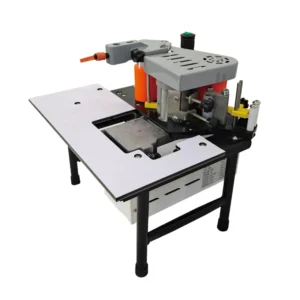
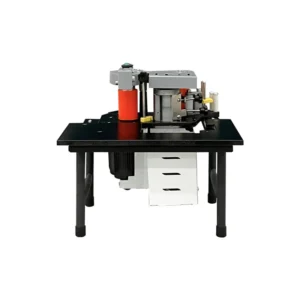
Verified Manufacturing Depth — every WF-2000 portable edge banding machine leaving our facility carries traceable QC records, confirmed voltage schematics, and OEM-ready branding options.
Technical Specifications
| Parameter |
Value |
| Model |
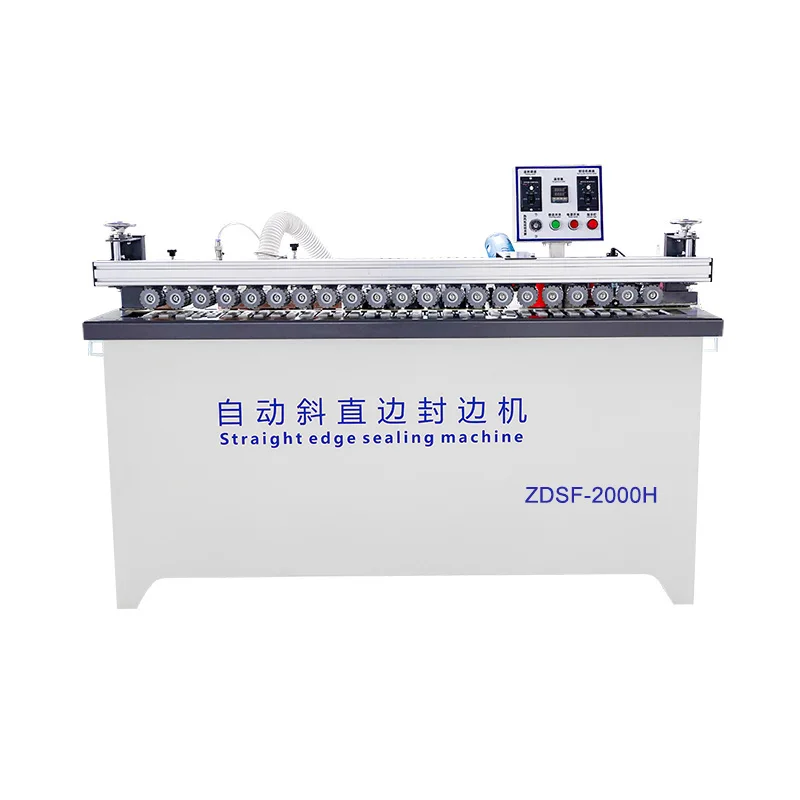
WF-2000 (WF-2000H variant also available with heavier frame) |
| Product Type |
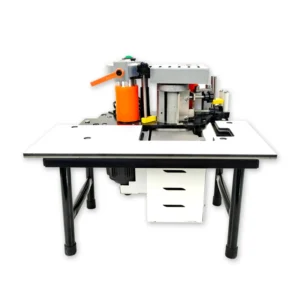
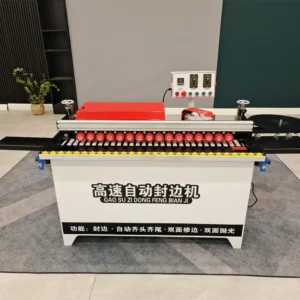
Portable Edge Banding Machine |
| Overall Dimensions (L×W×H) |
2100×600×630 mm (WF-2000) / 2100×600×1100 mm (WF-2000H) |
| Net Weight |
137 kg (WF-2000) / 149 kg (WF-2000H) |
| Rated Voltage |
220V |
| Rated Power |
6.17 kW |
| Rated Air Pressure |
0.4–0.6 MPa |
| Plate Feeding Speed |
0–14 m/min |
| Panel Thickness Range |
18–25 mm |
| Edge Strip Thickness |
1.2 mm |
| Glue Application |
Hot air heating, full-process thermal bonding |
| Trimming Stations |
Elastic profiling trimming |
| Pressing System |
8 pressing rollers |
| Auxiliary Functions |
Slotted edge banding; automatic belt breaking; self-contained vacuum device |
| Frame Material |
Aluminum alloy pressure beam, manually adjustable |
Application Suitability
| Application |
Material or Output |
| Small-scale custom furniture workshops |
MDF, particleboard, plywood edge finishing |
| On-site joinery and installation work |
Portable straight and 45-degree oblique edge banding |
| Cabinet and panel component finishing |
PVC and veneer edge strips up to 1.2 mm |
| Solid wood panel edge treatment |
Solid wood panels requiring thermal bonding |
Why the Voltage Question Must Come Before the Quotation
A portable edge banding machine ordered without voltage confirmation becomes dead weight on arrival.
I have seen machines land at a job site in the Middle East, still in the crate, only to find the local supply was 380V three-phase while the motor was wound for 220V single-phase. The portable edge banding machine factory had built exactly what was asked for — the problem was nobody asked the right question. That crate sat unopened for three weeks while a step-down transformer was sourced locally. [NEED_CITE: voltage and frequency standards by export market]

Component Sourcing and Assembly Transparency
Distributors evaluating a portable edge banding machine factory need to see past the brochure. The WF-2000 series is assembled in-house, from the aluminum alloy pressure beam to the integrated vacuum device mounted directly into the machine frame. Every pressing roller, every heating element, and every pneumatic fitting is sourced against a bill of materials that remains consistent across production runs — meaning spare parts ordered two years later will match the original build.
Four-Stage Quality Control Before the Crate Closes
Incoming materials are inspected before they reach the assembly bench. In-process checks verify pressure beam alignment and roller tension. Finished units run test cycles on actual panel stock — MDF, particleboard, or plywood depending on the destination customer’s profile. Pre-shipment verification includes a video record of the machine processing material at the rated feeding speed. [NEED_CITE: CE machinery directive requirements for industrial equipment]
How Key Specifications Shape Real Workshop Performance
The 18–25 mm panel thickness range covers the majority of cabinet and furniture stock, but the manually adjustable aluminum alloy pressure beam is what makes that range practical. An operator processing 18 mm particleboard sets the beam lower, ensuring the 8 pressing rollers maintain uniform contact across the edge strip without crushing the substrate surface. Switch to 25 mm plywood, and the beam adjusts upward while the same roller array adapts. The hot-air heating system delivers full-process thermal bonding rather than relying on a single glue pot, which means the adhesive reaches working temperature across the entire feed path — critical when processing moisture-variable substrates like particleboard in humid environments. The 0–14 m/min feeding speed allows operators to slow the feed for delicate veneer strips or increase throughput on standard PVC banding runs.
The Hidden Cost of Skipping Configuration Verification
Ordering a portable edge bander on listed specifications alone leaves gaps that surface only after commissioning. A machine specified for 18 mm panels will struggle with 12 mm stock if the pressure beam lacks sufficient downward travel — and that limitation may not appear on the spec sheet. Edge strip adhesion failures on high-moisture particleboard often trace back to insufficient thermal bonding capacity, not operator error. When a distributor’s customer reports peeling edge bands two months after installation, the blame lands on the distributor, not the factory. [NEED_CITE: common causes of edge banding adhesion failure on particleboard]
Why Distributors Source This Portable Edge Banding Machine Here
Every WF-2000 unit ships with a factory test record documenting performance on the panel material specified at order — not a generic test on ideal stock. Voltage and frequency are confirmed against the destination market’s electrical standards before the motor is mounted, eliminating transformer workarounds. OEM partners can apply their own branding to the machine body, control panel fascia, and documentation, with private-label runs available from single units onward. The self-contained vacuum device removes the need for external dust extraction infrastructure, simplifying resale to small workshops with limited floor space. Multilingual control panel options are configurable at order, so the operator interface matches the destination market’s language without aftermarket relabeling.
Documentation & Verification
- Factory test record on your specified panel thickness and material before dispatch
- Electrical schematic with voltage and frequency matched to destination market
- CE declaration of conformity for customs clearance and regulatory compliance
- Operation and maintenance manual in the agreed language at shipment
- Spare parts list with OEM part numbers for long-term distributor inventory
Installation, Commissioning & Support
- Fully assembled portable design requires no on-site mechanical assembly beyond unpacking
- 220V rated power supply requires a dedicated 6.17 kW circuit with proper grounding
- 0.4–0.6 MPa compressed air supply needed from existing workshop compressor
- Hot-air heating system requires initial warm-up cycle before first edge banding run
- Aluminum alloy pressure beam adjustment demonstrated for full 18–25 mm panel range
- Elastic profiling trimming station calibrated at factory; field adjustment documented in manual
What We Need to Configure Your Order
Provide the panel materials your customers process most frequently, the edge strip types and thicknesses they run, and the local voltage and frequency at the destination market. If OEM branding is required, share logo files and preferred control panel language. For production line integration, specify which upstream and downstream equipment the portable edge bander must align with.
Frequently Asked Questions
Q: What OEM customization options are available for distributors?
A: We apply your logo to the machine body and control panel fascia, customize the color scheme, configure the control panel language for your market, and match the voltage to your local electrical standard from 110V to 440V. Private-label documentation, packaging, and spare parts labeling are included. Single-unit OEM orders are accepted.
Q: How does the four-stage QC process verify edge quality before shipment?
A: Incoming materials are inspected at receipt, in-process checks verify beam alignment and roller pressure, finished units run test cycles on actual panel stock, and pre-shipment verification includes a video record of the machine processing material. Each stage generates documentation included with the shipment.
Q: Can you provide electrical schematics matching our local voltage standard?
A: Every unit ships with a confirmed electrical schematic matching the destination market’s voltage and frequency. Motors and heating elements are specified for the confirmed supply before assembly begins, eliminating the need for step-down transformers or field rewiring at the installation site.
Q: How are spare parts supplied for regional distributors?
A: Each machine ships with a spare parts list referencing OEM part numbers for every wear component, including pressing rollers, trimming blades, and heating elements. Distributors can stock fast-moving consumables regionally, and replacement parts are manufactured against the same bill of materials as the original build.