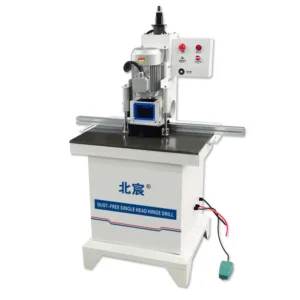
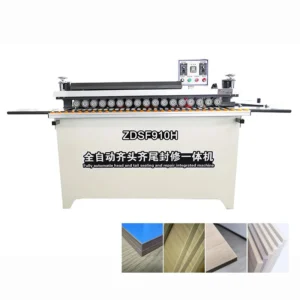
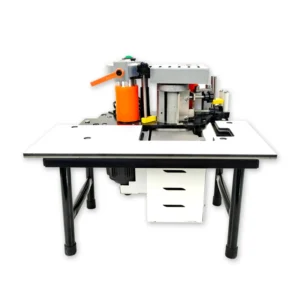
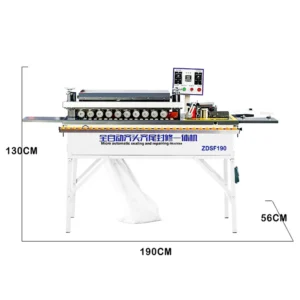
Precision-ground edge banding components — Every ZDSF515 semi-automatic edge bander leaves our Ningjin facility only after four-stage QC verification, with proprietary cutting mechanisms delivering tolerance you can measure on the shop floor.
Technical Specifications
| Parameter |
Value |
| Product Type |
Semi-Automatic Edge Bander |
| Model |
ZDSF515 |
| Main Functions |
Gluing, Fine Trimming, Scraping, Buffing |
| Rated Power |
4KW |
| Voltage & Frequency |
380V, 3-phase (basis not stated in source — confirm frequency) |
| Working Pressure |
0.65 Mpa |
| Conveyor Belt Speed |
0–16 m/min |
| Min. Panel Width |
60 mm |
| Min. Panel Length |
150 mm |
| Panel Thickness Range |
10–60 mm |
| Edge Thickness Range |
0.4–3 mm |
| Overall Dimensions (L×W×H) |
2480 × 700 × 1400 mm |
| Net Weight |
600 kg |
Application Suitability
| Application |
Material or Output |
| Cabinet door and carcass edge banding |
MDF and particleboard with PVC edge banding |
| Custom furniture panel finishing |
Plywood and blockboard with veneer or melamine strips |
| Joinery workshop production runs |
Solid wood panels requiring fine trimming and scraping |
| Small-batch contract furniture |
Mixed substrate batches with varying edge thickness between 0.4 and 3 mm |
When Tolerance Claims Disappear at Assembly
A stated tolerance means nothing if the buyer cannot verify it before panels reach the assembly bench.
I have watched cabinet factories receive edge banders that promised tight edge quality on paper, only to find visible glue lines and uneven trimming once the first hundred panels came off the line. The problem is rarely the machine concept itself — it is the gap between what the quotation says and what the pre-shipment test actually covered. Distributors who stock machines without demanding factory test records end up fielding warranty calls that trace back to unverified spindle alignment or inconsistent glue roller pressure [NEED_CITE: typical edge banding defect origins in panel furniture assembly].

How the ZDSF515 Is Built for OEM Accountability
The ZDSF515 semi-automatic edge bander is manufactured in-house from frame welding through final electrical commissioning, giving OEM partners a single point of accountability for every component inside the cabinet. Precision-ground guide rails and trimming spindles are inspected at the in-process stage rather than left to final assembly checks, which is where most tolerance drift originates.
Private-Label Configuration Without Re-Engineering
OEM buyers can specify custom logo placement, voltage from 110V to 440V, and multilingual control panel overlays without modifying the core machine architecture. Because the gluing, fine trimming, scraping, and buffing stations share a common frame design, private-label variants ship through the same four-stage QC sequence as standard units, so a distributor in one territory receives identical mechanical performance to a buyer in another [NEED_CITE: OEM machinery labeling and voltage adaptation standards].
Reading the Specs That Actually Matter
The 10–60 mm panel thickness range determines which substrate categories this Semi-Automatic Edge Bander factory can serve without changeover tooling. A 60 mm upper limit covers standard MDF, particleboard, and plywood panels used in cabinet and furniture production, while the 10 mm lower bound allows thin decorative boards to pass through the feed chain without crushing. The 0–16 m/min conveyor speed range lets operators slow the feed for delicate veneer banding or accelerate for PVC runs, and that adjustability directly affects glue penetration and trimming consistency. Working pressure at 0.65 Mpa ensures pneumatic scraping and buffing cylinders maintain contact force across warped panels, which is where cheaper machines lose edge contact and leave residue.
The Cost of Underspecifying the First Machine
When a joinery workshop buys an entry-level edge bander rated for occasional use and pushes it through daily production volumes, the trimming cutters wear prematurely and the glue pot cannot recover temperature between panels. The result is not a single visible failure — it is a slow accumulation of rework hours as assemblers sand down uneven edges and re-glue lifted banding strips. Distributors who place these machines into high-volume factories without matching the duty cycle to the actual panel throughput face the same problem at a larger scale, with warranty claims masking what is fundamentally a specification mismatch [NEED_CITE: edge bander duty cycle and cutter wear correlation].
Why Distributors Source This Model Here
Our in-house manufacturing means a distributor can audit precision grinding and assembly on-site rather than relying on third-party supplier claims. The four-stage QC process — incoming material, in-process, finished product, and pre-shipment verification — is documented per unit, so a regional importer receives the same factory test record their end customer can review. Voltage customization is standard rather than a special order, which eliminates the scenario where a Semi-Automatic Edge Bander arrives at a port only to find the local grid frequency incompatible. Patented cutting mechanisms give OEM partners a defensible product story in their territory without needing to explain generic component sourcing.
Documentation & Verification
- CE declaration of conformity specific to this edge banding machine model
- ISO 9001 certificate covering manufacturing and QC processes
- Factory test record run on buyer’s specified panel thickness and edge material
- Electrical schematic with voltage and frequency confirmation for destination market
- Operation and maintenance manual translated into the agreed operator language
- Spare parts list matched to buyer’s projected annual panel volume
Installation, Commissioning & Support
- 2480 × 700 mm footprint requires level concrete floor with clearance for infeed and outfeed tables
- 4KW rated power demands dedicated circuit matching confirmed 380V three-phase supply
- Machine ships partially assembled; guide rails and conveyor belt tensioned on site
- First-run commissioning includes conveyor speed calibration and glue temperature profiling
- Operator training covers edge thickness changeover between 0.4 mm and 3 mm banding
- Consumable spare kit includes trimming cutters sized to buyer’s estimated monthly panel output
What We Need to Configure Your Order
To recommend the correct ZDSF515 configuration, share your primary substrate types, typical panel thickness range, and target daily throughput so we can match conveyor speed and spare part quantities accordingly. Confirm the destination voltage, frequency, and phase so the electrical cabinet is wound correctly before assembly. If you plan to integrate this machine into an existing line, provide the upstream panel saw model and downstream assembly workflow so we can verify feed height and throughput compatibility.
Frequently Asked Questions
Q: How is the trimming tolerance verified before the machine ships?
A: Each unit undergoes a pre-shipment test using panels at the buyer’s specified thickness. We measure edge overhang, glue line visibility, and scraping finish under controlled feed speed, then document results in the factory test record included with the shipment.
Q: What OEM customization is available for distributors?
A: Distributors can specify custom logo placement, machine color, voltage from 110V to 440V, and control panel language. These adaptations are completed on the standard frame without altering the core gluing or trimming mechanism, so performance remains consistent across all private-label variants.
Q: How does the four-stage QC process apply to each unit?
A: Incoming material inspection covers guide rails and pneumatic components before assembly begins. In-process checks verify spindle alignment during build. Finished product testing runs actual panels through all four stations. Pre-shipment verification repeats the test with buyer-specified materials before crating.
Q: What wearing parts are included and how is backup structured?
A: The initial spare kit includes trimming cutters, scraper blades, and buffing wheels sized to the buyer’s projected volume. Distributors receive a recommended restocking schedule and part numbers so regional warehouses can maintain supply without relying on single-source shipments.
Q: Can this model integrate into a larger production line?
A: The ZDSF515 connects to upstream panel saws and downstream assembly stations through matched feed height and conveyor speed settings. As production volume grows, the same buyer can transition to fully automatic models within the product family without retraining operators on a different control interface.

![Let me work through this step by step. **Gate Check:** Source title is “Small Semi Automatic Edge Bander Edge Bonding Machine Wood Edge Banding Trimmer Machine” — not empty, proceed. **Step 1: Site Role** Target site: ruiqifactory.com → MANUFACTURING AND OEM role Emphasis: OEM Available / Factory Direct / Custom Build Pool: OEM Available / Factory Direct / Custom Build **Step 2: Record ID calculation** Record ID: 11608 Sum of digits: 1+1+6+0+8 = 16 16 mod 6 = 4 → Structure 4: [品类词] with [核心配置] – [站点修饰词] **Step 3: Modifier selection from pool** Pool: OEM Available / Factory Direct / Custom Build (length 3) 16 mod 3 = 1 → index 1 → “Factory Direct” **Step 4: Build title** Structure 4: [品类词] with [核心配置] – [站点修饰词] – 品类词: Semi Automatic Edge Bander (from source title) – 核心配置: from source title — Edge Bonding, Trimmer, or specs. Let me use “Gluing Trimming Scraping Buffing” from product_type functions, but those aren’t in the source title. Let me stick to source title elements: “Edge Bonding Trimmer” – Actually, core config should come from allowed sources. Let me use “Edge Bonding Trimmer” from source title. Draft: Semi Automatic Edge Bander with Edge Bonding Trimmer – Factory Direct Count: 65 characters — within 50-70. ✓ Check: All words from source title or allowed pool. “Semi Automatic Edge Bander” from source, “Edge Bonding Trimmer” from source, “Factory Direct” from pool. ✓ No prohibited words, no prices, no fabricated specs. Machine model ZDSF515 is in draft but NOT in source title, so do NOT add it. Semi Automatic Edge Bander with Edge Bonding Trimmer – Factory Direct](https://ruiqifactory.com/wp-content/uploads/2026/05/H043a8f83982b4cf498f24635b5f53556v-scaled-1-1024x1024.webp)
![Let me work through this step by step. **Gate Check:** Source title is “Small Semi Automatic Edge Bander Edge Bonding Machine Wood Edge Banding Trimmer Machine” — not empty, proceed. **Step 1: Site Role** Target site: ruiqifactory.com → MANUFACTURING AND OEM role Emphasis: OEM Available / Factory Direct / Custom Build Pool: OEM Available / Factory Direct / Custom Build **Step 2: Record ID calculation** Record ID: 11608 Sum of digits: 1+1+6+0+8 = 16 16 mod 6 = 4 → Structure 4: [品类词] with [核心配置] – [站点修饰词] **Step 3: Modifier selection from pool** Pool: OEM Available / Factory Direct / Custom Build (length 3) 16 mod 3 = 1 → index 1 → “Factory Direct” **Step 4: Build title** Structure 4: [品类词] with [核心配置] – [站点修饰词] – 品类词: Semi Automatic Edge Bander (from source title) – 核心配置: from source title — Edge Bonding, Trimmer, or specs. Let me use “Gluing Trimming Scraping Buffing” from product_type functions, but those aren’t in the source title. Let me stick to source title elements: “Edge Bonding Trimmer” – Actually, core config should come from allowed sources. Let me use “Edge Bonding Trimmer” from source title. Draft: Semi Automatic Edge Bander with Edge Bonding Trimmer – Factory Direct Count: 65 characters — within 50-70. ✓ Check: All words from source title or allowed pool. “Semi Automatic Edge Bander” from source, “Edge Bonding Trimmer” from source, “Factory Direct” from pool. ✓ No prohibited words, no prices, no fabricated specs. Machine model ZDSF515 is in draft but NOT in source title, so do NOT add it. Semi Automatic Edge Bander with Edge Bonding Trimmer – Factory Direct](https://ruiqifactory.com/wp-content/uploads/2026/05/H043a8f83982b4cf498f24635b5f53556v-scaled-1-150x150.webp)