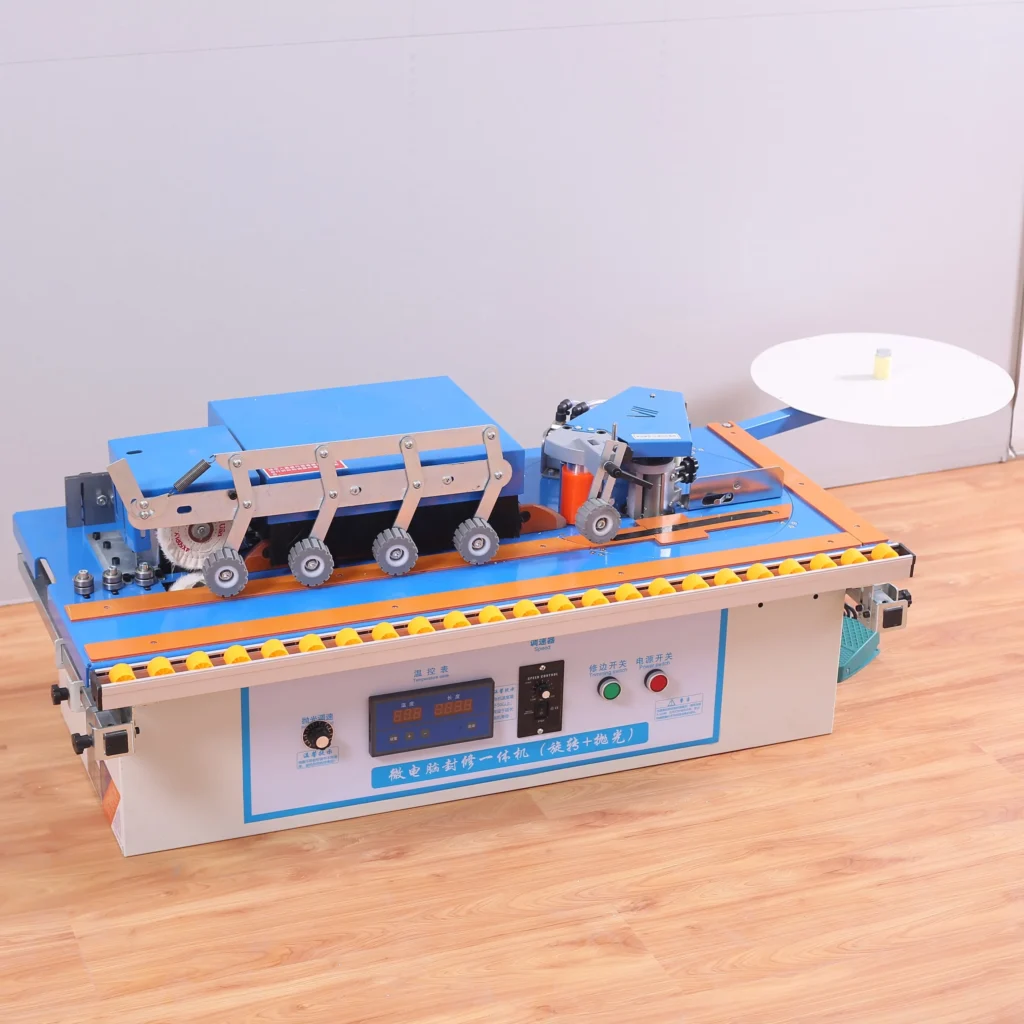
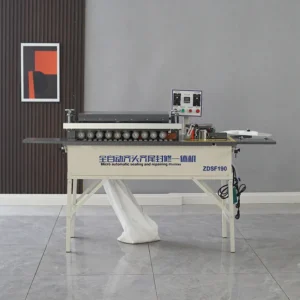
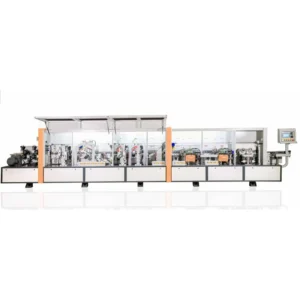
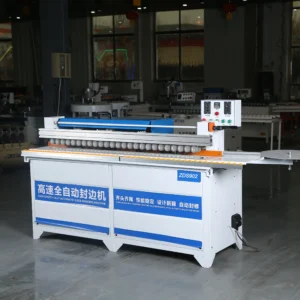
Verified Tolerance Manufacturing — our patented cutting mechanisms and four-stage QC ensure every ZDSF120 edge banding machine leaves the factory with documented precision, supporting full OEM and private label programs for distributors.
Technical Specifications
| Parameter |
Value |
| Model |
ZDSF120 Edge Banding Machine |
| Product Type |
Edge Banding Machine |
| Voltage |
220V (configurable from 110V to 440V for destination markets) |
| Rated Power |
2.8 kW |
| Glue Capacity |
1000 ml |
| Heating Time |
5–8 min |
| Cover Height Range |
10–60 mm |
| Edge Thickness Range |
0.5–3 mm |
| Overall Dimensions |
105 × 50 × 45 cm |
| Gluing Method |
Double-sided gluing |
| Trimming |
Automatic trimming and polishing |
| Head Cutting |
Pneumatic flush head cutting |
| Operation Mode |
Straight and curved panel dual use |
Application Suitability
| Application |
Material or Output |
| Cabinet furniture manufacturing |
MDF, particleboard, and plywood panels with PVC edge banding |
| Custom furniture production |
Solid wood panels and veneer edge banding for bespoke joinery |
| Small to medium woodworking workshops |
Mixed substrate batch processing for limited-run orders |
| Regional distributor demo and training |
PVC and melamine banding on standard cabinet components |
Why Voltage Confirmation Must Precede the Edge Banding Machine Factory Order
An edge banding machine specified without verifying local grid conditions is a liability, not an asset.
I learned this the hard way in Lagos. A container arrived with a motor wound for 440V while the workshop ran on a 380V supply. The crew stood around for three weeks waiting for a step-up transformer to be sourced locally. That delay cost the importer credibility with their own customer and burned margin on expedited freight [NEED_CITE: voltage and frequency standards by export market]. When you evaluate an edge banding machine factory for sourcing, the first question should never be about price — it should be about whether the electrical schematic matches the destination grid.
Component Sourcing and Precision Assembly
Building an edge banding machine at this compact scale requires disciplined component selection. The pneumatic flush head cutting mechanism relies on precisely ground cylinders and matched seals to deliver consistent end-trim quality across thousands of cycles. Our assembly team stages incoming parts through a four-stage inspection before any sub-assembly begins, rejecting components that fall outside tolerance before they reach the bench. This depth of manufacturing control is what separates a genuine edge banding machine factory from a trading house relabeling third-party equipment [NEED_CITE: CE machinery directive requirements for industrial equipment].
OEM and Private Label Configuration Depth
Distributors need more than a logo swap. True OEM support means reconfiguring the control panel language, adjusting the voltage and frequency to match regional standards, and modifying the documentation package so the end user receives manuals in their working language. The ZDSF120 supports voltage configurations from 110V to 440V, and the control interface can be labeled in the destination market’s language before crating. For importers planning a regional rollout, this level of customization at the edge banding machine factory stage eliminates costly field modifications after arrival.
How the Specifications Translate to Workshop Reality

Reading the ZDSF120 Spec Sheet Like a Production Engineer
The 2.8 kW rated power places this machine squarely in the light-duty category, meaning it draws from a standard single-phase circuit without requiring a dedicated industrial breaker panel. Workshops in regions with unstable grid capacity appreciate this lower draw during startup. The 1000 ml glue pot capacity supports continuous runs on standard cabinet panels without mid-batch refills, though operators processing oversized boards should plan refill intervals accordingly. Double-sided gluing applies adhesive to both the panel edge and the banding strip simultaneously, which improves bond integrity on porous substrates like particleboard. The 0.5–3 mm edge thickness range covers standard PVC banding as well as thinner veneer strips, giving workshops flexibility across product lines. Cover heights from 10 to 60 mm handle everything from slim drawer fronts to thick shelf panels. Pneumatic flush head cutting uses compressed air to drive the end-trim blade, delivering a clean square cut that reduces downstream sanding [NEED_CITE: woodworking machinery safety standards for pneumatic systems].
The Hidden Cost of Skipping Pre-Shipment Electrical Verification
When a machine arrives with the wrong voltage configuration, the consequences cascade. The workshop electrician may attempt a field rewind, which voids the motor warranty and introduces insulation weaknesses that surface months later as intermittent faults. In humid climates, poorly executed field rewinds fail faster. Importers absorb the cost of return shipping, replacement motors, and — most damaging — the loss of confidence from their end customers who expected a working machine on day one. These are not theoretical risks; they repeat across every market where equipment is ordered on price alone without a confirmed electrical checklist.
Why Distributors Source Their Edge Bander Line Here
Our in-house manufacturing means the patented cutting mechanism and precision-ground components are produced under one roof, not assembled from anonymous sub-contractor kits. The four-stage QC process — incoming material, in-process, finished product, and pre-shipment verification — generates a factory test record that travels with each machine. Voltage and language customization is handled on the production line, not bolted on afterward. For distributors evaluating manufacturing depth, we welcome factory visits so your technical team can inspect grinding stations, assembly benches, and the pre-shipment test protocol firsthand. Configuration recommendations are engineer-led, with formal quotations typically issued within one working day.
Documentation & Verification
- CE declaration of conformity matched to the ZDSF120 model configuration
- ISO 9001 certificate covering the edge banding machine production line
- Electrical schematic with confirmed voltage and frequency for the destination market
- Factory test record documenting trim quality and glue adhesion on your specified panel material
- Operation and maintenance manual in the agreed language with illustrated spare parts list
Installation, Commissioning & Support
- Requires a level floor section of at least 120 × 70 cm to accommodate the 105 × 50 × 45 cm frame plus operator clearance
- Dedicated 220V circuit with appropriate breaker rating for the 2.8 kW draw to prevent voltage sag during glue pot heating
- Arrives fully assembled; connect compressed air supply for pneumatic head cutting and power on
- First-run parameter setting covers glue temperature, feed speed, and trim pressure calibrated to your banding material
- Operator training on straight and curved panel dual-use mode and mid-run glue refill procedure
- Spare wear parts list covers trim blades, glue pot seals, and pneumatic cylinder service kits
What to Include in Your Inquiry
To configure the ZDSF120 correctly for your market, share the destination country’s standard voltage and frequency, the primary panel materials and edge banding types your customers process, and whether you require OEM branding with custom control panel language. If you are planning a phased line rollout, let us know the complementary equipment already in your catalog so we can verify feed height and throughput compatibility.
Frequently Asked Questions
Q: What OEM customization options are available beyond logo placement?
A: The ZDSF120 supports full OEM configuration including custom voltage from 110V to 440V, control panel labeling in the destination language, and branded documentation packages. Private label partners can also specify color schemes and packaging format to match their regional brand identity.
Q: How is manufacturing quality verified before the machine ships?
A: Each unit passes through four QC stages covering incoming material inspection, in-process assembly checks, finished product testing, and a pre-shipment verification run. A factory test record documenting trim quality, glue adhesion, and electrical safety accompanies every dispatch.
Q: Can you provide transparency on component sourcing and precision specifications?
A: Yes. We share component origin information for critical assemblies including the pneumatic cutting head and precision-ground guide rails. Factory visits are welcomed so distributor technical teams can inspect grinding stations and assembly practices directly.
Q: What lead times should distributors plan for large production runs?
A: Single-unit orders typically ship from stocked configuration slots, while large production runs require scheduling against assembly bench capacity. We provide a confirmed dispatch timeline with the formal quotation so you can plan container bookings and customer commitments.
Q: How do you support distributors with territory spare part backup?
A: We supply a recommended spare parts list based on regional service conditions, including trim blades, glue pot seals, and pneumatic components. Distributors can stock these locally, and our technical team provides remote troubleshooting support for field service calls.