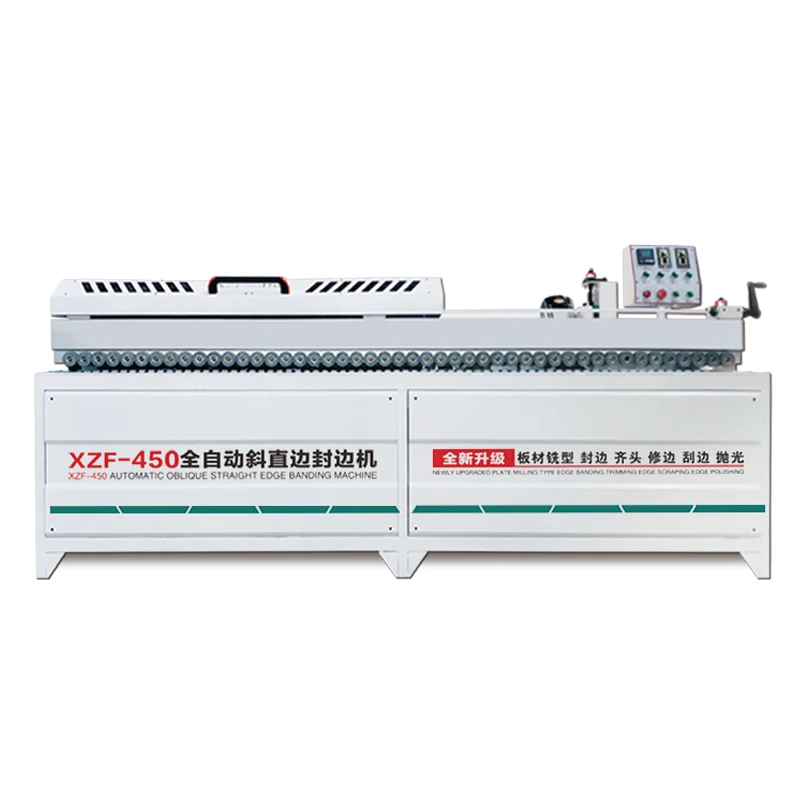
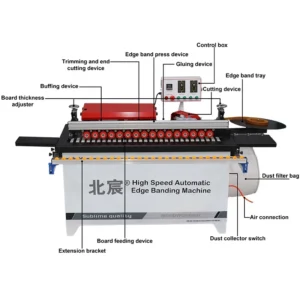
Precision-Ground Assembly — Every XZF-450 frame is aligned on our factory floor to within ±0.02mm before the glue pot is ever mounted, a discipline verified at four separate QC stages before the machine leaves our facility.
Technical Specifications
| Parameter |
Value |
| Model |
XZF-450 |
| Product Type |
Automatic Edge Banding Machine |
| Total Power |
9.5 kW |
| Voltage |
380V / 415V |
| Pre-milling Motor |
4 kW |
| Trimming Power |
2.2 kW × 2 |
| Polishing Power |
0.4 kW × 2 |
| Edge Banding Thickness |
0.3 – 3 mm |
| Edge Banding Height |
0 – 50 mm |
| Minimum Sheet Length |
30 cm |
| Minimum Sheet Width |
15 cm |
| Feed Speed |
0 – 12 m/min |
| Glue Pot Capacity |
4000 ml |
| Air Source Pressure |
0.5 – 0.7 MPa |
| Vacuum Power |
550 W |
| Machine Dimensions |
300 × 65 × 135 cm |
| Machine Weight |
430 kg |
| Standard Functions |
Pre-milling, 30°/45°/60° edge banding, trimming, scraping, polishing, vacuum extraction |
| Control Panel Language |
Chinese, English (customizable to Spanish or other languages) |
| Plug Options |
EU, USA, AU, UK |
| Certifications |
CE, ISO 9001 |
Application Suitability
| Application |
Material or Output |
| Cabinet door edge finishing |
MDF and melamine-faced particleboard with PVC or ABS edgebanding |
| Custom furniture panel processing |
Plywood and blockboard with veneer or melamine edgebanding |
| Polymer door production |
Polymer composite panels requiring 45° angled edge profiles |
| Large-format panel edging |
Solid wood panels and blockboard up to 50 mm edge height |
| Medium-volume workshop runs |
Particleboard and MDF components for cabinet and shelving assembly |
Why the Voltage Question Must Precede the Purchase Order
We confirm your local voltage and frequency before production starts — not after the machine is built.
An edge banding machine OEM manufacturer ships a unit rated for 380V/50Hz to a market running 415V/60Hz. The motors overheat within weeks, the glue pot temperature drifts, and the control board fails. The distributor absorbs the return shipping, the end user loses production time, and the brand reputation takes a hit that no manual reprint can fix. [NEED_CITE: voltage and frequency standards by export market]. This is not a hypothetical scenario — it surfaces regularly when procurement prioritizes lead time over electrical verification.

How Manufacturing Depth Separates Real OEM Partners from Resellers
When a regional distributor evaluates an edge banding machine OEM manufacturer, the first question should be whether the factory controls its own precision grinding and assembly. The XZF-450 is built on our floor from frame welding through final electrical termination. Our proprietary cutting mechanism in the 4 kW pre-milling station is not sourced from a third-party catalog — it is manufactured and balanced in-house, which means replacement parts carry the same tolerance as the original installation. Distributors who have audited our facility confirm that the assembly jigs and inspection gauges match the tolerance claims in the specification sheet.
What Four-Stage QC Actually Catches Before Dispatch
Incoming material inspection verifies that castings and linear guides meet dimensional requirements before they enter the assembly line. In-process checks confirm that the pre-milling head, glue pot, and trimming stations are aligned to ±0.02mm relative to the feed table. Finished-product testing runs actual panels — MDF, particleboard, or plywood — through all stations at production feed speeds to verify edge adhesion and trim quality. [NEED_CITE: CE machinery directive requirements for industrial equipment]. Pre-shipment verification includes a full electrical continuity test and a voltage confirmation check against the destination market specification. Each stage generates a documented record that ships with the machine.
Reading the Specs That Determine Edge Quality
The 4 kW pre-milling motor is the most consequential specification on this machine. It removes a thin layer from the panel edge before glue application, eliminating chip-out and saw marks that would otherwise telegraph through thin PVC edgebanding. Without adequate pre-milling power, the cutter slows under load on dense MDF, producing a scalloped edge that the glue roller cannot fully bridge. The dual 2.2 kW trimming motors operate independently on top and bottom, ensuring that the flush trim follows the panel contour regardless of slight thickness variation. Polishing at 0.4 kW per wheel removes residual adhesive haze without melting the edgebanding surface. The 0 – 12 m/min feed speed range allows operators to slow down for difficult substrates like cross-grain plywood without stalling the glue application, while maintaining throughput on standard melamine particleboard runs.
The Downstream Cost of Skipping Material-Specific Test Runs
A distributor once specified an edge banding line based on sample panels processed at a trade show. Those samples were cut from low-density particleboard. When the machine arrived at the end user’s factory and ran high-density MDF for cabinet doors, the pre-milling station could not maintain surface quality at the expected feed rate. Panels accumulated at the trimming station, operators slowed the feed to compensate, and the line throughput fell to a fraction of the projected output. The glue line on the denser substrate showed visible gaps because the pre-milled surface was not flat enough for consistent roller contact. [NEED_CITE: substrate density effects on edge banding adhesion]. A factory test run using the buyer’s actual material eliminates this failure mode before the order is locked.
Why Distributors Source the XZF-450 From This Facility
Our in-house precision grinding means that replacement pre-milling cutters and trimming blades ship with the same ±0.02mm tolerance as the originals, protecting the distributor’s after-sales reputation. Voltage configuration from 380V to 415V is confirmed in writing against the destination grid before the electrical panel is wired, preventing the arrival of an unusable machine. OEM logo application and private-label control panel branding are handled on our production line, not outsourced to a third-party printer. Control panels are programmed in the agreed language — English, Spanish, or others — so the end user’s operators can commission the machine without translation delays. Every unit ships with a factory test record produced on material specified by the buyer, providing documented proof of capability before the container is sealed.
Documentation & Verification
- CE declaration of conformity covering the XZF-450 mechanical and electrical assembly
- Electrical schematic with confirmed voltage and frequency for the destination market
- Factory test record processed on buyer-specified panel material before dispatch
- Operation and maintenance manual in the agreed control panel language
- Spare parts list with OEM part numbers matching the installed components
Installation, Commissioning & Support
- Requires a level concrete floor capable of supporting 430 kg across the 300 cm footprint
- Dedicated 380V or 415V three-phase circuit rated for 9.5 kW continuous draw
- Arrives partially assembled; glue pot and vacuum hood require on-site mounting and alignment
- First-run commissioning includes feed speed calibration and trimming depth adjustment per material
- Operator training covers glue pot temperature settings for PVC, ABS, and veneer edgebanding
- Pre-milling cutters and trimming blades are the primary wear items stocked as spare parts
Preparing Your Inquiry
To configure the XZF-450 correctly for your market, share the primary panel materials your customers process, the edgebanding types and thicknesses most common in your region, and the local voltage and frequency standard. If your end users run angled edge profiles for polymer doors or specialty furniture, specify the required degree settings. Let us know whether OEM branding and localized control panel language are part of your distribution requirements so we can include them in the initial quotation.
Frequently Asked Questions
Q: How is ±0.02mm tolerance verified and documented before shipment?
A: Each XZF-450 undergoes in-process alignment checks using precision gauges at the pre-milling, trimming, and scraping stations. A finished-product test run on buyer-specified material confirms edge flush and seam quality. The results are recorded in a factory test report that ships with the machine, giving distributors documented evidence to present to end users during commissioning.
Q: What OEM customization options are available for regional distributors?
A: We apply OEM logos and private-label branding on the machine body and control panel. Voltage is configured from 380V to 415V based on the destination grid. Control panel language is programmed to match the local market — English, Spanish, or other languages agreed during order confirmation. Plug type is selected from EU, USA, AU, or UK standards.
Q: Can distributors visit the factory to inspect manufacturing and QC processes?
A: Factory visits are welcomed at any production stage. Distributors can observe frame welding, precision grinding of the pre-milling mechanism, in-process alignment verification, and pre-shipment testing. We encourage buyers to bring sample panels from their market so the test run reflects actual end-user conditions and material densities.
Q: What documentation supports customs clearance and local compliance?
A: Each shipment includes the CE declaration of conformity, a detailed packing list, commercial invoice, and the electrical schematic showing confirmed voltage and frequency. The operation manual and spare parts list are provided in the agreed language. Additional customs documentation support is arranged based on the destination country’s import requirements.
Q: How do you ensure the machine matches our regional voltage and frequency?
A: Before production begins, we request your local voltage and frequency specification in writing. The electrical panel is then wired and labeled accordingly, and the motor ratings are matched to the confirmed supply. A pre-shipment electrical test verifies continuity and correct phase rotation, preventing the costly failure mode of machines arriving with incompatible power configurations.