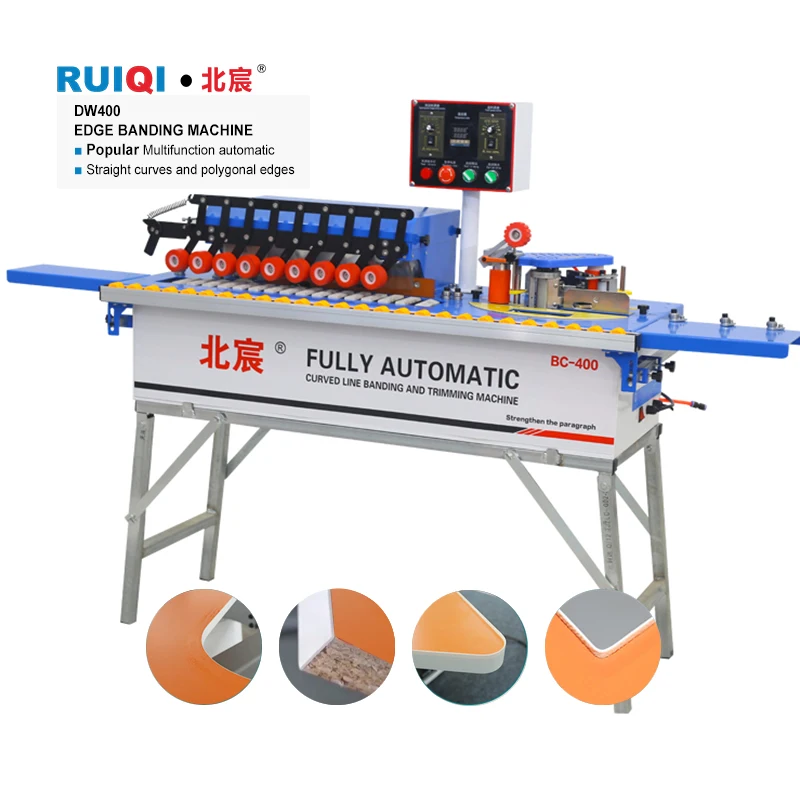
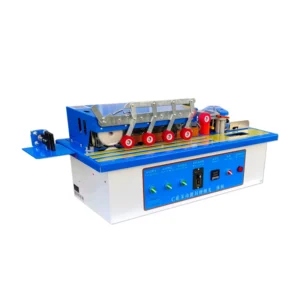
OEM manufacturing depth — DW400 automatic edge banding machines leave our Shandong facility with buyer-specified voltage, plug type, and control panel language locked in before assembly begins, supported by proprietary cutting mechanisms verified through four-stage QC.
Technical Specifications
| Parameter |
Value |
| Model |
DW400 |
| Product Type |
Automatic Edge Banding Machine |
| Total Power |
3800 W |
| Voltage & Frequency |
220 V / 380 V / customizable (50 Hz / 60 Hz to be confirmed) |
| Control System |
Operation panel with Chinese/English default; multilingual customization available |
| Overall Dimensions (L×W×H) |
116 × 47 × 69 cm |
| Net Weight |
70 kg |
| Minimum Sheet Length |
25 cm |
| Minimum Sheet Width |
10 cm |
| Edge Banding Height |
0–50 mm |
| Edge Banding Thickness |
0.3–3 mm |
| Edge Feed Power |
20 W |
| Transmission Power |
60 W |
| Trimming Power |
650 W × 2 |
| Polishing Power |
180 W × 2 |
| Vacuum Power |
1200 W |
| Air Source Pressure |
0.5–0.8 MPa |
| Glue Pot Capacity |
1000 ml |
| Standard Features |
Straight edge banding, trimming, polishing |
| Feed Speed |
To be confirmed |
| Panel Thickness Range |
To be confirmed |
| Tolerance |
To be confirmed |
| Language Options |
Chinese / English default; Spanish and other languages customizable |
| Certification |
CE, ISO 9001 |
Application Suitability
| Application |
Material or Output |
| Cabinet door edge banding |
MDF and plywood panels with PVC or veneer strips |
| Custom furniture production |
Particleboard and blockboard with 0.3–3 mm edge banding |
| Polymer door finishing |
Polymer door blanks requiring straight edge trimming and polishing |
| Small-batch joinery runs |
Solid wood panels and wood-based composites for bespoke joinery |
Why Voltage Confirmation Must Happen Before the Edge Banding Machine OEM Factory Order
Specifying the destination market’s voltage and frequency before production starts prevents machines from arriving as dead weight on the workshop floor.
Every year, distributors receive woodworking equipment that was quoted on throughput and price alone, with no one asking whether the buyer’s grid runs at 50 Hz or 60 Hz, or whether the local supply is single-phase 220 V or three-phase 380 V. The machine sits crated while transformers are sourced, or worse — it is powered on and the motors burn within the first week. As someone who has stood on the assembly floor watching these mismatches come back as warranty claims, I can confirm that voltage-related failures are among the most preventable and most expensive faults we see returned [NEED_CITE: voltage and frequency standards by export market]. The DW400 edge banding machine OEM factory process addresses this by requiring a signed electrical confirmation document before the main motor and control transformer are installed.

Locking Down Electrical Standards for Every Destination Market
When a distributor in South America orders the DW400 for a region with 220 V / 60 Hz supply, the motor windings and control transformer are wound to match before the machine leaves the bench. The edge banding machine OEM factory workflow includes a dedicated electrical schematic showing the exact wiring configuration, plug type, and breaker rating — so the buyer’s electrician can prepare the workshop circuit while the machine is still in production. This eliminates the common situation where the installer opens the cabinet and discovers an unfamiliar terminal layout with no documentation to reference.
Private-Label Branding Without Compromising the Build
OEM partners need their logo and colour scheme on the machine, but they also need the internal build quality to match the brand promise. The DW400 is assembled in our 10,000 m² Shandong facility using precision-ground components inspected across four QC stages — incoming material, in-process, finished product, and pre-shipment verification. Every unit undergoes a test run with actual board stock before crating, and the results are documented in a factory test record that ships with the machine [NEED_CITE: CE machinery directive requirements for industrial equipment]. Private-label buyers receive the same build discipline as direct-sale orders; the only difference is the nameplate on the front.
Reading the Spec Sheet Against the Real Workshop Environment
The DW400’s trimming stations deliver 650 W each, providing enough torque to cleanly trim PVC and veneer banding in the 0.3–3 mm thickness range without chatter marks. The dual 180 W polishing wheels follow immediately, smoothing the trimmed edge to a finish that meets cabinet-grade visual standards. Air source pressure between 0.5 and 0.8 MPa drives the pneumatic actuators for banding feed and pressure rollers — workshops with undersized compressors will notice inconsistent pressure at the banding nip point, producing visible glue squeeze-out or, conversely, poor adhesion. The 1000 ml glue pot is sized for sustained small-to-medium batch runs; shops planning continuous high-volume production should evaluate glue replenishment intervals during their sample test.
The Cost of Skipping the Sample Run
I once watched a batch of custom cabinets get torn apart and re-banded because the customer’s particleboard was lower density than the MDF we used during the factory test. The glue penetrated unevenly, the edge strips lifted at the corners, and the rework cost wiped out the profit on that entire order. Since then, my rule has been simple: send me a sample of your actual board stock before I finalise the machine parameters [NEED_CITE: substrate density variation and adhesive penetration in edge banding]. A few days of sample testing saves weeks of field troubleshooting and protects the OEM partner’s reputation with their end customer.
Why Distributors Source This Edge Banding Machine from Ruiqi
The DW400 is produced entirely in-house — from frame welding to final QC — meaning OEM modifications do not require negotiating with third-party sub-assemblers. Custom logo application, colour matching, and private-label documentation are integrated into the production schedule rather than added as an afterthought. Voltage and plug configurations for EU, USA, AU, and UK markets are handled as standard options, not special engineering requests. The four-stage QC protocol provides a 99.8% pass rate at pre-shipment inspection, and every machine ships with a test record tied to its serial number. Engineer-led configuration recommendations are returned with a formal quotation within 24 hours, keeping the distributor’s own project timeline on track.
Documentation & Verification
- CE declaration of conformity matched to the DW400 serial number and destination market
- Electrical schematic showing confirmed voltage, frequency, and plug type for your region
- Factory test record using your specified panel material and edge banding thickness
- Operation and maintenance manual produced in the agreed language with exploded diagrams
- Spare parts list with OEM part numbers for fast reordering through your local distributor network
- Packing photographs and customs documentation support for smooth port clearance
Installation, Commissioning & Support
- The 116 × 47 × 69 cm footprint fits standard workshop bays; verify floor levelness within tolerance before placement
- Dedicated circuit matching confirmed voltage (220 V or 380 V) with appropriate breaker rating required
- Machine ships with all stations assembled; connect compressed air at 0.5–0.8 MPa and power to begin commissioning
- First-run parameter setting covers glue temperature, feed speed, and trimming depth for your specific board stock
- Operator training addresses control panel navigation in the configured language and routine glue pot cleaning
- Wear parts including trimming blades and polishing wheels included in the initial spare parts kit
Starting Your OEM Evaluation
Distributors considering the DW400 for their regional market should provide the target country’s voltage and frequency standard, preferred control panel language, and the primary board materials their customers process. If private-label branding is required, share the logo artwork and colour references early so these are incorporated into the production plan rather than applied post-assembly. We welcome sample board stock shipped to our facility for a pre-production edge banding test, or buyers may arrange a factory visit to inspect the assembly line and QC process firsthand.
Frequently Asked Questions
Q: What elements of the DW400 can be customised under an OEM agreement?
A: Logo placement, machine colour, voltage from 110 V to 440 V, plug type, control panel language, and packaging can all be configured to your brand identity. Production to buyer-supplied drawings is also available for deeper modifications. Each OEM order is documented with a signed specification sheet before manufacturing begins.
Q: How do you ensure the machine matches our country’s electrical standard?
A: We require written confirmation of your local voltage, frequency, and plug type before the motor and control transformer are installed. An electrical schematic reflecting these specifications is reviewed and approved by your engineering team. The finished machine is tested under the confirmed voltage before crating.
Q: What support do distributors receive after the machines are delivered?
A: Distributors receive a spare parts supply agreement, technical training for their local service team, and operation manuals in the agreed language. We provide remote troubleshooting support and can dispatch engineers for on-site commissioning when required. Territory considerations are discussed during the initial OEM agreement.
Q: Can we send our own board material for a test run before placing a bulk order?
A: Yes. We encourage OEM partners to ship sample panels and edge banding material to our Shandong facility. We run the DW400 with your exact stock, document the results including edge quality and trimming finish, and share the test record before you commit to a production order.
Q: What documentation ships with each OEM order?
A: Every DW400 order includes a CE declaration of conformity, ISO 9001 certificate, electrical schematic, factory test record, operation manual in the agreed language, spare parts list, packing photographs, and customs documentation support. All documents reference the machine serial number for traceability.