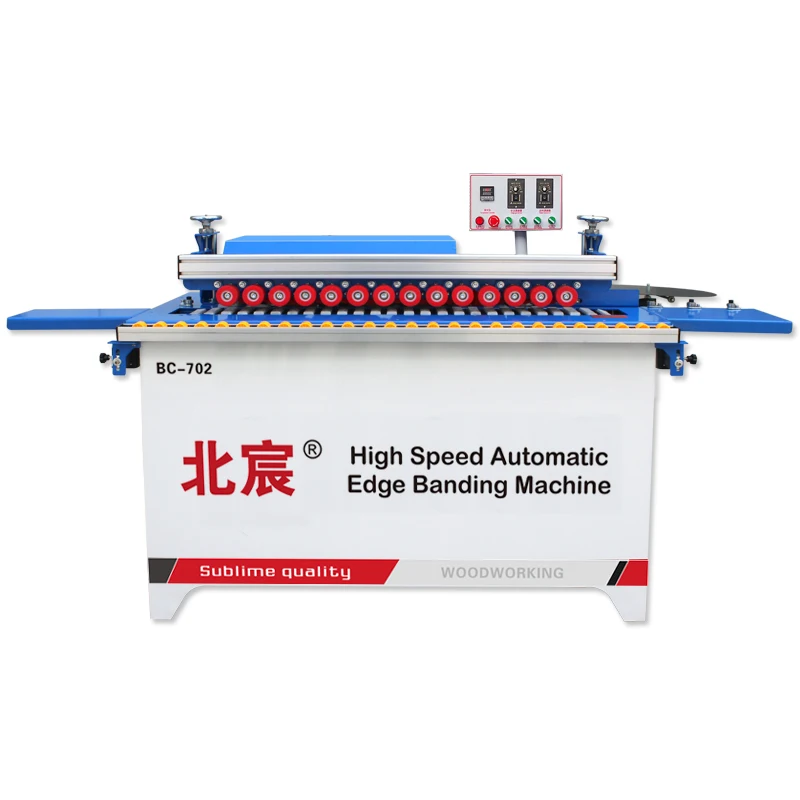
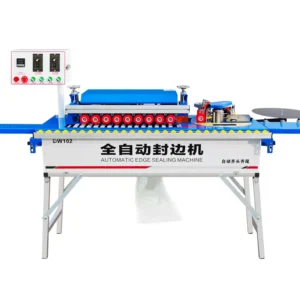
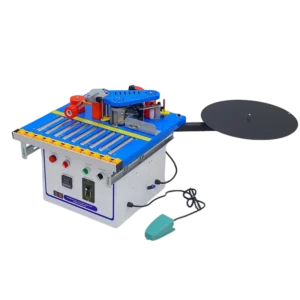
Patented Mechanisms Built In-House — Every DW702 automatic edge banding machine leaving our Ningjin floor carries verified tolerance data and a formal electrical schematic matched to the buyer’s local grid before crating begins.
Technical Specifications
| Parameter |
Value |
| Model |
DW702 |
| Product Type |
Automatic Edge Banding Machine |
| Total Power |
3800W |
| Voltage & Frequency |
220V / 380V / customization (frequency to be confirmed per destination market) |
| Control System |
PLC (controller model to be confirmed at quotation stage) |
| Overall Dimensions (L×W×H) |
120×55×110 cm |
| Net Weight |
105 kg |
| Minimum Sheet Length |
25 cm |
| Minimum Sheet Width |
10 cm |
| Edge Banding Height Range |
0–50 mm |
| Edge Banding Thickness Range |
0.3–3 mm |
| Edge Power |
20W |
| Transmission Power |
140W |
| Trimming Power |
800W×2 |
| Polishing Power |
180W×2 |
| Vacuum Power |
1200W |
| Glue Pot Capacity |
1000 ml |
| Air Source Pressure |
0.4–0.8 MPa |
| Standard Functions |
Edge banding, trimming, polishing, automatic head and tail cutting, vacuum hold-down |
| Language Options |
Chinese, English; customizable to Spanish or other languages |
| Feed Speed |
(basis not stated in source) |
| Panel Thickness Range |
(basis not stated in source) |
| Tolerance |
(basis not stated in source) |
Application Suitability
| Application |
Material or Output |
| Cabinet door edge finishing |
MDF and plywood panels with PVC or veneer banding |
| Custom furniture small-batch production |
Particleboard and blockboard with 0.3–3 mm edge material |
| Small workshop panel processing |
Polymer door blanks requiring trimming and polishing |
| Joinery startup automation |
Transitioning from manual edge application to machine-fed output |
Why the Voltage Question Must Come Before the Quotation
A machine that cannot energize on arrival stops the entire workshop — we match the DW702 electrical system to your grid before the first bolt is tightened.
An edge banding machine factory that ships without confirming local voltage and frequency delivers a crate that sits idle while a transformer is sourced. In our early production years I saw a unit land in a market with a different frequency standard, and the buyer lost weeks of output waiting for compatible components [NEED_CITE: voltage and frequency standards by export market]. The DW702 order process begins with a formal electrical review — 220V or 380V base configurations, with frequency confirmed against the destination grid and documented on the schematic before production starts. This step eliminates the most common cause of commissioning failure on exported OEM edge bander shipments.

Private Label and Distributor Branding Workflow
Regional distributors and OEM partners building a model mix for local markets need more than a logo sticker. The DW702 supports custom color schemes, branded control panel overlays, and repackaged documentation sets so the machine arrives at the end customer looking like your own product line. An OEM edge bander built this way carries your brand identity through every touchpoint — from the operator interface to the spare parts catalog — rather than exposing the original factory origin at the point of sale.
Four-Stage Quality Verification Before Crating
Every DW702 passes through incoming material inspection, in-process assembly checks, finished-product functional testing, and a pre-shipment verification run that simulates actual panel feed conditions. The pre-shipment stage records edge quality on a test substrate matching the buyer’s material specification, and those samples ship inside the crate so the receiving party can inspect banding adhesion and trim finish upon arrival [NEED_CITE: CE machinery directive requirements for industrial equipment]. This sequence means an edge banding machine factory ships evidence, not promises, and distributors can hand the test record directly to their downstream customers.
How Compact Specs Translate to Workshop Reality
The 3800W total power envelope across all stations means the DW702 can run from a standard workshop distribution board without dedicated high-capacity circuits, keeping installation cost manageable for small to medium joinery shops. The 120×55×110 cm footprint allows placement against a wall or between existing panel saws and boring stations in tight production layouts. A 1000 ml glue pot capacity reduces refill interruptions during continuous runs on PVC banding, while the 0.4–0.8 MPa air requirement aligns with compressor systems already present in most woodworking environments. Trimming power at 800W across two stations provides adequate cutting force for 0.3–3 mm edge material on MDF and particleboard without the motor strain that causes inconsistent trim quality on underpowered units. An edge banding machine factory that publishes these figures allows buyers to cross-reference against their existing infrastructure before committing to an order.
When a Machine Arrives Without Voltage Confirmation
A buyer who receives an OEM edge bander built for a different voltage standard faces a forced choice: source a step-up or step-down transformer locally, or return the unit and wait for a replacement. Either path halts production for a period that compounds with every day the workshop operates at reduced capacity [NEED_CITE: common commissioning delays on imported woodworking machinery]. Beyond the electrical mismatch, control panels programmed in a language the operator cannot read delay the first productive run while translated documentation is sourced. These are not rare edge cases — they represent the most frequent complaints logged by importers who purchased on price alone without requiring formal specification sign-off before production.
Manufacturing Depth That Distributors Can Verify
In-house assembly of the DW702 means component sourcing, precision grinding, and final calibration all happen within one facility, giving distributors a single point of accountability for quality. The patented cutting mechanism inside the trimming station is engineered and tested on our floor, not outsourced as a complete sub-assembly from an unknown vendor. Factory visits are open to any buyer evaluating manufacturing depth — walk the assembly stations, inspect the grinding equipment, and watch pre-shipment test runs on your own panel stock. This transparency separates an edge banding machine factory that builds its own mechanisms from trading companies that re-label third-party output. Four-stage quality control with documented checkpoints at each stage means distributors receive inspection records, not verbal assurances, when presenting the DW702 to their regional customers.
Documentation & Verification
- CE declaration of conformity issued specifically for the DW702 automatic edge banding machine model
- ISO 9001 certificate covering the manufacturing process for this edge bander product family
- Electrical schematic with destination voltage and frequency confirmed before production release
- Factory test record showing edge banding output on the buyer’s specified substrate and thickness
- Operation and maintenance manual produced in the agreed language for operator reference
- Spare parts list with exploded diagram included for downstream service and inventory planning
Installation, Commissioning & Support
- 120×55×110 cm footprint requires a level concrete floor with standard anchor points and no special foundation work
- 3800W total draw requires a dedicated circuit matching the confirmed voltage before the machine is energized
- Delivered fully assembled within the frame; on-site setup limited to air connection, power connection, and glue loading
- PLC control panel configured in the agreed language before dispatch to eliminate commissioning translation delays
- 1000 ml glue pot and vacuum system checked during factory pre-shipment test with records included in the crate
- Spare parts list identifies wear items for local stocking so distributor service teams can respond without factory lead times
Before You Request a Quotation
Send us your destination market voltage and frequency, the panel materials and edge banding thickness range you plan to run, and the language your operators need on the control panel. If you are evaluating the DW702 for a private label or distributor arrangement, include your branding requirements and target market so we can align packaging and documentation accordingly. Sample test runs on your own substrate stock can be arranged before order confirmation to verify edge quality against your assembly tolerances.
Frequently Asked Questions
Q: What OEM and private label customization is available for the DW702?
A: Custom logo placement, machine color, control panel language, and repackaged documentation are all configurable at the factory. Voltage is built to your destination market specification from 220V to 380V with frequency confirmed before production. Distributors can brand the operator interface and spare parts catalog to present the DW702 as their own product line without exposing the original factory identity to end customers.
Q: Can I visit the factory to verify the manufacturing process before ordering?
A: Factory visits are open to all buyers evaluating the DW702 for distributor or OEM partnerships. You can walk the assembly stations, inspect the precision grinding equipment, and observe pre-shipment test runs on your own panel stock. Video audits are available for buyers who cannot travel before placing a container-load order.
Q: What documentation ships with each DW702 unit?
A: Every unit ships with a CE declaration of conformity, ISO 9001 manufacturing certificate, electrical schematic matched to destination voltage, factory test record with sample output, operation manual in the agreed language, and a spare parts list with exploded diagram for downstream service support and customs clearance.
Q: How is spare part supply structured for regional distributors?
A: The spare parts list identifies wear items by part number so distributors can stock high-turnover components locally. Lead times for replacement parts depend on order volume and specification, and are confirmed at the quotation stage. Distributors placing container orders can negotiate bundled spare part packages to reduce per-unit logistics cost.
Q: What is the production lead time for an OEM container order?
A: Lead time depends on order volume, the extent of private label customization, and current production scheduling. Formal timelines are provided in the engineer’s quotation within 24 hours of receiving your specification. Buyers requiring expedited delivery should confirm stock availability for standard configurations at the inquiry stage.