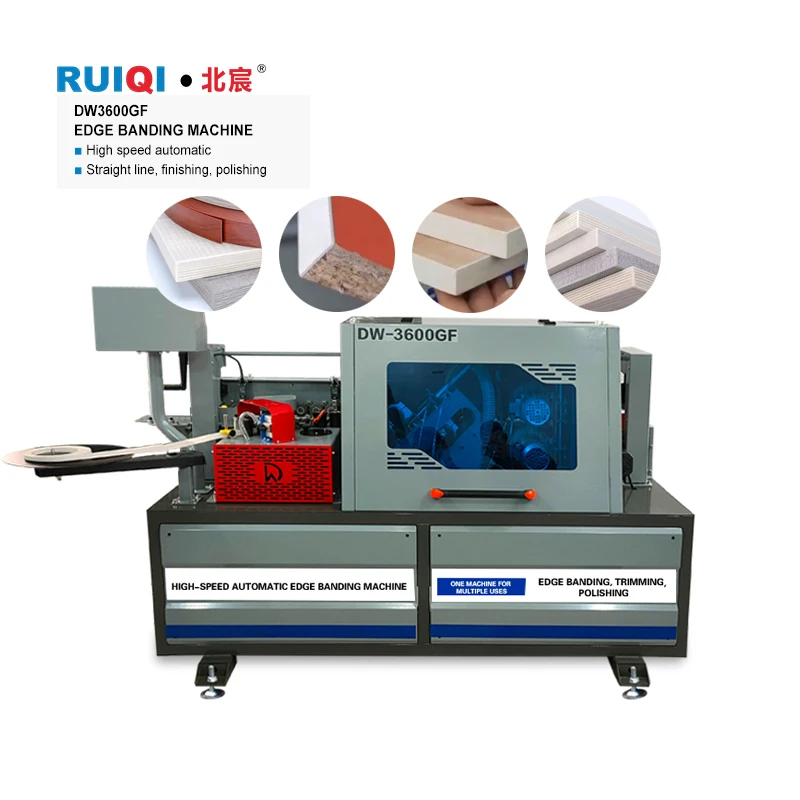
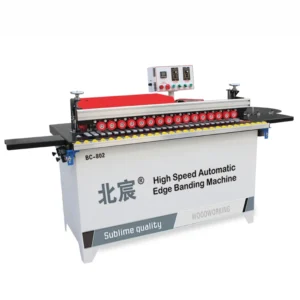
In-House Manufacturing — Every DW3600 unit rolls off our own assembly line with proprietary trimming mechanisms and documented four-stage QC, giving OEM partners a verifiable production source rather than a rebranded trading desk.
Technical Specifications
| Parameter |
Value |
| Model |
DW-3600GF |
| Product Type |
Compact Automatic Edge Banding Machine |
| Voltage & Frequency |
380V Three-Phase Four-Wire (50/60Hz to confirm) |
| Total Power |
4.9 kW |
| Overall Dimensions (L×W×H) |
2200 × 650 × 1250 mm |
| Net Weight |
320 kg |
| Edge Banding Type |
Straight Edge Banding |
| Edge Band Height Range |
0–50 mm |
| Edge Band Thickness Range |
0.3–3 mm |
| Minimum Panel Length |
200 mm |
| Feed Speed |
0–14 m/min |
| Trimming Motor Power |
800 W × 2 |
| Trimming Spindle Speed |
24,000 r/min |
| Polishing Motor Power |
400 W × 2 |
| Edge Banding Motor Power |
160 W |
| Transmission Motor Power |
180 W |
| Air Supply Requirement |
0.4–0.6 MPa |
| Standard Functions |
Gluing, Front & Rear Trimming, Scraping, Polishing, Vacuuming |
| Language Options |
Chinese and English standard; other languages configurable |
| Certification |
CE (unit-level declaration to verify) |
Application Suitability
| Application |
Material or Output |
| Custom cabinet door edge finishing |
MDF and particleboard with PVC edge banding 0.4–1 mm |
| Plywood shelving panel banding |
Plywood panels with melamine or wood veneer banding up to 3 mm |
| Small-batch office furniture production |
Particleboard and MDF substrates in joinery workshops |
| Startup workshop scale-up from manual banding |
Straight panels above 200 mm length across common furniture board stocks |
Why Unconfirmed Voltage Turns a New Machine Into Dead Weight
Confirming local voltage and frequency before the order is placed eliminates the single largest cause of unusable shipments.
I once watched a distributor in Lagos take delivery of three edge banders wired for a frequency his grid did not support. The motors overheated within the first hour of commissioning, and the shipping window for returns had already closed. When sourcing as an Edge Banding Machine manufacturer OEM, the voltage question belongs in the very first exchange — not after the crate is opened on the factory floor [NEED_CITE: voltage and frequency standards by export market]. Skipping that step means the machine may power on but run at the wrong spindle speed, producing visible chatter marks on every trimmed edge.

Private-Label Consistency Across Production Runs
When you place repeat orders under your own brand, the units must match — same logo placement, same control panel layout, same paint code. As an Edge Banding Machine manufacturer OEM operating our own production line, we control every variable that a trading company outsources. Each private-label run references a locked specification sheet that covers branding position, packaging artwork, and control language. Distributors who have been burned by inconsistent shipments from intermediaries find that factory-level documentation removes the guesswork between batch one and batch ten.
Four-Stage QC Before the Crate Closes
Incoming material inspection catches out-of-tolerance linear guides before they reach the assembly bench. In-process checks verify that each trimming motor mounts true to the reference plane. Finished-product testing runs actual panels through all five stations — gluing, front and rear trimming, scraping, and polishing — under load. Pre-shipment verification records feed speed, air pressure response, and glue pot behaviour on a test panel that ships inside the crate. Every stage produces a signed checklist, so an OEM partner can audit the file remotely before authorising dispatch [NEED_CITE: CE machinery directive requirements for industrial equipment].
How Feed Speed and Trimming Spindle Speed Shape Edge Quality
The 24,000 r/min trimming spindle paired with a feed speed range up to 14 m/min defines the practical quality window of this machine. At lower feed rates the cutter removes material in finer increments, producing a clean flush trim on thin PVC banding. Pushing feed speed toward the upper limit shortens cycle time but demands that the 800 W trimming motors maintain torque at the spindle — any drop shows up as a micro-step on the trimmed edge. For workshops running 0.3 mm veneer banding, keeping feed speed in the lower half of the range typically delivers the cleanest result, while 2–3 mm PVC benefits from the mid-range where chip load stays balanced.
The Real Cost of Skipping a Factory Audit
Distributors who commit to container quantities without visiting the production floor often discover tolerance issues only after their end customers report assembly gaps. A trimming offset of a fraction of a millimetre may not show in a showroom sample, but it compounds across a full kitchen run where every carcass panel must meet its neighbour flush. When the root cause traces back to a worn fixture on the supplier’s assembly bench, the distributor — not the factory — absorbs the freight and replacement cost [NEED_CITE: typical OEM warranty claim patterns in woodworking machinery imports]. A single day on the factory floor reviewing precision-ground components and running sample panels removes that exposure entirely.
What Manufacturing Depth Actually Means for Your Supply Chain
Our in-house production line handles component sourcing, precision grinding, assembly, and testing under one roof, so specification changes do not wait on a third-party machine shop. Proprietary cutting mechanisms designed for ±0.02 mm tolerance are built and inspected here, not outsourced. Voltage configurations from 110 V to 440 V are wired on our bench, documented on an electrical schematic that travels with the machine. OEM partners requesting custom logo placement and packaging artwork deal directly with the production scheduler, cutting lead-time uncertainty. Four-stage QC with pre-shipment verification means the factory test record you review before dispatch reflects the actual unit in the crate. Engineer-led configuration recommendations arrive within 24 hours, because the people quoting the machine are the same people building it.
Documentation & Verification
- CE declaration of conformity covering the DW-3600GF series available for audit
- ISO 9001 certificate accessible during factory visit or video walkthrough
- Electrical schematic and voltage confirmation sheet matched to your local grid
- Factory test record documenting functional run on your specified panel thickness range
- Operation and maintenance manual produced in the agreed language before dispatch
- Packing photographs showing crate interior and securing method before shipment
Installation, Commissioning & Support
- Floor space of roughly 2.5 m × 1 m required with clearance on the infeed side for panel handling
- Dedicated 380 V three-phase circuit with confirmed 50 or 60 Hz frequency before energising the 4.9 kW total load
- Machine ships fully assembled; position, level, connect air supply at 0.4–0.6 MPa, and power on
- First-run commissioning includes glue pot temperature calibration and trimming motor alignment on your actual panels
- Spare parts list covering trimming cutters, polishing wheels, and feed chain links provided at delivery
What to Include in Your First Inquiry
Send us the panel substrates and edge banding materials you run most often, along with typical panel dimensions and daily volume targets. Specify your local voltage and frequency so that the electrical package is confirmed before production starts. Let us know whether you need control panel text in a language beyond Chinese and English, and whether your brand requires logo placement on the machine body or packaging.
Frequently Asked Questions
Q: Can you produce the DW-3600GF to our own drawings and private-label specifications?
A: Yes. OEM scope covers custom logo, paint code, packaging artwork, and specification adjustments. We lock a signed specification sheet per project so that repeat orders remain identical. Engineering reviews your drawings and returns a feasibility note within one working day.
Q: How is voltage and plug configuration confirmed before production?
A: We request your local voltage, phase, and frequency in the inquiry stage and issue a voltage confirmation sheet. The electrical schematic is reviewed with you before assembly begins, ensuring the machine matches your grid on arrival.
Q: What does the four-stage QC process cover, and can we review test records?
A: The four stages are incoming material, in-process, finished product, and pre-shipment verification. Each stage generates a signed checklist. Pre-shipment records include a functional run on test panels, and the full file is shared with you before crating.
Q: How do you handle control panel language customization for our operators?
A: Chinese and English are standard. Additional languages are configured at the factory before dispatch, covering touchscreen labels and alarm messages. We confirm the target language during the specification review so operators can commission the machine without translation delays.
Q: What spare parts backup and technical training do you provide for our service team?
A: A spare parts list covering high-wear items ships with every unit. We offer remote video-guided training on trimming adjustment, glue pot maintenance, and chain lubrication. Distributors can also arrange on-site training sessions for their regional technicians at the factory.