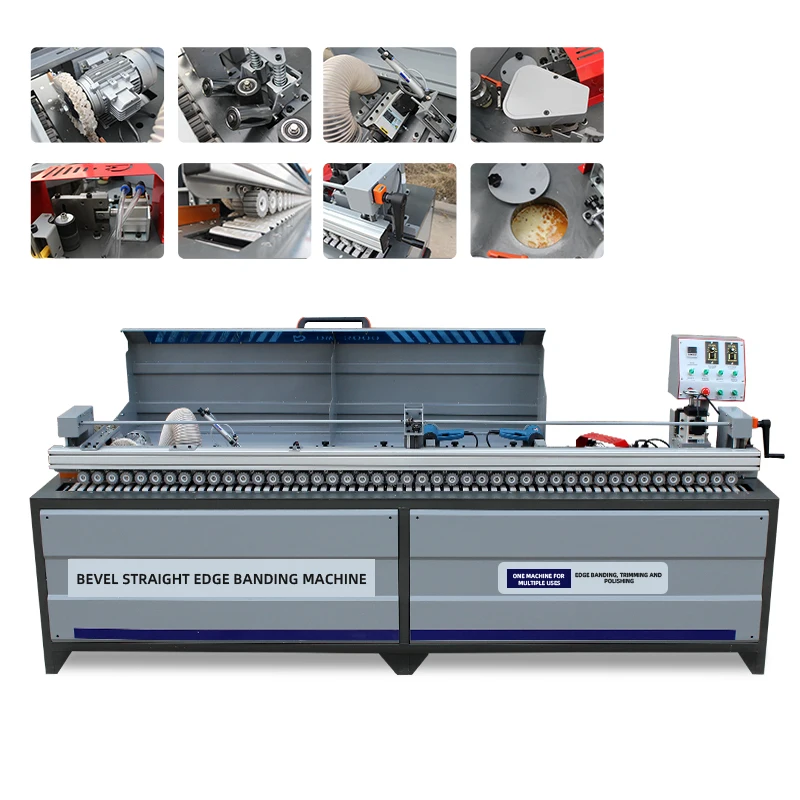
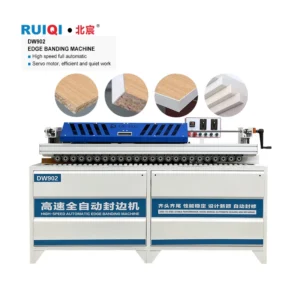
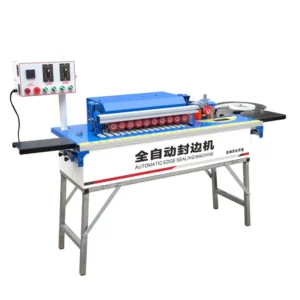
Precision-ground spindle trimming with patented mechanisms — Every DW3000 unit is built in-house with verified tolerance documentation, ensuring your private label ships with consistent edge quality that your end-users can measure themselves.
Technical Specifications
| Parameter |
Value |
| Model |
DW3000 |
| Product Type |
Automatic Straight Bevel Edge Banding Machine |
| Total Power |
11 kW |
| Voltage |
380V/415V (basis to be confirmed) |
| Overall Dimensions (L×W×H) |
299 × 65 × 130 cm |
| Net Weight |
430 kg |
| Feed Speed |
0–12 m/min |
| Minimum Panel Length |
30 cm |
| Minimum Panel Width |
15 cm |
| Edge Banding Height Range |
0–50 mm |
| Edge Banding Thickness Range |
0.3–3 mm |
| Pre-milling Motor |
2.2 kW |
| Trimming Motor |
2.2 kW × 2 (spindle type) |
| Polishing Motor |
0.4 kW × 2 |
| Heating Power |
2.2 kW × 2 (double heat gun design) |
| Glue Pot Capacity |
4000 ml |
| Vacuum Power |
550 W |
| Air Supply Pressure |
0.5–0.7 MPa |
| Bevel Angle Adjustment |
30°–90° (8 groups of oblique pressure wheels) |
| Key Features |
Plate pre-milling, straight and bevel edge banding, trimming, scraping, polishing, high-power vacuuming, edge band slotting with adjustable height, automatic alignment, flexible edge scraper |
Application Suitability
| Application |
Material or Output |
| Custom furniture panel edge banding |
MDF and plywood with PVC or ABS banding |
| Cabinet door bevel edge finishing |
Particleboard with 45° bevel PVC banding |
| One-pass pre-milling and slotting |
Laminated particleboard requiring glue-line cleanup |
| Joinery workshop scaling to automation |
Solid wood panels with veneer edge banding |
Why Voltage Confirmation Must Precede Your Purchase Order
An edge banding machine OEM manufacturer must verify your local supply before the build starts, not after the machine arrives.
I have seen containers arrive at ports where the motor winding was specified for 380V/50Hz, but the facility ran 440V/60Hz. The control transformer saturates, the heater elements overshoot glue temperature, and the banding lifts within the first hour of production. These are not warranty claims — they are specification failures that happen when the voltage question is skipped during quoting [NEED_CITE: voltage and frequency standards by export market]. For distributors and OEM partners placing bulk or private-label orders, confirming the exact supply standard at the inquiry stage prevents an entire shipment from becoming idle iron.

Manufacturing Depth Behind Every Private Label Order
When an importer evaluates an edge banding machine OEM manufacturer, the question is not just whether a logo can be printed on the sheet metal. The real manufacturing depth shows in component sourcing and machining capability. The DW3000 uses spindle-type trimming motors rather than standard cutters, and these spindles are precision-ground in-house to maintain concentricity across the trimming pass. This is the kind of process detail that determines whether your branded machines develop chatter marks after a few months in the field.
Four-Stage Quality Control Across the Build Cycle
Incoming material inspection catches bearing and motor variance before assembly begins. In-process checks verify pressure wheel alignment and glue pot sealing at each station. Finished product testing runs actual panel stock through all functions — pre-milling, bevel banding, trimming, scraping, and polishing — to confirm edge quality under load. Pre-shipment verification produces a signed test record with photographs before the crate closes. This sequence is what allows our edge banding machine OEM manufacturer output to ship with documentation your local service team can reference [NEED_CITE: CE machinery directive requirements for industrial equipment].
Reading the Spec Sheet Against Your Production Reality
The 0–12 m/min feed speed range matters less than the stability at the speed you will actually run. On recycled particleboard with inconsistent density, a slower feed with pre-milling engaged produces cleaner substrate edges before the glue is applied, directly affecting bond strength. The double heat gun design (2.2 kW × 2) maintains stable adhesive temperature across the 4000 ml glue pot, which becomes critical when your workshop ambient temperature fluctuates between morning and afternoon shifts. The 8-group oblique pressure wheels with 30°–90° adjustment control how firmly the banding is pressed against bevel cuts — insufficient pressure on a 45° angle leaves visible glue lines that your furniture assembler will reject during final inspection. Edge band slotting with adjustable height allows the glue to penetrate into the substrate edge rather than sitting on the surface, particularly relevant when processing MDF that tends to absorb adhesive unevenly.
The Cost of Skipping Factory Verification
Some buyers approve a machine on quoted specifications alone, then discover during commissioning that the bevel pressure wheels cannot maintain contact on warped panels, or that the pre-milling station leaves chatter marks on softer particleboard grades. These issues are not visible in a catalog — they surface only when your specific panel stock runs through the machine under continuous production conditions. Importers who skip the sample processing test often face field service calls their own technicians are not equipped to handle [NEED_CITE: typical edge banding adhesion failure causes on recycled substrates].
Why OEM Partners Source the DW3000 from This Floor
In-house manufacturing means the patented trimming mechanisms and precision-ground components are not outsourced to a secondary workshop. Voltage customization from 110V to 440V is configured at the winding and transformer level, not patched with external converters. Multilingual control panels are programmed before assembly, so the operator interface matches the destination market from first power-on. The four-stage QC process with pre-shipment verification produces test records tied to your order number, not generic batch certificates. Single-unit sample orders through to large production runs use the same build line and inspection checkpoints.
Documentation & Verification
- CE declaration of conformity matched to the DW3000 configuration shipped
- ISO 9001 certificate covering the manufacturing process for your order
- Electrical schematic with confirmed voltage and frequency for your market
- Factory test record using your specified panel thickness and edge banding material
- Operation and maintenance manual translated to the agreed language before dispatch
- Spare parts list with part numbers matching your machine’s actual build configuration
Installation, Commissioning & Support
- Floor space planning must account for the 299 cm length plus operator access clearance on both sides
- Dedicated 380V/415V circuit required with appropriate breaker rating for the 11 kW total draw
- Machine ships with feed table and pressure wheel assemblies pre-aligned to reduce on-site setup
- First-run commissioning includes glue temperature calibration across both heat guns for your ambient conditions
- Operator training covers bevel angle adjustment using the 8-group oblique pressure wheel system
- Wear parts inventory includes scraper blades and polishing wheels matched to your edge banding thickness range
Request a Configuration Proposal
To receive an engineer-led quotation for the DW3000, provide your target market voltage and frequency, the panel materials and edge banding types you intend to process, and whether the machine will carry your private label branding. If you are evaluating manufacturing depth for a distribution territory, specify the volume range and any documentation requirements for your local compliance standards.
Frequently Asked Questions
Q: What logo, voltage, language, and specification customizations are available for private label?
A: OEM customization covers logo placement on sheet metal and control panel branding, voltage configuration from 110V to 440V matched to your market frequency, multilingual operator interfaces including Spanish and other languages on request, and tailored station configurations. These are configured during the build, not applied after assembly, ensuring your private label DW3000 ships as a unified product rather than a modified standard unit.
Q: Can I visit the factory and witness a sample processing test before placing a bulk order?
A: Factory visits are scheduled around your itinerary, and you can bring or ship your own panel stock for a live test run. The sample processing test covers pre-milling, straight and bevel edge banding, trimming, and polishing on your actual materials. Test results are documented with photographs and measurements before you commit to a production order.
Q: How do you recommend the right station configuration based on my panel materials and edge banding types?
A: Our engineers review your substrate density, edge banding thickness, and bevel requirements to confirm which stations are active and how pressure wheels are set. Recycled particleboard may require aggressive pre-milling, while MDF with veneer banding needs gentler scraping. The DW3000 station configuration is adjusted at the build stage to match your production profile rather than relying on field adjustments.
Q: What spare parts are included at shipment, and how are replacements sourced for international distributors?
A: Each DW3000 ships with a spare parts list matched to the machine’s actual build, including scraper blades, polishing wheels, and pressure wheel components. Distributors receive part number documentation for reorder, and replacement parts are manufactured on the same production line to maintain fit and tolerance consistency across shipments.
Q: What is the typical lead time from order confirmation to pre-shipment verification for OEM-configured machines?
A: Lead time depends on the customization scope and current production schedule. Standard voltage and language configurations move through the build line within typical multi-week lead times, while extensive specification changes or large batch orders require additional scheduling. Pre-shipment verification and documentation preparation are completed before the container is booked.