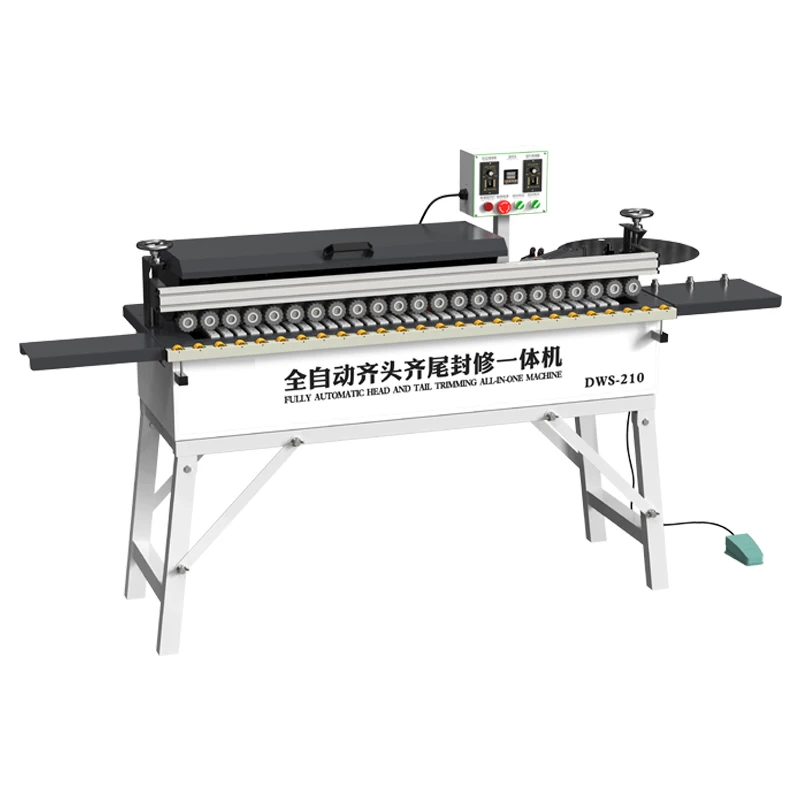
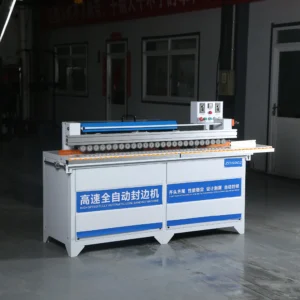
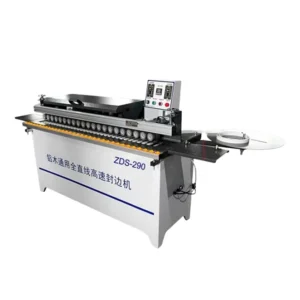
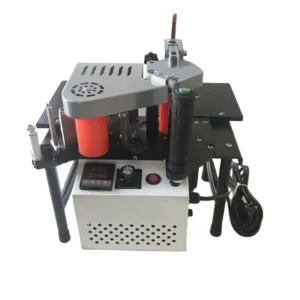
Voltage-Locked Manufacturing — every DW210 edge banding machine leaves the floor only after its electrical schematic is cross-checked against the destination grid, preventing on-site commissioning failures.
Technical Specifications
| Parameter |
Value |
| Model |
DW210 |
| Product Type |
High-speed Automatic Edge Banding Machine |
| Power Supply Voltage |
220V (configurable from 110V to 440V; frequency 50Hz/60Hz to be confirmed) |
| Rated Power |
4000W |
| Glue Pot Capacity |
1000ML |
| Heating Time |
5-10 min |
| Overall Dimensions (Standard) |
150 × 53 × 67 cm |
| Overall Dimensions (Extension) |
210 × 84 × 117 cm |
| Net Weight |
110 KG |
| Trimming Function |
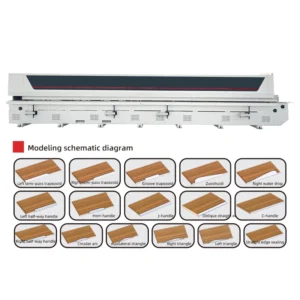
Profiling trimming for arc edges |
| Control Panel Language |
Chinese and English (customizable to Spanish or other languages) |
| Plug Options |
EU / USA / AU / UK |
| Assembly State |
Fully assembled |
| Feed Speed |
(basis to be confirmed) |
| Panel Thickness Range |
(basis to be confirmed) |
| Tolerance |
(basis to be confirmed) |
Application Suitability
| Application |
Material or Output |
| Custom cabinet door edge finishing |
MDF and particleboard with PVC edge banding |
| Small-batch furniture panel processing |
Plywood panels with melamine or veneer strips |
| Joinery workshop production |
Solid wood panels requiring profiling trim on curved edges |
| Regional distributor demonstration units |
Mixed substrate sample boards for showroom validation |
Why the Voltage Question Must Come Before the Quotation
A machine wired for the wrong grid is dead iron the moment it arrives.
I have stood in workshops where a brand-new edge bander sat under tarps for weeks because the local supply was 415V three-phase and the unit was built for 380V. The dealer had to fly in an auto-transformer, absorb the freight, and still lost the customer’s trust. When sourcing an Edge Banding Machine factory OEM manufacturer, the first document exchanged should be a signed voltage confirmation sheet, not a price list. [NEED_CITE: voltage and frequency standards by export market]

Component Sourcing and Assembly Depth
The DW210 is assembled from the frame up within a single facility, meaning the motor, glue pot, trimming head, and control board all pass through one quality chain. For an Edge Banding Machine factory OEM manufacturer evaluating partnership depth, this matters because it eliminates the blame-shifting that happens when a supplier merely bolts together third-party sub-assemblies. The profiling trimming mechanism is fitted and calibrated on the same floor where the electrical cabinet is wired.
Four-Stage Quality Control Before the Crate Closes
Incoming steel is checked for flatness before the frame is welded. During assembly, each station — glue application, trimming, buffing — is verified independently. The finished DW210 then runs a continuous cycle on actual panel stock, and only after that pre-shipment test is signed off does the wooden crate close. Distributors auditing an Edge Banding Machine factory OEM manufacturer should request the test record with photos of the trimmed edge and measured glue-line thickness. [NEED_CITE: CE machinery directive requirements for industrial equipment]
Reading the Specs That Actually Matter
The 4000W rated power drives both the glue pot heater and the feed motor simultaneously, so the unit can maintain temperature during continuous runs without tripping a standard single-phase breaker. The 1000ML glue pot capacity allows roughly a full shift of intermittent work before a refill is needed, reducing mid-shift downtime. Profiling trimming directly addresses arc edges, which means a workshop producing shaped cabinet doors does not need a secondary manual routing step. Control panel language is set at the factory — ordering a Spanish interface for a Latin American distributor avoids the operator guessing at icon meanings on day one.
The Hidden Cost of Skipping Pre-Shipment Verification
When a machine arrives without a factory test record, the first panel you run becomes the test piece. If the glue temperature is off or the profiling head is misaligned, you discover it on customer stock, not scrap. Importers who skip the voltage confirmation step often find that local electricians void the warranty by rewiring the cabinet on-site. These are not rare events; they are the most frequent support tickets logged in the first thirty days after delivery. [NEED_CITE: common commissioning failures in exported woodworking machinery]
Why Procurement Starts at the Factory Floor
The DW210 carries CE marking, supported by a declaration of conformity that names the exact model. Voltage is configurable across the 110V–440V range, confirmed by a signed electrical schematic before production begins. OEM branding extends to logo silk-screening on the machine body, custom carton markings, and translated operation manuals. The factory welcomes on-site visits or third-party inspections at any production stage. Configuration recommendations are engineer-led, with a formal quotation typically returned within twenty-four hours of a complete inquiry.
Documentation & Verification
- CE declaration of conformity naming the DW210 model
- ISO 9001 certificate covering woodworking machinery manufacturing
- Signed voltage and frequency confirmation sheet for your destination grid
- Factory test record with edge-trim photos on your specified panel thickness
- Electrical schematic matching the as-built control cabinet
- Operation and maintenance manual in your chosen language
Installation, Commissioning & Support
- Requires a dedicated 220V single-phase circuit rated for at least 20A to handle the 4000W load
- Standard footprint of 150 × 53 cm fits through a standard workshop door without disassembly
- Machine ships fully assembled; only the extension table and dust hood need fitting on arrival
- First-run parameter setting covers glue temperature, feed rate, and profiling trim depth
- Spare profiling trim cutters and glue pot seals included in the initial parts kit
- Daily maintenance limited to glue pot cleaning and trim head inspection
What We Need to Quote Accurately
To configure a DW210 for your market, share the local voltage and frequency, the primary panel materials and thickness range you intend to run, and the control panel language your operators require. If you are evaluating OEM branding, specify logo placement, carton markings, and any documentation translations. Sample panel stock can be sent to the factory for a pre-order processing test.
Frequently Asked Questions
Q: What can be customized under an OEM agreement for the DW210?
A: Logo silk-screening on the machine body, private-label packaging with your carton artwork, control panel language selection, plug type matching your market, and voltage configuration from 110V to 440V are all standard OEM options. Operation manuals and spare parts lists are translated to your required language before shipment.
Q: How does the four-stage QC process work on each unit?
A: Incoming materials are inspected first, followed by in-process checks at each assembly station. The completed DW210 then runs a continuous edge banding test on actual panel stock. Finally, a pre-shipment verification confirms electrical safety, trimming accuracy, and documentation completeness before the crate is sealed.
Q: Which certification documents ship with the machine?
A: Each DW210 is accompanied by a CE declaration of conformity, an ISO 9001 certificate copy covering the manufacturing scope, a factory test record, an electrical schematic matching the as-built cabinet, and a signed voltage confirmation sheet for the destination market.
Q: How are spare parts and technical training handled for distributors?
A: An initial spare parts kit ships inside the crate. Distributors can arrange for their service technicians to attend commissioning training at the factory or request a guided installation via video call for the first unit placed in their territory.
Q: Can I arrange a factory visit or third-party inspection?
A: Factory visits are welcomed at any production stage. Third-party inspection agencies such as SGS or Bureau Veritas can be coordinated for pre-shipment audits. Appointment scheduling requires notice to align with your unit’s position on the production schedule.