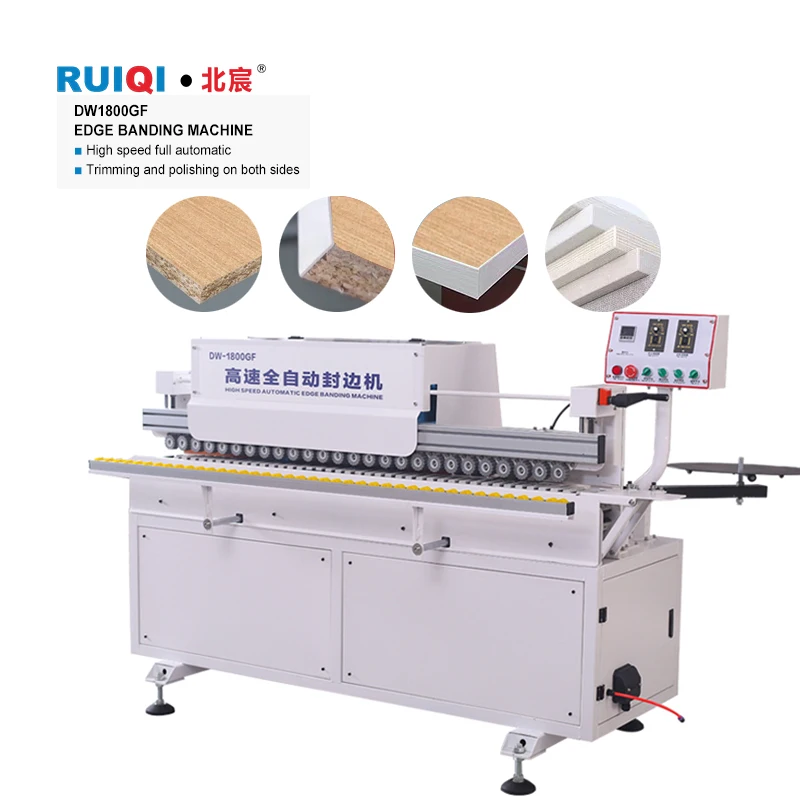
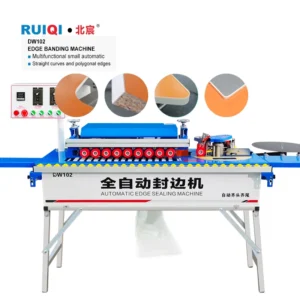
Custom-Built to Your Facility — DW1800 edge banders leave our Ningjin workshop configured for your exact voltage, frequency, and control panel language, with every electrical schematic validated before crating.
Technical Specifications
| Parameter |
Value |
| Model |
DW1800 |
| Product Type |
Automatic Edge Banding Machine |
| Total Power |
4.9 kW |
| Voltage & Frequency |
380V / 220V / 415V (50Hz or 60Hz confirmed before production) |
| Feed Speed |
0–14 m/min |
| Edge Banding Height |
0–50 mm |
| Edge Banding Thickness |
0.3–3 mm |
| Minimum Sheet Length |
20 cm |
| Minimum Sheet Width |
10 cm |
| Glue Pot Capacity |
4000 ml |
| Trimming Power / Speed |
800 W × 2, 24,000 r/min |
| Polishing Power |
380 W × 2 |
| Vacuum Power |
550 W |
| Air Source Pressure |
0.4–0.6 MPa |
| Overall Dimensions (L×W×H) |
220 × 65 × 125 cm |
| Net Weight |
320 kg |
| Key Features |
Double-sided gluing, top & bottom trimming, top & bottom polishing, front & rear alignment, flexible edge scraping, dust extraction port, profile tracking, multi-language control panel |
| Plug Options |
EU, USA, AU, UK |
| Assembly State |
Fully assembled at factory |
Application Suitability
| Application |
Material or Output |
| Cabinet door and carcass production |
MDF and particleboard with PVC or melamine edge banding |
| Custom furniture panel finishing |
Plywood and ABB boards with veneer or ABS banding |
| Workshop-scale joinery |
Solid wood panels and organic glass plates |
| OEM-branded machinery lines |
Fully private-labeled units for regional distributors |
Why the Voltage Question Comes Before the Quotation
An Automatic Edge Banding Machine OEM manufacturer that skips electrical verification is building you a problem, not a production asset. Confirming voltage and frequency before the first weld saves weeks of on-site transformer retrofits.
I learned this the hard way when a unit shipped to a Middle East cabinet shop sat idle because the local grid ran 60 Hz and the motor was wound for 50 Hz. The buyer waited three weeks for a step-down transformer while installers and raw material stood around [NEED_CITE: voltage and frequency standards by export market]. Since then, every DW1800 order goes through a two-pass electrical check — first at quotation, again before the control cabinet is wired — so the machine that arrives on your floor powers up the same day it is uncrated.

How OEM Branding Works on This Platform
Distributors and private-label partners can specify logo placement, color scheme, and control panel language down to the boot screen text. The DW1800 frame and guard panels accept screen printing or adhesive badge application, and the HMI firmware loads your chosen language pack — Spanish, Arabic, or any other agreed script — before the unit enters the pre-shipment test cycle.
Manufacturing Depth Behind Every Custom Request
Each DW1800 begins as a bare cast-iron bed that passes through precision grinding and multi-stage inspection before sub-assemblies are mounted. The mobile table guide uses a roll-ball differential structure machined in-house, and the extruded aluminum workstations receive oxidation treatment for wear resistance [NEED_CITE: surface treatment standards for industrial aluminum profiles]. Because every major component is sourced or fabricated within our own supply network, an OEM request for a non-standard feed rail length or a relocated dust extraction port does not delay the production schedule — it simply enters the next build slot.
What the Specs Mean for Daily Output
The 0–14 m/min feed speed range lets an operator dial down for thick 3 mm PVC banding on particleboard, where slower travel prevents glue starvation, then ramp up for thin 0.3 mm veneer on MDF cabinet sides. Double-sided gluing applies adhesive to both the panel edge and the banding back simultaneously, which matters when bonding porous substrates that would otherwise absorb all the glue from a single-side application. The 24,000 r/min trimming motors at 800 W each leave a clean radius on the four corners during the profile tracking pass, reducing the hand-scraping time that bottlenecks downstream packing stations. Meanwhile, the 4000 ml glue pot holds enough hot-melt adhesive to run a full shift on standard panel thicknesses without a mid-batch refill, and the 550 W vacuum port ties into a central dust collection system so the trimming and polishing swarf never settles on the glue roller.
When the Wrong Configuration Costs More Than the Machine
A unit ordered without matching the air source pressure to your compressor line will either starve the pneumatic cylinders — causing the trimming heads to chatter — or blow seals inside the alignment station. Similarly, specifying a single-sided glue system for a factory that runs both porous particleboard and sealed melamine-faced MDF forces operators to re-glue rejected panels by hand [NEED_CITE: edge banding adhesion failure modes on coated substrates]. The hidden cost is never the machine itself; it is the rework hours, the scrapped banding rolls, and the cabinet assemblies that fail quality checks because edge tolerances drifted out of spec.
Why Procurement Teams Route Orders Through This Facility
Our in-house manufacturing lets us change a conveyor width or relocate a control pendant without outsourcing a single bracket. The four-stage QC protocol — incoming material, in-process, finished product, and pre-shipment verification — catches tolerance deviations before they reach the packing crate. Voltage and language customization are treated as standard line items, not premium add-ons, so an OEM partner ordering ten differently branded units receives the same documentation and lead-time commitment as a buyer taking a single machine. Every DW1800 ships with a factory test record run on the buyer’s own panel thickness range, not a generic demo board.
Documentation & Verification
- CE declaration of conformity matching the DW1800’s electrical and mechanical configuration
- ISO 9001 certificate covering the production batch of your order
- Electrical schematic confirming your specified voltage, frequency, and plug type
- Factory test record showing edge trimming tolerance on your submitted panel samples
- Operation and maintenance manual translated into your agreed control panel language
- Packing photographs documenting crating condition before container loading
Installation, Commissioning & Support
- Allocate a level concrete pad for the 220 × 65 cm footprint with clearance on the infeed side
- Provide a dedicated 380V or 220V circuit matching the 4.9 kW total draw plus start-up surge
- Unit arrives fully assembled; only dust extraction hose and air line require connection
- First-run calibration sets glue roller temperature, feed speed, and trimming head offsets
- Spare parts list identifies the trimming cutters, polishing wheels, and glue pot seals by part number
- Scheduled maintenance covers daily vacuum port cleaning and weekly roll-ball guide lubrication
What We Need to Prepare Your Quotation
Send us the panel materials you run most often, the edge banding thickness range, and the daily linear meter target so we can confirm whether the DW1800’s feed speed envelope covers your throughput. Include your facility’s voltage, phase, and frequency, plus the language your operators will need on the control screen. If you plan to integrate the unit into an existing line, share the upstream saw output rate and the downstream boring station’s cycle time so we can match feed heights and avoid bottlenecks.
Frequently Asked Questions
Q: What OEM and private label options are available for the DW1800?
A: You can specify logo placement on the frame and guard panels, choose a custom color for the sheet metal, and select the control panel language including boot-screen text. Plug type is set to EU, USA, AU, or UK standard. All branding changes are documented in the build sheet before production starts.
Q: How is voltage and frequency confirmed before my machine is built?
A: We verify your local supply at the quotation stage and again before wiring the control cabinet. A signed electrical confirmation sheet, listing voltage, phase, frequency, and plug type, is returned with your order acknowledgment. The matching schematic ships inside the documentation pack.
Q: Can you produce the DW1800 to my own drawings or dimensional changes?
A: Non-standard feed rail lengths, relocated dust ports, and modified workpiece support widths are feasible because all major components are fabricated in-house. Submit your drawings during the inquiry stage and our engineering team will confirm feasibility and any effect on lead time within one working day.
Q: What documents arrive with the shipment for customs clearance and installation?
A: The packing crate contains the CE declaration, ISO 9001 certificate, electrical schematic, factory test record, operation manual in your chosen language, and a numbered spare parts list. Commercial invoice and packing list are emailed separately to your freight forwarder before vessel departure.
Q: How do I arrange a factory visit or request a sample processing test?
A: Notify us of your preferred dates and we will prepare a production schedule showing your DW1800 on the assembly floor. For a sample test, ship representative panels and banding material; we will run them on a calibration unit and send back the finished edges along with a measurement report within the same week.