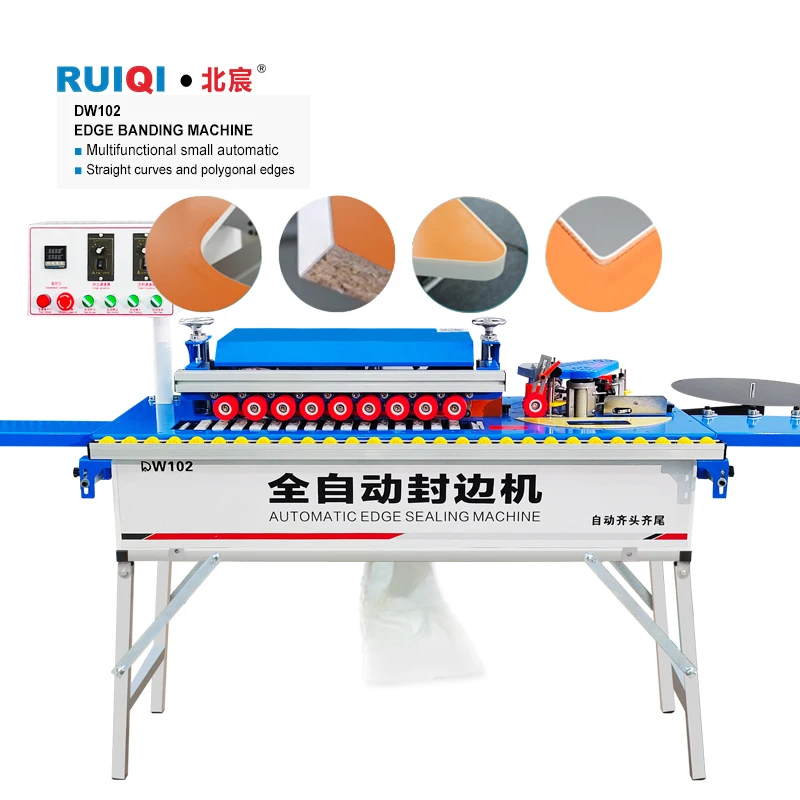
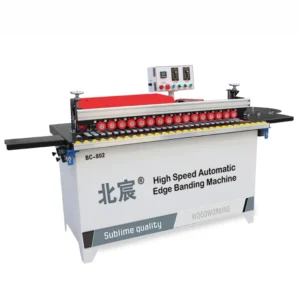
Precision Ground Assembly — The DW102 Automatic Edge Banding Machine is built on a verified manufacturing protocol with OEM capability, ensuring every unit leaving our Shandong facility meets the exact voltage and specification requirements of its destination market.
Technical Specifications
| Parameter |
Value |
| Model |
DW102 |
| Product Type |
Automatic Edge Banding Machine |
| Total Power |
3800W |
| Voltage |
220V/380V (customizable 110V–440V) |
| Control System |
PLC (brand/model to be confirmed) |
| Overall Dimensions (L×W×H) |
128×47×69 cm |
| Net Weight |
75 kg |
| Minimum Sheet Length |
25 cm |
| Minimum Sheet Width |
5 cm |
| Edge Banding Height |
0–50 mm |
| Edge Banding Thickness |
0.3–3 mm |
| Air Source Pressure |
0.5–0.8 MPa |
| Glue Pot Capacity |
1000 ml |
| Trimming Power |
650W×2 |
| Polishing Power |
180W×2 |
| Vacuum Power |
1200W |
| Key Features |
Curved and straight edge banding, automatic head and tail trimming, integrated vacuum |
| Feed Speed |
(basis to be confirmed) |
| Panel Thickness Range |
(basis to be confirmed) |
| Tolerance |
(basis to be confirmed) |
| Language Options |
Chinese, English; customizable |
Application Suitability
| Application |
Material or Output |
| Cabinet door production |
MDF and particleboard with PVC or melamine edge banding |
| Custom furniture components |
Plywood panels with veneer or ABS edge strips |
| Polymer door manufacturing |
Polymer substrates requiring curved and straight edge finishing |
| Small-batch joinery |
Blockboard and solid wood panels for bespoke joinery workshops |
Why the Voltage Question Should Come Before the Price on Every Edge Banding Machine OEM Factory Order
A machine built for 380V/50Hz will not start on a 220V/60Hz supply, regardless of how attractive the quotation looked.
I have seen containers arrive at ports where the buyer discovered too late that the frequency mismatch caused the PLC to fault repeatedly and the trimming motors to overheat within the first hour of operation. The DW102 is configurable across voltage ranges, but that configuration only works if the destination market’s electrical standard is confirmed before production begins. An Edge banding machine OEM factory that does not ask for your local voltage and frequency upfront is not building for your market — they are shipping inventory. [NEED_CITE: voltage and frequency standards by export market]

In-House Manufacturing Depth for Consistent OEM Output
Every DW102 is assembled on our own production floor, not sourced from a third-party integrator. This matters when a distributor needs twenty units with identical build characteristics and the same private-label markings across the entire run. An Edge banding machine OEM factory that controls its own precision grinding and component sourcing can guarantee that the trimming spindle alignment on unit number one matches unit number twenty. Our patented cutting mechanisms are installed and verified at our facility before any machine leaves for its destination.
Private-Label and Brand Customization at the Component Level
OEM partnerships go beyond a logo decal on the side panel. For the DW102, customization extends to control panel language, electrical schematics labeled in the distributor’s preferred terminology, and packaging that reflects the buyer’s brand identity. Regional distributors who build their service reputation around a specific brand need documentation and machine labeling that matches — from the PLC screen prompts to the spare parts catalog. We support this level of integration as a standard part of the OEM workflow rather than a special request. [NEED_CITE: CE machinery directive requirements for industrial equipment]
How Core Parameters Define the DW102’s Production Role
The 0.3–3 mm edge banding thickness range positions this machine for both thin PVC strips on cabinet components and thicker solid wood edging on furniture panels. The dual 650W trimming motors provide the torque needed for clean flush trimming across that full thickness spectrum without stalling on denser substrates. The 0–50 mm edge banding height covers standard panel thicknesses used in cabinet and furniture production, though buyers should confirm their specific panel range during the configuration stage. The 1000 ml glue pot capacity is suited to production runs where the machine operates continuously through a batch rather than intermittent single-piece feeding. Air source pressure at 0.5–0.8 MPa must be maintained at the point of connection — pressure drop across long hose runs in large workshops can cause inconsistent pneumatic actuator response.
When Specification Gaps Become Assembly-Line Failures
A machine that arrives without a confirmed feed speed or verified tolerance specification leaves the buyer guessing during commissioning. If the feed rate is set too aggressive for a thin PVC edge on particleboard, the banding lifts before the glue cures. If the trimming tolerance is not verified against the buyer’s actual panel material, cabinet doors arrive at the assembly station with visible gaps that force the entire batch back to the edge bander for rework. These are not warranty claims — they are production losses that compound across every shift. [NEED_CITE: typical edge banding tolerance requirements in cabinet manufacturing]
Why Distributors Source the DW102 from This Facility
Our four-stage QC process covers incoming material inspection, in-process assembly checks, finished product verification, and pre-shipment testing — each DW102 runs on the buyer’s specified panel material before crating. The patented cutting mechanisms are manufactured in-house, meaning spare parts availability is not dependent on a third-party supplier’s production schedule. Voltage customization from 110V to 440V is confirmed with a formal document at the order stage, not assumed. Single-unit sample orders through to large production runs follow the same assembly and testing protocol. Every machine ships with an electrical schematic and voltage confirmation record that the distributor’s service team can reference during field installation.
Documentation & Verification
- Factory test record captured on your specified panel thickness and edge banding material
- Electrical schematic with confirmed voltage and frequency for your destination market
- Operation and maintenance manual in the agreed language with illustrated spare parts list
- CE declaration of conformity documentation provided at inquiry confirmation stage
- ISO 9001 manufacturing system records available for distributor audit review
Installation, Commissioning & Support
- The 128×47×69 cm footprint requires a level concrete floor with minimum 0.5–0.8 MPa air supply at the connection point
- Dedicated circuit required matching the confirmed voltage configuration and 3800W total power draw
- Machine ships with PLC pre-configured in the agreed control language before dispatch
- First-run parameter settings recorded during factory testing and included in the random documentation archive
- Trimming and polishing stations require periodic alignment checks based on production volume
- Glue pot cleaning schedule provided based on the 1000 ml capacity and adhesive type used
What to Include in Your OEM Inquiry
Provide the panel materials and edge banding types your market demands most frequently, along with the local voltage and frequency standard for each destination country. Specify the control panel language required by your end-user base and whether private-label packaging is needed for your distribution territory. Let us know the order volume range you are evaluating so we can confirm production scheduling and pre-shipment testing capacity.
Frequently Asked Questions
Q: What OEM and private-label customization is available for the DW102?
A: Customization includes logo placement on the machine body and packaging, private-label documentation, control panel language configuration, and electrical labeling in your preferred terminology. Each OEM order is assigned a dedicated configuration record so that repeat orders maintain identical build specifications and branding across every production run.
Q: How is voltage and frequency confirmed for the destination market before production?
A: At the order stage, we issue a formal voltage confirmation document that specifies the exact voltage and frequency for the destination market. This document is signed off before the machine enters assembly, and the electrical schematic shipped with the machine reflects the confirmed configuration for your local service team’s reference.
Q: What factory testing and QC steps are completed before shipment?
A: Each DW102 undergoes our four-stage QC covering incoming components, assembly verification, finished product testing, and pre-shipment validation. The machine runs on panel material matching your specifications, and a factory test record with parameter settings is generated and included in the shipment documentation.
Q: Can the control panel language be customized for the end-user’s market?
A: Chinese and English are standard on the PLC interface. Additional languages including Spanish, French, and others are configured at the order stage based on the end-user market. The language setting is locked in during factory testing and verified before the machine is cleared for dispatch.
Q: What is the lead time and production scheduling process for OEM orders?
A: Lead time depends on order volume and customization scope. Single-unit samples through to multi-unit production runs follow the same assembly and QC protocol. Production scheduling is confirmed at the quotation stage, and pre-shipment testing is factored into the timeline before a dispatch date is committed.