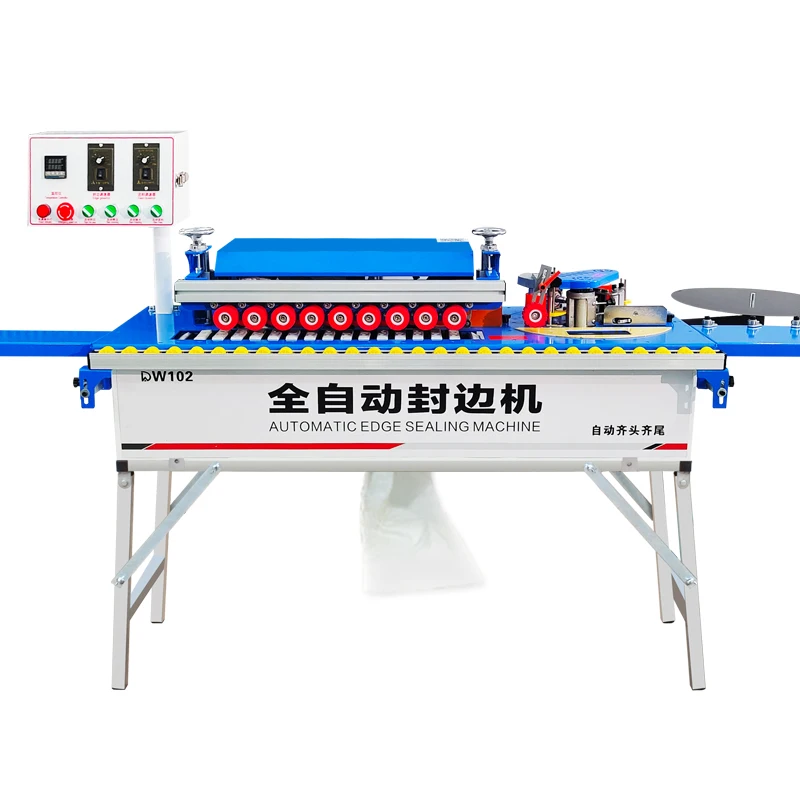
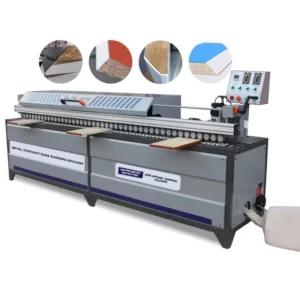
Voltage-First Build Protocol — every DW102 Automatic Edge Banding Machine for Furniture – Custom Build leaves our facility with confirmed electrical schematics, region-specific plugs, and operator language locked in before assembly starts.
Technical Specifications
| Parameter |
Value |
| Model |
DW102 |
| Product Type |
Automatic Edge Banding Machine |
| Total Power |
3800W |
| Voltage |
220V / 380V / customization |
| Plug Options |
EU, USA, AU, UK |
| Standard Functions |
Curved and straight edge banding, edge trimming, polishing, automatic head and tail cutting, vacuum |
| Minimum Sheet Length |
25 CM |
| Minimum Sheet Width |
5 CM |
| Edge Banding Height |
0–50 MM |
| Edge Banding Thickness |
0.3–3 MM |
| Edge Power |
20W |
| Transmission Power |
60W |
| Trimming Power |
650W × 2 |
| Polishing Power |
180W × 2 |
| Vacuum Power |
1200W |
| Air Source Pressure |
0.5–0.8 MPa |
| Glue Pot Capacity |
1000 ml |
| Product Size |
128 × 47 × 69 CM |
| Product Weight |
75 KG |
| Control System |
(basis to be confirmed) |
| Feed Speed |
(basis to be confirmed) |
| Panel Thickness Range |
(basis to be confirmed) |
| Tolerance |
(basis to be confirmed) |
| Language Options |
Chinese, English standard; Spanish or other languages customizable |
Application Suitability
| Application |
Material or Output |
| Cabinet door edge finishing |
MDF and particleboard with PVC or veneer banding |
| Custom furniture panel processing |
Plywood and blockboard with 0.3–3 MM edge thickness |
| Polymer door profiling |
Polymer substrates requiring curved and straight trimming |
| Small-batch workshop production |
Solid wood panels up to 50 MM edge height |
| Medium-volume furniture manufacturing |
Mixed substrate runs across MDF, plywood, and particleboard |
Why the Voltage Question Must Come Before the Quotation
A machine wired for the wrong frequency is a crate of dead steel sitting on your dock.
I spent three weeks in Lagos watching a furniture line sit idle because an edge bander arrived with a 380V/50Hz motor while the local supply ran 60Hz. The distributor had skipped the voltage confirmation step to save a few days on the order cycle. That experience reshaped how I approach every OEM edge bander build — electrical verification is now the first gate, not an afterthought. For the DW102, we document the destination country’s voltage and frequency before the motor is sourced, and the schematic is signed off before assembly begins. [NEED_CITE: voltage and frequency standards by export market]

Private Label Manufacturing Scope
Distributors evaluating an edge banding machine factory need clarity on what can actually be customized beyond a logo sticker. On the DW102, the OEM scope covers control panel language, plug type, voltage winding, and color — each specified at the order stage and verified during the pre-shipment audit. This means a regional distributor in South America can stock units with Spanish-language panels and NEMA plugs without retrofitting after arrival.
Component Sourcing and Assembly Transparency
The trimming stations run 650W × 2 motors, and the polishing heads draw 180W × 2 — these are not commodity off-the-shelf parts. We trace each motor batch to its winding specification and match it to the confirmed voltage. The 1200W vacuum system is tested under load against actual MDF dust before the unit is crated. For OEM partners, this traceability extends to the packaging: private label cartons, branded operation manuals, and customs documentation all carry the distributor’s identity. [NEED_CITE: CE machinery directive requirements for industrial equipment]
Reading the DW102 Spec Sheet Against Real Workshop Conditions
The 0.3–3 MM edge banding thickness range covers PVC, melamine, and thin veneer — materials that behave very differently under the trimming heads. Veneer at 0.3 MM requires lighter trimming pressure to avoid tear-out, while 3 MM PVC demands rigid feed stability. The 1000 ml glue pot capacity suits short-run production; workshops running continuous shifts should evaluate whether refill frequency aligns with their throughput. At 75 KG and a 128 × 47 × 69 CM footprint, the DW102 fits workshops where floor space restricts larger automatic lines, but the 0.5–0.8 MPa air pressure requirement means a dedicated compressor circuit is non-negotiable. The automatic head and tail cutting function eliminates manual trimming of band overhang, which directly affects edge consistency on panels as short as 25 CM.
The Hidden Cost of Skipping Pre-Shipment Electrical Verification
When a 220V machine lands in a 240V region without a step-down transformer, the motor runs hot within the first hour. The insulation degrades, the trimming motors draw excess current, and the glue pot thermostat cycles erratically — none of which shows up as an obvious fault until the panels start coming off the line with uneven edge adhesion. By that point, the machine has already run hundreds of panels through compromised conditions. [NEED_CITE: electrical fault patterns in mismatched voltage equipment]
Why OEM Partners Source This Platform
The DW102 is manufactured in-house with patented cutting mechanisms, not assembled from third-party sub-contracts — OEM partners control the brand while we control the build quality. Voltage, plug, and language customization is treated as standard configuration, not an expensive add-on. Our four-stage QC covers incoming material inspection, in-process assembly checks, finished product testing, and pre-shipment verification with your specific panel samples. Engineer-led configuration recommendations arrive as formal quotations within 24 hours, so distributors can quote their own customers without delay. Factory visits are welcomed at any production stage, and all units ship with the documentation package your customs broker requires.
Documentation & Verification
- Electrical schematic confirming voltage and frequency matched to your destination country
- Factory test record with sample panels in your specified substrate and edge material
- CE declaration of conformity and ISO 9001 certificate for customs clearance
- Operation and maintenance manual printed in your agreed operator language
- OEM logo application and private label packaging inspection photographs
- Spare parts list with part numbers matching your regional inventory codes
Installation, Commissioning & Support
- Requires a dedicated circuit matching confirmed 220V or 380V supply with proper grounding
- 128 × 47 × 69 CM footprint needs a level concrete pad with clearance for panel infeed
- 0.5–0.8 MPa air source must be plumbed with a moisture trap before first startup
- Glue pot requires initial temperature calibration against your specific edge banding material
- Trimming and polishing stations aligned during commissioning to your panel thickness range
- Spare trimming blades and polishing wheels included for initial operational period
What We Need From You to Start a Build
To configure a DW102 for your market, we need your local voltage and frequency, the plug standard your customers expect, and the operator language for the control panel. Share the primary substrates your end-users process — MDF, particleboard, plywood — and the edge banding materials they run most often. If you are evaluating us as an OEM partner, tell us your brand color requirements and packaging format so we can prepare samples before you commit to a container order.
Frequently Asked Questions
Q: What customization is included in the OEM scope for the DW102?
A: The OEM scope covers your logo on the machine body and packaging, control panel language beyond the standard Chinese and English, voltage winding matched to your market, and region-specific plug types including EU, USA, AU, and UK. Color customization is available on request. Each element is confirmed in the specification document before production begins.
Q: How do you prevent voltage mismatch problems before shipment?
A: We confirm your destination country voltage and frequency at the inquiry stage and document it on the electrical schematic. The motor winding, transformer, and control wiring are all built to that confirmed specification. A pre-shipment electrical test verifies voltage under load, and the signed schematic ships with the machine documentation.
Q: Can I visit the factory to witness a sample production run?
A: Factory visits are welcomed at any stage. We can run your specific panel material and edge banding stock through the DW102 so you can inspect edge quality, trimming accuracy, and polishing finish in person. We recommend scheduling the visit during the pre-shipment verification phase of your order.
Q: What documentation ships with the machine for customs and compliance?
A: Each unit ships with a CE declaration of conformity, ISO 9001 certificate, machine specification sheet, electrical schematic matching your confirmed voltage, factory test record, operation manual in your agreed language, spare parts list, packing photographs, and customs documentation support for your destination port.
Q: How do you support spare parts for regional distributors?
A: We provide a complete spare parts list with part numbers that match your inventory system. Distributors can stock trimming blades, polishing wheels, glue pot components, and wear items based on their service territory volume. Parts orders ship independently of machine orders to maintain continuous regional availability.