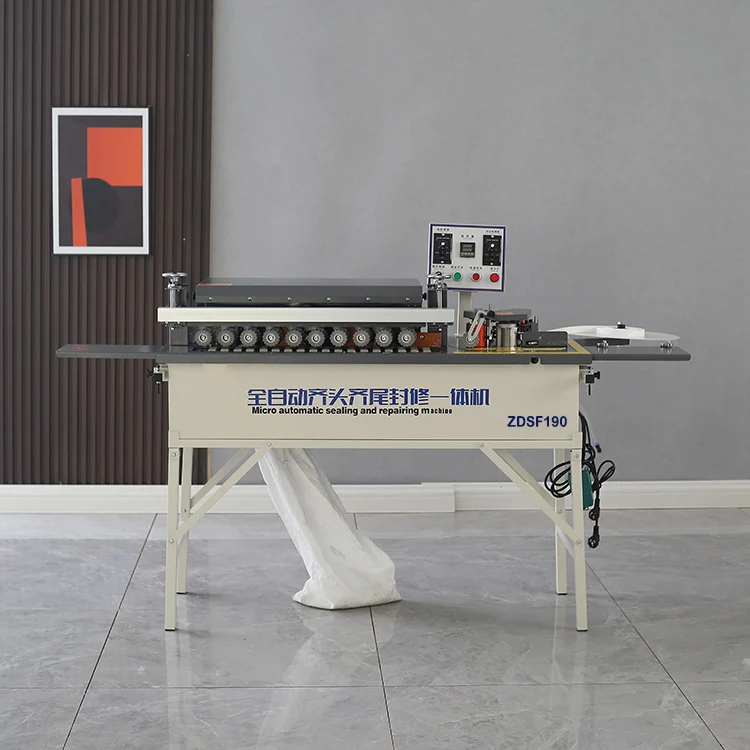
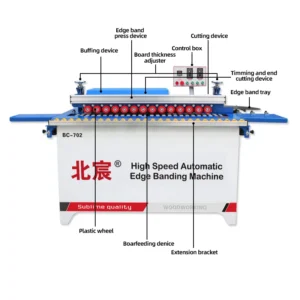
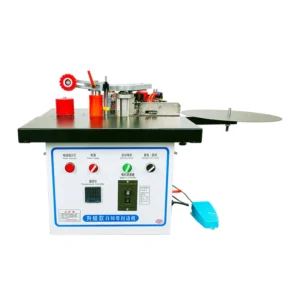
Manufacturing Traceability — every ZDSF190 unit ships with a documented QC trail from incoming material inspection through pre-shipment verification, giving OEM partners full confidence in what they are reselling.
Technical Specifications
| Parameter |
Value |
| Model |
ZDSF190 |
| Product Type |
Automatic Curved and Straight Edge Banding Machine |
| Function |
Automatic plate feeding, belt breaking, double-sided gluing, upper and lower trimming and polishing, curved and straight edge banding, large diameter surrounding vacuum |
| Edge Type |
Both curved and straight lines |
| Voltage & Frequency |
220V 50Hz (configurable from 110V to 440V) |
| Rated Power |
4 kW |
| Heating Power |
800 W |
| Trimming Power |
800 W × 2 |
| Polishing Power |
180 W × 2 |
| Suction Power |
1200 W |
| Feed Speed |
0–14 m/min |
| Panel Thickness Range |
10–50 mm |
| Strip Thickness Range |
0.5–2.5 mm |
| Glue Pot Capacity |
1000 ml |
| Rated Air Pressure |
0.4–0.6 MPa |
| Trimming Mechanism |
Square slide rail profiling with 4-blade alloy arc knife |
| Feed System |
Double-row rubber pressure wheels, steel rod slide rails for crawler transmission |
| Pressure Beam |
Adjustable aluminum alloy |
| Dust Collection |
Dual large-diameter vacuum collectors |
| Control Panel |
Multi-function button operation |
| Overall Dimensions (L×W×H) |
1900 × 560 × 1300 mm |
| Net Weight |
120 kg |
Application Suitability
| Application |
Material or Output |
| Custom furniture panel edge banding |
MDF, plywood, particleboard with PVC or veneer strips |
| Cabinet door profiling on curved contours |
Solid wood panels with 0.5–2.5 mm edge banding |
| Joinery workshop transition from manual to machine |
Small-batch board processing on both straight and curved edges |
| OEM-branded production runs for regional distributors |
Consistent output across varied panel substrates |
Why the Voltage Question Should Come Before the Price on an Automatic Curved and Straight Edge Banding Machine OEM factory Order
Specifying local voltage and frequency before production starts prevents the most expensive kind of commissioning failure — the one where the machine simply will not run.
I have stood on factory floors in Latin America watching a brand-new edge bander trip its variable frequency drive within minutes of startup. The local grid fluctuated beyond what the standard inverter could handle, and nobody had confirmed the electrical conditions before the machine left the factory. When you source an Automatic Curved and Straight Edge Banding Machine OEM factory unit from a trading company, the electrical configuration is often an afterthought. The result is a machine that either needs a costly external stabilizer or, worse, suffers repeated component damage that voids any meaningful warranty [NEED_CITE: voltage and frequency standards by export market].
Component Sourcing and Assembly Depth
The ZDSF190 is assembled on a line where each major sub-assembly — the trimming carriage, the glue pot housing, the feed crawler — passes through incoming material inspection before it reaches the bench. For an Automatic Curved and Straight Edge Banding Machine OEM factory partner, this matters because it means the private-label machine you receive has the same internal traceability as a factory-branded unit. The square slide rail profiling mechanism with its 4-blade alloy arc knife is not sourced from a generic catalog; it is built around a proprietary cutting geometry that holds tolerance across both curved and straight contours.
Precision Grinding and Tolerance Verification
Every steel rod slide rail and rubber pressure wheel on the ZDSF190 goes through multi-stage inspection before final assembly. The adjustable aluminum alloy pressure beam is ground to match the feed system’s alignment envelope, which is what allows the machine to handle panel thicknesses from 10 mm to 50 mm without manual recalibration between jobs. For distributors evaluating manufacturing depth, this level of component verification is what separates a factory you can build a brand around from one that will leave you fielding warranty calls [NEED_CITE: CE machinery directive requirements for industrial equipment].
How Core Parameters Translate to Workshop Output
The 0–14 m/min feed speed range pairs directly with the 10–50 mm panel thickness capacity. Thicker panels require slower feed rates to let the double-sided gluing system achieve full adhesive transfer, particularly on porous substrates like particleboard. The 1000 ml glue pot capacity supports continuous runs without frequent refills, though the actual interval depends on strip width and glue viscosity at the set heating temperature. The dual 800 W trimming motors drive the 4-blade alloy arc knives through the square slide rail, and this configuration is what allows consistent profiling on both curved and straight edges without swapping tooling between jobs. The dual large-diameter vacuum collectors handle chip extraction at the trimming and polishing stations, keeping the work area clear and maintaining cut visibility for the operator.

The Hidden Cost of Skipping Pre-Shipment Electrical Verification
When an edge bander arrives at a port with the wrong voltage configuration, the options are limited and all of them are expensive. You either source a step-up or step-down transformer locally — adding weight, footprint, and another point of failure — or you ship the unit back for rewinding, which can take weeks. I have seen distributors in South America absorb the transformer cost on the first machine and then quietly switch suppliers by the third order, because their customers were asking why the equipment needed external hardware that competing brands did not [NEED_CITE: industrial equipment electrical compliance for export markets].
Why Distributors Commit to This Factory for OEM Runs
In-house manufacturing with patented cutting mechanisms means the ZDSF190 is not a relabeled unit from a third-party workshop — the factory controls the entire assembly process. Full OEM customization covers logo placement, voltage configuration from 110V to 440V, and multilingual control panels, so the machine arrives ready for the end user’s language and electrical grid. The four-stage QC protocol covers incoming material, in-process assembly, finished product, and pre-shipment verification, with each stage documented. Engineer-led configuration recommendations ensure the quoted machine matches the distributor’s actual market requirements rather than a generic catalog spec. Factory visits are open for distributors who want to audit the assembly line and precision grinding stations firsthand.
Documentation & Verification
- CE declaration of conformity matched to ZDSF190 configuration and export market
- ISO 9001 certificate covering the production line that built your unit
- Electrical schematic with confirmed voltage and frequency for your destination grid
- Factory test record on your specified panel thickness range before dispatch
- Operation and maintenance manual in the language you select at order confirmation
- Spare parts list with part numbers cross-referenced to the ZDSF190 assembly drawings
Installation, Commissioning & Support
- The 1900 × 560 mm footprint fits standard workshop bays; verify door clearance for the 1300 mm height
- Dedicated 220V circuit rated for 4 kW continuous draw with appropriate breaker sizing
- Machine ships fully assembled; connect air supply at 0.4–0.6 MPa and power to begin commissioning
- First-run parameter setting covers feed speed calibration and glue pot temperature for your strip material
- Dual vacuum collectors require ducting to your central dust extraction or standalone collector units
- Trimming blade replacement schedule based on your daily panel volume and substrate type
What We Need to Build Your OEM Configuration
To prepare an engineer-led quotation for the ZDSF190 under your brand, share the target market’s standard voltage and frequency, the control panel language your customers expect, and the panel materials and thicknesses they process most often. If you are evaluating a full production line rather than a standalone unit, include the upstream and downstream equipment already in your customers’ workshops so we can confirm feed height and throughput compatibility.
Frequently Asked Questions
Q: What OEM customization options are available for the ZDSF190?
A: Logo placement, voltage from 110V to 440V, multilingual control panels, and tailored specifications are all configurable. Each customization is confirmed during the engineering proposal stage before production begins, ensuring the machine matches your market requirements exactly.
Q: How does the four-stage QC process work for OEM orders?
A: Every unit passes through incoming material inspection, in-process assembly checks, finished product testing, and pre-shipment verification. Each stage is documented, and the full QC record ships with the machine so you can show your customers the traceability chain.
Q: Can I visit the factory before placing an OEM production run?
A: Factory visits are welcomed at any stage. You can inspect the precision grinding stations, assembly line, and test area where ZDSF190 units are run on actual panel stock before dispatch. Many distributors visit before their first order and return annually.
Q: What is the minimum order quantity for private label runs?
A: Single-unit orders through to large production runs are supported. The MOQ discussion happens during the configuration proposal stage, where we align batch size with your market demand and delivery schedule.
Q: How are spare parts and technical training handled for distributor service teams?
A: A full spare parts list with cross-referenced part numbers ships with every unit. Technical training for your service team covers the ZDSF190 trimming mechanism, electrical system, and maintenance intervals, available either at the factory or on-site depending on order volume.