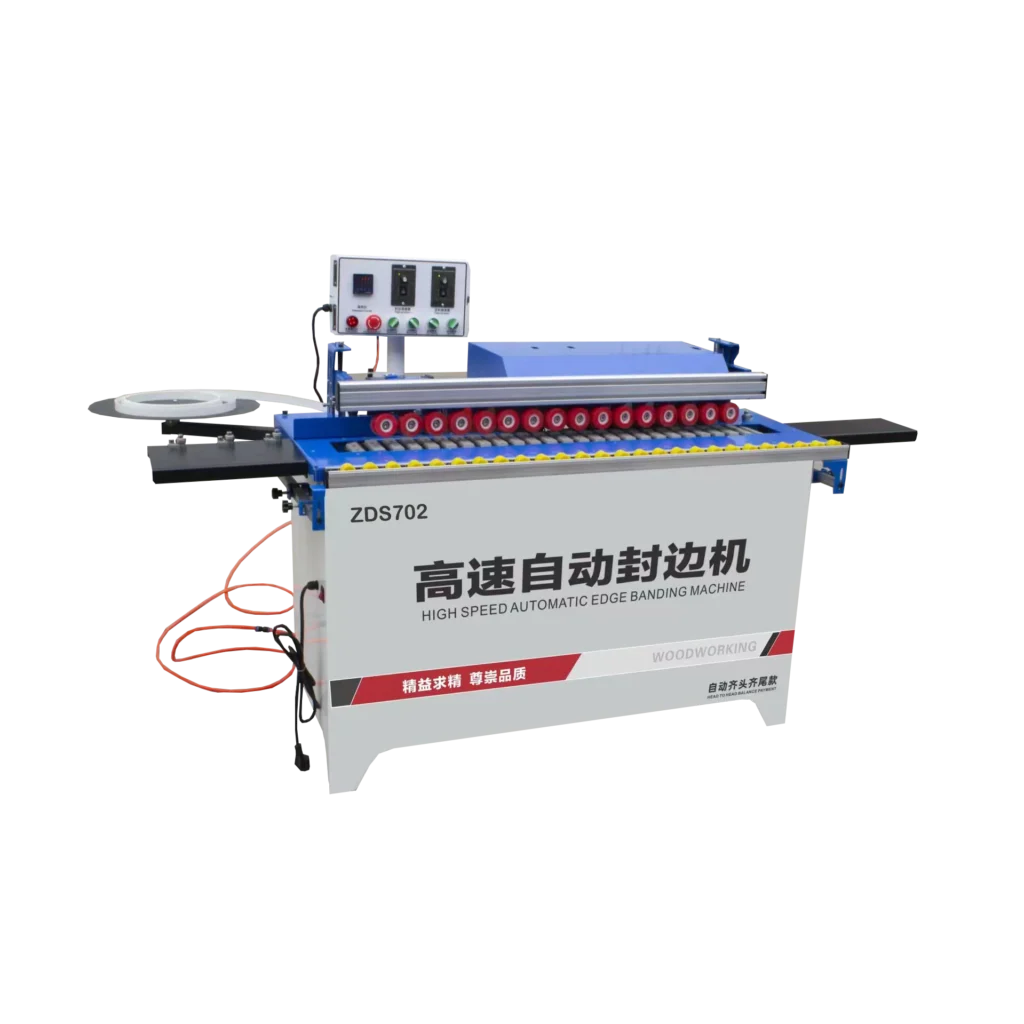
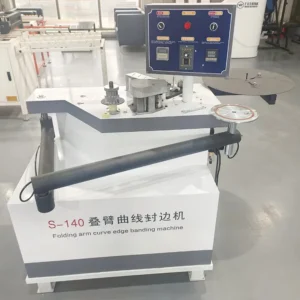
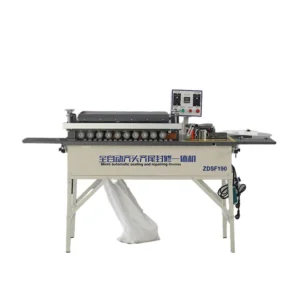
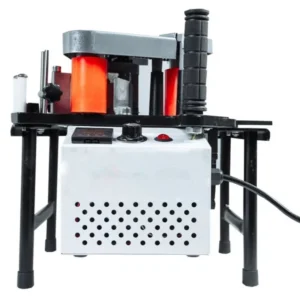
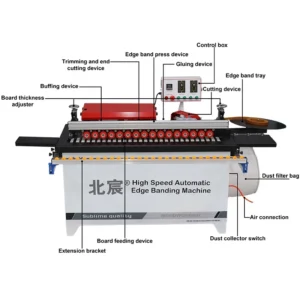
Precision-Built Assembly — every ZDS702 unit undergoes four-stage verification from incoming material inspection through pre-shipment testing, with OEM branding applied under controlled factory conditions.
Technical Specifications
| Parameter |
Value |
| Model |
ZDS702 |
| Product Type |
Semi-Automatic Edge Banding Machine |
| Edge Type |
Straight line |
| Rated Voltage |
220V / 380V / Customization |
| Rated Power |
3.8 kW |
| Rated Air Pressure |
0.4–0.6 MPa |
| Feed Speed |
0–10 m/min |
| Trimming Height (Panel Thickness) |
5–50 mm |
| Edge Banding Thickness |
0.3–3 mm |
| Glue Pot Capacity |
1000 ml |
| Heating Power |
1000 W |
| Overall Dimensions (L×W×H) |
120×55×120 cm |
| Machine Weight |
105 kg |
| Function Stations |
Automatic plate feeding, end cutting, head/tail trimming, upper/lower polishing, integrated dust collector |
| Pressure System |
One-piece pressure beam, double-row pressure wheels, silicone conveyor belt |
| Key Features |
Straight-line operation, compact footprint, built-in dust extraction |
Application Suitability
| Application |
Material or Output |
| Custom cabinet door edge finishing |
MDF and particleboard with PVC edge banding (0.3–3 mm) |
| Small-batch furniture panel edging |
Plywood panels with veneer or melamine strip |
| Joinery workshop semi-automated trimming |
Solid wood panels requiring head/tail cleanup |
| Regional distributor private-label portfolio |
Mixed substrate batches for cabinet makers |
Why the Voltage Question Must Come Before the Quotation
A semi-automatic edge banding machine OEM factory must confirm local electrical standards before production begins, not after the container is loaded.
I learned this the hard way early in my export career. A shipment went out to Southeast Asia with 380V/50Hz wiring because the voltage confirmation step was rushed. The customer’s facility ran on 415V/60Hz. The machine tripped on first power-up, and the entire workshop line sat idle while a transformer was air-freighted across two time zones [NEED_CITE: voltage and frequency standards by export market]. Since that incident, I personally cross-check every voltage slip against the destination grid before any unit leaves our floor. When evaluating a semi-automatic edge banding machine OEM factory, ask for the electrical schematic and voltage confirmation document before signing the order — that single document separates a prepared supplier from a risky one.

Component Sourcing and In-House Precision Control
A credible semi-automatic edge banding machine OEM factory does not merely assemble purchased sub-assemblies. On the ZDS702, the one-piece pressure beam and double-row pressure wheels are machined and matched in-house, meaning concentricity and belt alignment are verified at the component level before final assembly. This matters for distributors because it ensures that repeat orders carry consistent mechanical behavior — the first unit and the fiftieth unit feed panels with the same lateral stability.
OEM Branding Depth Beyond a Sticker
Private-label partnerships require more than swapping a logo plate. For the ZDS702, OEM scope covers control panel language, voltage configuration per destination market, exterior color, manual translation, and packaging artwork. Each customization point is documented in the formal quotation so that a distributor’s brand identity carries through to the end user without last-minute substitutions [NEED_CITE: CE machinery directive requirements for industrial equipment].
How Panel Thickness Range and Feed Speed Interact on the Shop Floor
The ZDS702 handles panel thicknesses from 5 mm to 50 mm, which covers everything from thin MDF shelving to thick solid-wood tabletop blanks. At the lower end of the 0–10 m/min feed speed range, the trimming stations have more dwell time on the workpiece, producing a cleaner cut on harder substrates like high-density particleboard. Pushing toward the upper feed limit works well on softer MDF with thin PVC banding but may leave witness marks on veneer if the trimming tools need re-sharpening. The integrated dust collector pulls debris away at the source, keeping the polishing stations free of buildup and maintaining consistent edge appearance throughout a production run. For workshops processing mixed material batches, setting feed speed per substrate type rather than running one speed all day yields noticeably better edge quality.
The Hidden Cost of Skipping Pre-Shipment Verification
When a distributor orders semi-automated edge banders without requesting factory test records, problems surface only after installation. Panels that pass visual inspection at the factory may arrive with trimming offsets that show up during assembly, forcing the end user to re-calibrate on-site without proper tooling. Voltage mismatches discovered at commissioning can damage motor windings permanently. Language-incompatible control panels stall operator training, and missing spare parts lists turn minor wear replacements into week-long email exchanges [NEED_CITE: typical causes of commissioning delays in exported woodworking machinery].
Why Distributors Source This Machine Here
Every ZDS702 is built in a facility where precision grinding of critical components happens on-site, not outsourced to third-party machine shops. The four-stage quality process — incoming material check, in-process inspection, finished product audit, and pre-shipment verification — produces traceable records that a distributor can share with end customers as proof of build integrity. Voltage and frequency customization is confirmed in writing before production starts, eliminating the on-site failures that damage a reseller’s reputation. OEM documentation packages arrive complete with CE declarations, electrical schematics, and translated manuals, so the distributor’s service team can support the equipment independently. Factory visits and third-party inspections are accommodated before container loading, giving buyers confidence that what was quoted is what ships.
Documentation & Verification
- CE declaration of conformity covering the ZDS702 mechanical and electrical safety scope
- Electrical schematic with confirmed voltage and frequency for the destination market
- Factory test record run on buyer-specified panel thickness and edge banding material
- Operation and maintenance manual translated into the agreed language before dispatch
- Spare parts list with wear-part part numbers for the trimming and polishing stations
- ISO 9001 certificate covering the manufacturing quality management system
Installation, Commissioning & Support
- Requires a dedicated circuit matching the confirmed rated voltage (220V or 380V) and 3.8 kW power draw
- Compact 120×55×120 cm footprint fits standard workshop bays without special foundation work
- Ships fully assembled; only dust collector hose and air supply connection needed on arrival
- Air supply must deliver 0.4–0.6 MPa clean, dry compressed air to the rated pressure station
- Glue pot requires 1000 ml fill and 5–10 minute heat-up before first panel run each shift
- Silicone conveyor belt and pressure wheels should be cleaned weekly to maintain feed accuracy
What We Need to Prepare Your Quotation
To configure the right ZDS702 build for your market, share the destination country’s standard voltage and frequency, the primary panel materials and thickness range your customers process, and the edge banding types they use most often. Let us know the preferred control panel language and any OEM branding requirements including logo artwork and packaging specifications. If your customers run mixed batches, describe the typical daily volume so we can advise on feed speed settings and consumable intervals.
Frequently Asked Questions
Q: What OEM and private-label options are available for this machine?
A: OEM scope for the ZDS702 includes custom logo placement on the machine body, exterior color selection, control panel language, voltage and frequency matched to your market, translated operation manuals, and branded packaging artwork. Each item is confirmed in the formal quotation so there are no substitutions during production.
Q: How do you verify trimming quality before the machine ships?
A: Every ZDS702 runs through a pre-shipment test using panel thickness and edge banding material matching the buyer’s specification. Trimming offsets, polishing finish, and dust extraction performance are recorded. The test record accompanies the shipment so the end user can verify settings on arrival.
Q: What voltage and frequency options are supported?
A: The ZDS702 is configurable for 220V or 380V supply with frequency matched to the destination grid. Voltage and frequency are confirmed in writing before production begins, and the electrical schematic included with the shipment reflects the actual build configuration, not a generic template.
Q: What spare parts support do regional distributors receive?
A: Each machine ships with a spare parts list identifying wear components for the trimming cutters, polishing pads, and pressure wheels. Distributors can order replacement sets directly, and part numbers remain consistent across repeat orders so inventory planning stays predictable.
Q: Can we inspect the factory or arrange third-party verification before loading?
A: Factory visits are welcomed at any production stage. Buyers may also appoint a third-party inspection agency to verify build quality, run a witnessed test cycle, and check documentation before the container is sealed. We coordinate scheduling around the inspection timeline.