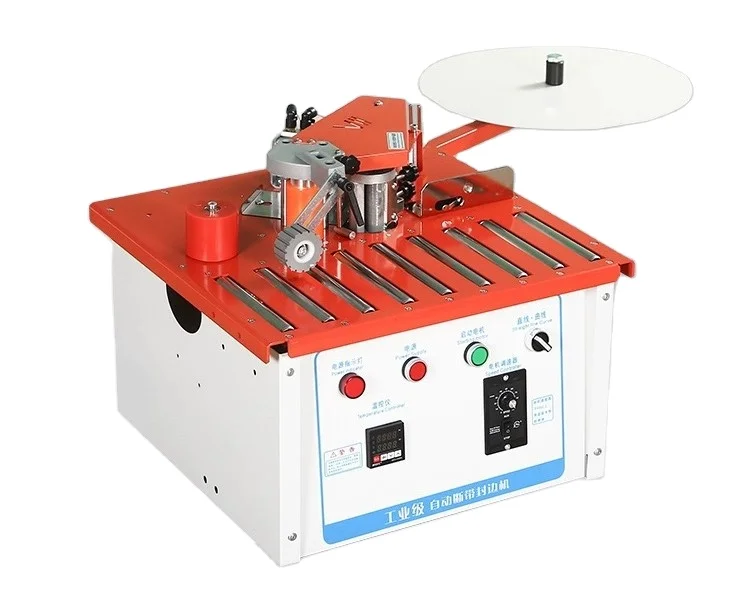
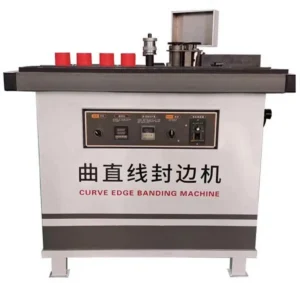
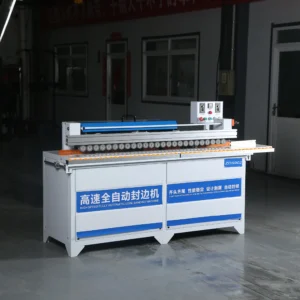
Private-Label Manufacturing — every ZDSF50+ portable edge bander leaves our Ningjin facility with your brand, your voltage, and four-stage QC records tied to its serial number.
Technical Specifications
| Parameter |
Value |
| Model |
ZDSF50+ |
| Product Type |
Portable Edge Banding Machine |
| Rated Voltage |
220V (single-phase), configurable from 110V to 440V for OEM orders |
| Rated Power |
1.2 kW |
| Functions |
Light, small and portable / automatic tape breaking / curve and straight line / double-sided gluing |
| Rated Air Pressure |
0.4–0.6 MPa |
| Strip Thickness |
0.5–1.5 mm |
| Sheet Thickness |
10–60 mm |
| Glue Pot Capacity |
1000 ml |
| Heating Time |
5–10 min |
| Edge Banding Speed |
0–6 m/min |
| Overall Dimensions |
54 × 54 × 56 cm |
| Machine Weight |
28 kg |
| Glue Application |
Double-sided gluing with glue-coated rollers |
| Pressure Rollers |
Adjustable, rubber material |
| Tape Breaking |
Pneumatically controlled with foot switch and travel switch for straight-line auto-breaking |
| Edge Strip Transport |
Adjustable bayonet for strip height |
| Heating System |
4 heating tubes |
Application Suitability
| Application |
Material or Output |
| Small workshop edge banding |
MDF, plywood, and particleboard panels |
| Custom furniture startup production |
Solid wood panels with PVC edge banding strips |
| Joinery workshop transitioning from manual methods |
Curved and straight panel profiles |
| Regional distributor sample and demo stock |
Entry-level edge banding for customer trials |
Why the Voltage Question Should Come Before the Quotation for Every edge banding machine factory OEM Order
A mismatched voltage specification renders an entire shipment idle on arrival, and the cost of rectification always falls on the distributor.
I spent years on the assembly floor before moving into technical sales, and I still remember the call from a Southeast Asian buyer who had received a single-phase 220V unit into a 110V grid. The machine sat in its crate for three weeks while the workshop arranged transformer modifications. That single oversight erased any margin the deal carried. Now, before any quotation goes out, the first document I ask for is a photo of the buyer’s distribution board [NEED_CITE: voltage and frequency standards by export market]. For an edge banding machine factory OEM partner, confirming local electrical standards is not a courtesy — it is the foundation of the entire transaction.

Component Sourcing and Precision Assembly for OEM Partners
Distributors evaluating an edge banding machine factory OEM relationship need visibility into how components are sourced and assembled. The ZDSF50+ uses precision-ground rollers and an adjustable bayonet strip transport mechanism that are inspected at multiple stages before final assembly. Each unit passes through incoming material checks, in-process inspection during sub-assembly, finished product testing, and pre-shipment verification — a four-stage protocol that protects the private-label brand from field failures that damage market reputation.
Private-Label Configuration and Branding Scope
An OEM arrangement on this platform extends well beyond a logo sticker. Voltage can be configured from 110V to 440V to match the destination market’s grid. Control panel labels, operation manuals, and maintenance documentation can be produced in the buyer’s local language. Custom color schemes, private-label packaging, and branded customs documentation are available for regional distributors who need a cohesive product line. Every customization is recorded against the order so that repeat batches remain consistent across shipments [NEED_CITE: CE machinery directive requirements for industrial equipment].
Reading the Specifications Against Real Workshop Conditions
The 10–60 mm sheet thickness range and 0.5–1.5 mm strip thickness coverage define what this machine can process, but the practical implication matters more to a distributor selecting a product mix. Workshops handling thin 10 mm MDF shelving will operate at the lower end of the range where the adjustable pressure rollers must be set carefully to avoid crushing the substrate. At the upper 60 mm limit — typically solid wood worktops — the double-sided glue-coated roller system with its 1000 ml glue pot ensures adequate adhesive coverage on both the strip and the panel edge. The 0–6 m/min feed speed is manually guided, meaning actual throughput depends on operator skill and panel geometry; curved profiles will naturally run slower than straight edges. The 4-tube heating system brings the glue pot to working temperature in 5–10 minutes, which matters in workshops that cycle the machine on and off throughout the day rather than running continuous shifts. For distributors building a catalogue, this machine occupies the entry point — it complements larger automatic edge banders rather than competing with them.
The Hidden Cost of Skipping Pre-Shipment Verification
When a distributor accepts a machine without reviewing factory test records, the first real test happens on the customer’s workshop floor. Glue temperature inconsistencies, pneumatic pressure leaks, or a misaligned strip transport bayonet surface only after the machine is unpacked and commissioned — at which point the distributor’s own service team is the one fielding the complaint. For an OEM partner whose brand name is on the machine, this is a reputation problem that compounds with every unit [NEED_CITE: industrial equipment pre-shipment inspection standards]. Qualitative differences in assembly consistency are exactly what four-stage QC is designed to catch before the crate is sealed.
Why Distributors Build Their Portable Range Here
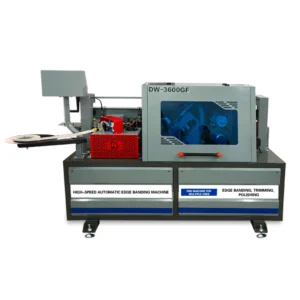
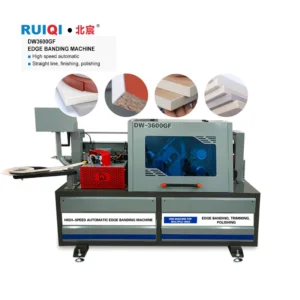
In-house manufacturing with patented cutting mechanisms means the ZDSF50+ is not a rebranded trading product — the engineering team that designs it also supports it. The full product family, from this portable unit to full-function pre-milling models, allows a distributor to offer a complete edge banding range under one supplier relationship. Voltage and language customization is treated as standard procedure, not a special request that delays production. Four-stage QC with pre-shipment verification means every batch ships with documented evidence of quality. Engineer-led configuration recommendations are delivered as formal quotations within 24 hours, so distributors can respond to their own market inquiries without waiting weeks for factory feedback.
Documentation & Verification
- CE declaration of conformity referencing the ZDSF50+ portable platform specifications
- ISO 9001 certificate covering the manufacturing process for this edge bander line
- Factory test record showing glue temperature and pressure performance on your target sheet thickness
- Electrical schematic with confirmed voltage and frequency for the destination market
- Operation and maintenance manual produced in the agreed language for your customer base
- Spare parts list with part numbers matching the as-built configuration
Installation, Commissioning & Support
- Requires a dedicated single-phase circuit rated for at least 1.2 kW with appropriate breaker protection
- Compact 54 × 54 × 56 cm footprint fits standard workbenches — no special floor preparation needed
- Pneumatic connection requires a 0.4–0.6 MPa air supply with moisture filtration upstream
- First commissioning includes glue pot temperature calibration across all four heating tubes
- Operator training covers manual feed technique for both curved and straight-line profiles
- Spare glue-coated rollers and replacement pressure rollers included in the initial parts kit
What We Need to Prepare Your OEM Quotation
To configure a ZDSF50+ for your market, provide the local voltage and frequency at the installation site, the primary panel materials your customers process, and the language required for control labels and manuals. If you are building a regional product line, share which larger automatic models you already stock so we can position this unit as a complementary entry point. Sample processing tests on your specific substrates can be arranged before order confirmation.
Frequently Asked Questions
Q: What elements of the ZDSF50+ can be customized under an OEM arrangement?
A: Custom logo placement, voltage configuration from 110V to 440V, multilingual control panel labels, operation manuals, private-label packaging, and custom color options are all available. Each customization is documented against the order to ensure consistency across repeat batches. We confirm the full scope before production begins so there are no surprises at dispatch.
Q: How can a distributor arrange a factory visit to inspect the production line?
A: Factory visits are welcomed at our Ningjin facility. You can inspect precision-ground component storage, observe the four-stage QC process at each checkpoint, and witness pre-shipment testing on finished ZDSF50+ units. Visits can be scheduled alongside a production run so you see live assembly rather than a static showroom display.
Q: How is voltage and frequency confirmed before the machine ships?
A: We request a photo or specification of the destination workshop’s distribution board during the quotation stage. The electrical schematic and voltage confirmation document are then produced specifically for that configuration and included in the shipment documentation. This prevents the costly transformer modifications that arise when standard voltage assumptions are made.
Q: What spare parts and technical training are provided for a distributor’s service team?
A: Each ZDSF50+ shipment includes a spare parts list matched to the as-built configuration. Distributors can order backup inventory of glue-coated rollers, pressure rollers, heating tubes, and pneumatic components. Technical training for the distributor’s own service team covers common fault diagnosis, roller replacement procedures, and glue pot maintenance routines.
Q: How are CE certificates and customs documents handled under private-label branding?
A: The CE declaration of conformity and ISO 9001 certificate are issued referencing the machine specifications and can be co-branded with the distributor’s label. Operation manuals, packing photographs, and customs documentation support are all prepared under the private-label arrangement so the end customer sees a consistent brand experience from unboxing through commissioning.