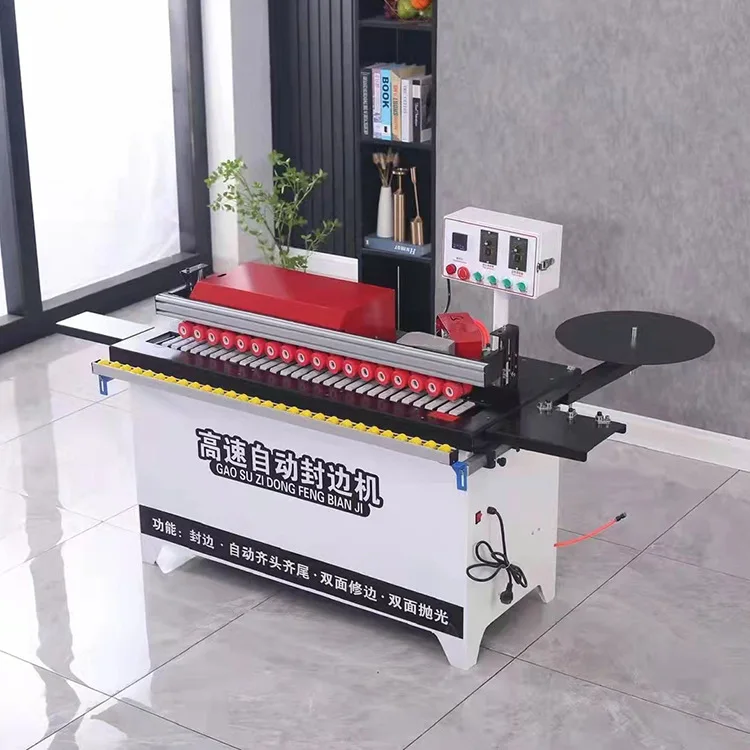
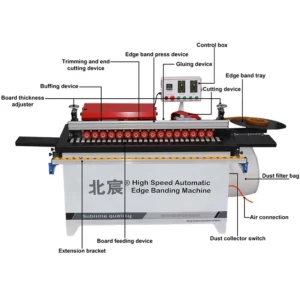
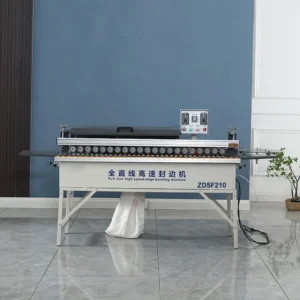
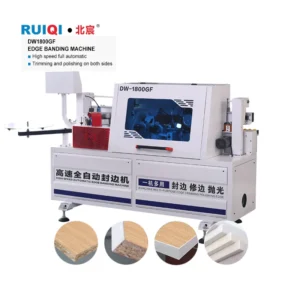
Precision-Verified Assembly — each Model 802 edge bander is assembled with proprietary trimming mechanisms and four-stage quality checks before leaving the production floor.
Technical Specifications
| Parameter |
Value |
| Model |
802 |
| Product Type |
Automatic Edge Banding Machine |
| Edge Type |
Straight line |
| Rated Voltage |
220V |
| Rated Power |
4 kW |
| Trimming Power |
800W × 2 |
| Polishing Power |
180W × 2 |
| Suction Power |
1200W |
| Heating Power |
1000W (5–10 min heat-up) |
| Feed Speed |
0–10 m/min |
| Conveyor Belt Speed |
0–10 m/min |
| Strip Thickness Range |
0.5–2.5 mm |
| Sheet Thickness Range |
10–50 mm |
| Glue Pot Capacity |
4000 ml |
| Rated Air Pressure |
0.4–0.6 MPa |
| Pressure Beam |
One-piece beam, double-row pressure wheels |
| Conveyor Belt Material |
Silicone |
| Belt Breaking Method |
Pneumatically controlled |
| Overall Dimensions (L×W×H) |
130 × 65 × 75 cm |
| Machine Weight |
150 kg |
| Warranty |
1 year |
Application Suitability
| Application |
Material or Output |
| Cabinet door edge finishing |
PVC and ABS strips on MDF and particleboard |
| Custom wardrobe panel sealing |
Veneer edge banding on plywood substrates |
| Small-batch furniture production |
Straight-edge banding on solid wood panels |
| Joinery workshop scale-up |
Melamine and laminate strips on composite boards |
Why the Voltage Question Should Come Before the Price on an Automatic Edge Banding Machine Factory OEM Order
A machine wired for the wrong frequency will not simply underperform — it will fail commissioning on arrival.
When importers source an automatic edge banding machine factory OEM unit from overseas, the conversation often starts with throughput and price. Yet workshops in Southeast Asia and parts of South America operate on grid frequencies and voltages that differ sharply from the Chinese domestic standard. I have seen entire container loads held at customs or sitting idle in factories because the motor winding and heating elements were spec’d without confirming the destination grid [NEED_CITE: voltage and frequency standards by export market]. The Model 802 is rated at 220V with a 4 kW total draw, meaning the electrical infrastructure at the buyer’s facility must be verified before the order is placed.

How In-House Manufacturing Controls Component Sourcing
The Model 802 is assembled on a single factory line where each station has defined inspection checkpoints. The trimming motors, polishing heads, and pneumatic belt-breaking cylinder are sourced from verified suppliers and logged against the unit serial number. This traceability matters for distributors planning an automatic edge banding machine factory OEM partnership because it means replacement parts can be specified and reordered with confidence, rather than relying on generic substitutions that may alter the feed dynamics or trimming tolerance.
The Four-Stage QC Process Before the Crate Is Sealed
Incoming material inspection catches dimensional deviations in pressure beam castings and conveyor belt stock before they enter assembly. In-process checks verify the alignment of the double-row silicone pressure wheels and the concentricity of the trimming spindles. Finished-product testing runs actual MDF and plywood panels through the machine, measuring edge adhesion and trim quality. Pre-shipment verification repeats the test with the buyer’s specified voltage and panel thickness [NEED_CITE: CE machinery directive requirements for industrial equipment]. Each stage is documented, and the records travel with the machine.
What the Spec Sheet Numbers Mean on the Workshop Floor
The 10–50 mm sheet thickness range covers everything from thin cabinet back panels to thick shelving stock, but the practical limit depends on how well the one-piece pressure beam maintains even contact across the panel surface. The double-row silicone wheels distribute pressure without marking melamine or veneer faces. The 4000 ml glue pot capacity allows continuous operation through a standard production shift without stopping for refills — a meaningful advantage when running batch orders of identical cabinet components. The 0.5–2.5 mm strip thickness range accommodates both thin PVC for visible surfaces and thicker ABS for impact-prone edges. Feed speed is variable up to 10 m/min, letting the operator slow down for delicate veneer work or speed up for repetitive PVC runs. The 800W × 2 trimming motors provide sufficient cutting force for clean flush trims on particleboard without chatter marks.
The Hidden Cost of Skipping Pre-Shipment Verification
Machines that arrive without verified test records create a cascade of problems. The operator discovers the glue temperature does not stabilize within the stated 5–10 minute window, or the pneumatic belt breaker leaves ragged ends that require manual cleanup. Panels come off the line with visible glue lines or uneven trimming, and the workshop owner traces it back to a pressure beam that was never checked under load. For OEM partners putting their own label on the equipment, these field failures reflect directly on the brand [NEED_CITE: machinery warranty claim frequency by root cause category].
Why Distributors and OEM Partners Source Here
In-house manufacturing with patented trimming mechanisms means the cutting geometry is controlled from design to final grind, not outsourced to a third-party machine shop. The product family spans entry-level to full-function models, so a distributor can offer a complete range to regional customers without managing multiple supply chains. Voltage, control panel language, and branding are configured as part of the standard order process, not treated as special requests. Four-stage QC with documented pre-shipment testing provides the verification paper trail that importers need for customs compliance and end-customer confidence. Engineer-led configuration review ensures the quoted machine matches the buyer’s actual panel materials and production volume.
Documentation & Verification
- Factory test record run on your specified panel thickness and strip material
- Electrical schematic confirming voltage and frequency for your destination grid
- Operation and maintenance manual in your agreed language
- CE declaration of conformity for European market entry
- Spare parts list with OEM part numbers for reorder accuracy
- Packing photographs taken before crate closure for shipping insurance claims
Installation, Commissioning & Support
- Requires a dedicated 220V circuit rated for at least 4 kW continuous draw
- Compressed air supply must deliver 0.4–0.6 MPa at the machine inlet
- 130 cm length footprint fits standard workshop bays; allow rear clearance for panel feed
- Extendable fluent strips support oversized panels beyond the conveyor width
- Glue pot heating element verified for target voltage before dispatch
- Pneumatic belt-breaking cylinder tested with your specified strip thickness range
Preparing Your Inquiry
When requesting a quotation, include your target market voltage and frequency, the panel materials and thicknesses you process most frequently, and whether you require custom branding or control panel language. If you are evaluating this machine for a regional distribution agreement, specify the model mix and annual volume you anticipate so the engineering team can confirm production scheduling.
Frequently Asked Questions
Q: What OEM customization options are available for the Model 802?
A: Custom logo placement on the machine body and control panel, voltage configuration from 110V to 440V depending on destination market, and control panel language in the operator’s native language are all available as standard order options. Specification adjustments for specific strip or sheet thickness requirements can be discussed with the engineering team during the quotation stage.
Q: How is build quality verified before shipment?
A: The four-stage QC process covers incoming material inspection, in-process assembly checks, finished-product functional testing, and pre-shipment verification. Each unit is tested with actual panel and strip materials matching the buyer’s production requirements, and the test record is included with the shipping documentation.
Q: Can I visit the factory to inspect the assembly line?
A: Factory visits are welcomed at any stage. Buyers and OEM partners can walk the assembly line, observe the QC stations, and witness pre-shipment testing of their specific order. Scheduling a visit during the production run of your unit allows direct verification of component sourcing and assembly practices.
Q: What documentation accompanies each machine for customs clearance?
A: Each shipment includes a CE declaration of conformity, ISO 9001 certificate copy, electrical schematic with voltage confirmation, factory test record, operation manual, spare parts list, and packing photographs. Additional customs documentation support is available depending on the destination country’s import requirements.
Q: How are proprietary components like trimming motors sourced?
A: The trimming mechanisms use proprietary cutting geometry developed in-house and precision-ground at the factory. Component suppliers are qualified through incoming inspection, and each part is logged against the unit serial number for traceability. Replacement parts are available for direct reorder using the OEM part numbers provided in the spare parts list.