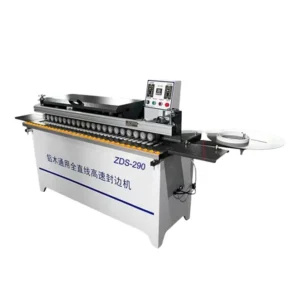
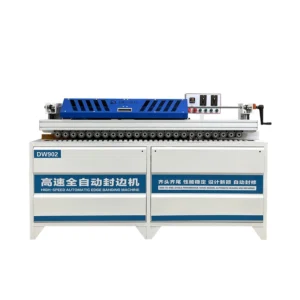
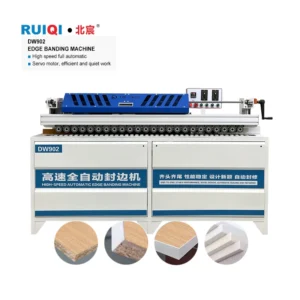
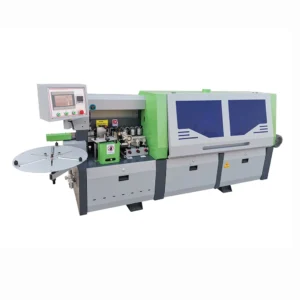
Precision Manufacturing Depth — Every unit of this automatic edge banding machine undergoes a four-stage inspection sequence from incoming material grading to pre-shipment verification, with test records shipped alongside each crate.
Technical Specifications
| Parameter |
Value |
| Model |
802 |
| Product Type |
Automatic Edge Banding Machine |
| Function Sequence |
Automatic plate feeding, end cutting, upper/lower polishing, head/tail trimming, built-in dust collector |
| Edge Type |
Straight line |
| Rated Voltage |
220V (frequency to be confirmed) |
| Feed Speed |
0–10 m/min |
| Sheet Thickness Range |
10–50 mm |
| Strip Thickness Range |
0.5–2.5 mm |
| Rated Power |
4 kW |
| Trimming Power |
800 W × 2 |
| Polishing Power |
180 W × 2 |
| Heating Power |
1000 W (heat-up 5–10 min) |
| Suction Power |
1200 W |
| Glue Pot Capacity |
4000 ml |
| Rated Air Pressure |
0.4–0.6 MPa |
| Overall Dimensions (L×W×H) |
130 × 65 × 75 cm |
| Machine Weight |
150 kg |
| Pressure Beam |
One-piece integrated, double-row pressure wheels |
| Conveyor Belt |
Silicone anti-scratch, pneumatically controlled belt breaking |
| Extension Support |
Extendable fluent strips for large panels |
| Control System |
Digital display panel (PLC/CNC status to be confirmed) |
| Warranty |
1 year |
| Assembly State |
KD packing, manual and video guidance provided |
| Delivery Time |
25–30 days (basis to be confirmed) |
Application Suitability
| Application |
Material or Output |
| Custom furniture panel edge finishing |
MDF and particleboard with PVC edge banding |
| Cabinet door and carcass production |
Plywood panels with 0.5–2.5 mm strip thickness |
| Small to mid-size workshop edge sealing |
Straight-line PVC on engineered wood substrates |
| Continuous multi-plate operations |
Batch runs within the 10–50 mm sheet thickness range |
Why Voltage Confirmation Must Happen Before the Purchase Order
Every Automatic Edge Banding Machine OEM factory shipment leaves the dock with a signed voltage and frequency confirmation document matched to the buyer’s market.
I spent years on the assembly floor before moving to technical sales, and the most expensive mistake I ever witnessed was not a mechanical failure. It was a fully wired machine arriving at a customer site in a country running 60 Hz power, while the motor and heating circuit had been configured for 50 Hz. The workshop sat idle for weeks waiting for a transformer and rewiring. That single oversight cost more than the machine itself. When evaluating any automatic edge banding machine from an overseas source, the electrical specification conversation has to happen at the quotation stage — not after the container is sealed. [NEED_CITE: voltage and frequency standards by export market]
Component Sourcing and In-House Machining
The manufacturing process for this 802 automatic edge banding machine begins with sourcing raw castings, linear guides, and motor assemblies that pass incoming material inspection before entering the machining workshop. Precision-ground components — including the pressure beam seating surface and the trimming motor mounts — are held to tolerances that directly affect edge finish quality. In-house manufacturing means every bearing seat and conveyor alignment point can be traced back to the operator and inspection record, which matters when a distributor needs to stand behind the equipment in their territory.
Four-Stage Quality Control from Raw Material to Crate
The QC sequence covers incoming material verification, in-process dimensional checks during assembly, finished product functional testing, and a final pre-shipment run with the buyer’s specified panel stock. Each stage generates a documented record. For an OEM automatic edge banding machine partner or regional importer, this traceability means you can show your own downstream customers exactly how the machine was validated before it left Shandong. The test run uses panels within your specified thickness range and edge material type, not a generic factory demo board. [NEED_CITE: ISO 9001 quality management requirements for machinery manufacturing]
What the Specification Sheet Actually Means on the Shop Floor
The 4000 ml glue pot capacity translates to fewer refill interruptions during a continuous production run, which matters when a workshop is pushing through a batch of cabinet panels and cannot afford the glue temperature to fluctuate mid-job. The one-piece integrated pressure beam with double-row pressure wheels prevents panel drift during conveyance — a common source of uneven edge contact on smaller machines where segmented beams flex under load. The 10–50 mm sheet thickness range covers standard MDF, particleboard, and plywood used in furniture carcass and door production, but the 0–10 m/min feed speed means operators must match conveyor rate to glue open time for reliable adhesion on porous substrates. The 1200 W suction system, built in rather than ducted to an external extractor, keeps the immediate trimming zone clear of PVC and wood dust that would otherwise interfere with polishing finish.

The Hidden Cost of Specifying Too Early
Machines ordered on brochure weight alone — without matching feed speed, panel thickness range, and edge strip compatibility to actual production volume — routinely underperform. A workshop running continuous multi-plate sealing operations on 50 mm particleboard will overload a pressure beam designed for lighter stock, leading to inconsistent glue contact and visible seam lines. Similarly, ordering a machine rated for 220V without confirming local frequency can cause the heating element to run outside its designed thermal curve, degrading glue bond strength over time. These mismatches are rarely caught until the first production week, when rework costs have already accumulated. [NEED_CITE: common edge banding adhesion failures traced to machine configuration]
Why Distributors and OEM Partners Source from This Facility
In-house manufacturing with patented cutting mechanisms means the trimming and polishing assemblies are not off-the-shelf components bolted onto a generic frame — they are designed and machined within the same facility that handles final assembly and testing. The full product family, from entry-level to full-function pre-milling models, allows a distributor to build a model mix for their regional market without managing multiple supplier relationships. Voltage, control panel language, and branding customization are treated as standard configuration options rather than special requests. The four-stage QC with pre-shipment verification produces documentation that an importer can hand directly to their local service team. Engineer-led configuration recommendations arrive as formal quotations, not catalog pages forwarded by a trading desk.
Documentation & Verification
- CE declaration of conformity and ISO 9001 certificate provided with each unit
- Electrical schematic confirming voltage and frequency matched to destination market
- Factory test record run on buyer-specified panel thickness and edge material
- Machine specification sheet reflecting actual shipped configuration, not catalog defaults
- Operation and maintenance manual produced in the agreed operator language
- Spare parts list with OEM part numbers for local stocking planning
Installation, Commissioning & Support
- Requires a dedicated 220V circuit rated for the 4 kW total draw plus compressor supply
- KD packing means partial assembly on-site using included manual and video guides
- 130 × 65 × 75 cm footprint fits within standard single-bay workshop allocations
- Pneumatic belt breaking system needs a stable 0.4–0.6 MPa air supply connection
- Glue pot digital temperature display requires calibration against local ambient conditions at first start-up
- Extendable fluent strips must be leveled to match conveyor height for large panel support
What to Include with Your Inquiry
To receive a configuration recommendation and quotation that reflects actual production requirements, provide the panel materials and thickness range you run most frequently, the edge banding strip type and thickness, your local voltage and frequency specification, the preferred control panel language for operators, and whether the machine will operate standalone or within an existing line. For OEM or private-label orders, include logo artwork and any packaging or documentation customization requirements at the inquiry stage so the engineering team can scope the full order accurately.
Frequently Asked Questions
Q: What OEM and private label customization is available for this automatic edge banding machine?
A: Custom logo application on the machine body, control panel language configuration, voltage and frequency matching from 110V to 440V, and tailored packaging with your branding are all available as standard options. Specification adjustments such as conveyor length or glue pot capacity can be scoped during the quotation stage based on your market requirements.
Q: How is manufacturing quality verified before shipment?
A: Every unit passes through four QC stages: incoming material inspection, in-process dimensional checks during assembly, finished product functional testing, and a pre-shipment verification run using panels within your specified thickness range. Each stage generates a documented record that ships with the machine.
Q: Can the factory provide component sourcing transparency?
A: Yes. Precision-ground components, motor assemblies, and linear guides are sourced and inspected in-house. Documentation covering component origin, machining tolerances, and assembly inspection records can be included with the shipment for distributor or OEM partner review.
Q: What is the lead time for OEM orders?
A: Standard configurations typically require several weeks from order confirmation to dispatch, with the exact timeline depending on order quantity and the scope of customization requested. Voltage configuration, language setup, and branding application are factored into the production schedule at the quotation stage.
Q: Is a factory visit or sample processing test available before placing a bulk order?
A: Factory visits are welcomed for on-site inspection of precision grinding, assembly, and the four-stage QC process. Sample processing tests can be arranged using your specified panel material and edge banding stock, with results documented and shared before any order commitment.

![【目标站】 ruiqifactory.com → MANUFACTURING AND OEM → 制造OEM类角色 → OEM Available / Factory Direct / Custom Build 【记录ID】15337 → 1+5+3+3+7 = 19 → 19 % 6 = 1 → 句式: [站点修饰词] [品类词] for [应用或物料] 19 % 3 = 1 → 池 (OEM Available / Factory Direct / Custom Build) 取 Factory Direct 品类词: Automatic Edge Banding Machine 应用或物料: PVC Edge Banding Plywood Making Factory Direct Automatic Edge Banding Machine for PVC Plywood](https://ruiqifactory.com/wp-content/uploads/2026/05/He4a5edec182345d899eff9858f03aaef2-1.webp)
![【目标站】 ruiqifactory.com → MANUFACTURING AND OEM → 制造OEM类角色 → OEM Available / Factory Direct / Custom Build 【记录ID】15337 → 1+5+3+3+7 = 19 → 19 % 6 = 1 → 句式: [站点修饰词] [品类词] for [应用或物料] 19 % 3 = 1 → 池 (OEM Available / Factory Direct / Custom Build) 取 Factory Direct 品类词: Automatic Edge Banding Machine 应用或物料: PVC Edge Banding Plywood Making Factory Direct Automatic Edge Banding Machine for PVC Plywood](https://ruiqifactory.com/wp-content/uploads/2026/05/He4a5edec182345d899eff9858f03aaef2-1-150x150.webp)