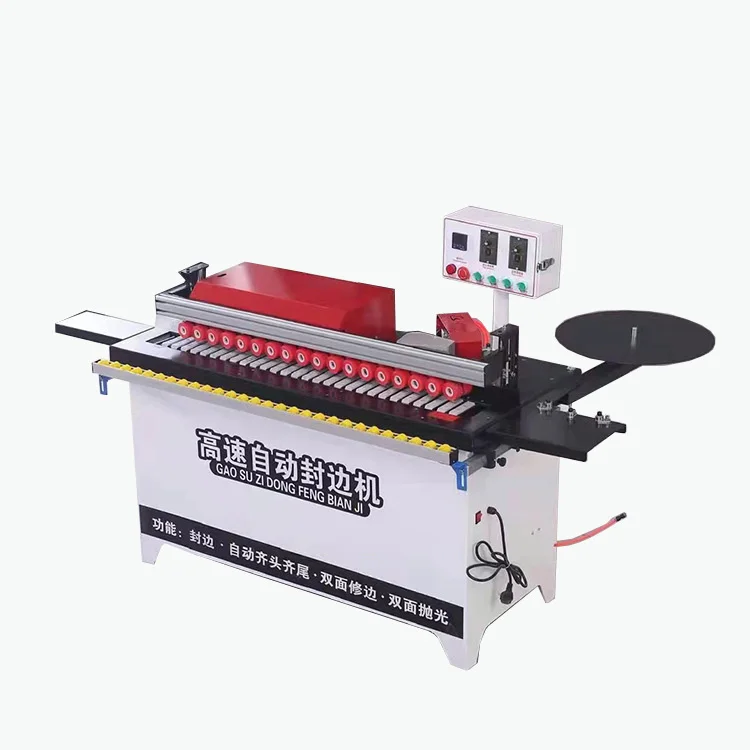
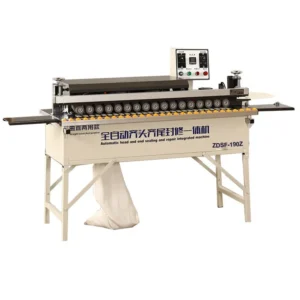
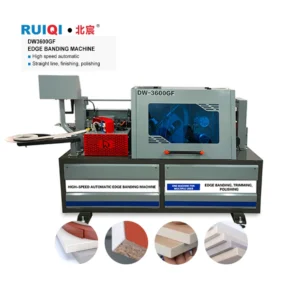
Precision-Ground Components — Every ZDSF802 leaving the Ningjin workshop carries a pre-shipment test record signed against the destination voltage, a habit forged from hard downtime on export jobs.
Technical Specifications
| Parameter |
Value |
| Model |
ZDSF802 |
| Product Type |
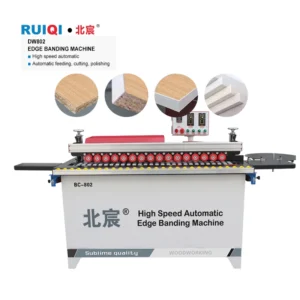
High Speed Small Automatic Edge Banding Machine |
| Edge Type |
Straight line |
| Rated Voltage |
220V (frequency to be confirmed for destination market) |
| Rated Power |
4 kW |
| Trimming Power |
800W × 2 |
| Polishing Power |
180W × 2 |
| Suction Power |
1200W |
| Glue Pot Capacity |
4000 ml |
| Glue Pot Heating Power |
1000W |
| Feed Speed |
0–10 m/min |
| Strip Thickness Range |
0.5–2.5 mm |
| Sheet Thickness Range |
10–50 mm |
| Rated Air Pressure |
0.4–0.6 MPa |
| Conveyor Belt Material |
Silicone |
| Pressure Beam |
One-piece integrated beam, double rows of pressure wheels |
| Extension Support |
Extendable fluent strips for large plate sealing |
| Overall Dimensions (L×W×H) |
130 × 65 × 75 cm |
| Machine Weight |
150 kg |
Application Suitability
| Application |
Material or Output |
| Custom cabinet door edging |
MDF and PVC foil with 0.5–2.0 mm strip |
| Small-batch wardrobe panel finishing |
Plywood and melamine-faced particleboard |
| Joinery workshop straight-edge sealing |
Solid wood panels up to 50 mm thickness |
| Starter furniture production lines |
Pre-cut sheet stock requiring clean trim and polish |
Why the Voltage Question Must Precede the Purchase Order
Machines quoted without confirming local voltage and frequency arrive unusable, turning a quick install into a three-week factory standstill.
An edge banding machine factory OEM build that ships at 380V/50Hz into a 440V/60Hz workshop will trip the inverter on over-voltage before the first panel feeds through. I once watched a cabinet shop in Mexico sit idle while a step-down transformer was sourced locally because the spec sheet had never been matched to the grid. That kind of oversight erases any lead-time advantage the faster shipment promised. Confirming the exact voltage, phase, and plug type at quotation stage removes the most common reason export machines fail to start. [NEED_CITE: voltage and frequency standards by export market]

How OEM Branding Extends Beyond the Logo Plate
Regional distributors building a private-label woodworking range need more than a sticker swap. The ZDSF802 edge banding machine factory OEM configuration allows control panel language, safety decal wording, and operator manual translation to match the destination market before assembly begins. This keeps the end user from staring at unfamiliar characters during commissioning and reduces the distributor’s own support calls.
Private-Label Electrical Documentation That Holds Up at Customs
Every export shipment requires paperwork that satisfies both the importing country’s machinery directive and the local electrical inspector. For the ZDSF802, the electrical schematic and voltage confirmation sheet are finalized and signed before the wiring harness is cut, so the CE declaration of conformity references the exact configuration shipped. Distributors receive a documentation package that clears customs without supplementary requests. [NEED_CITE: CE machinery directive requirements for industrial equipment]
What the Numbers on the Spec Sheet Actually Mean on the Shop Floor
The 10–50 mm sheet thickness range covers everything from thin MDF shelving to thick plywood cabinet carcases, but the one-piece integrated pressure beam with double-row pressure wheels is what keeps those panels flat against the silicone belt across that entire range. Without even pressure distribution, thinner sheets lift during trimming, leaving a visible snipe at the leading edge. The dual 800W trimming motors combined with pneumatic belt-breaking give the end-trim station enough authority to shear through 2.5 mm PVC cleanly, while the 180W × 2 polishing motors finish the edge to a level that requires no secondary hand-work. The 4000 ml glue pot capacity means a full morning run on standard PVA hot melt without stopping to refill, and the 1000W heater holds temperature within a narrow band so adhesive viscosity stays consistent from the first panel to the last.
The Hidden Cost of Specifying a Machine Below Its Duty Cycle
A compact edge bander asked to run production volumes beyond its design intent will show the strain first in the glue pot thermostat and then in the polishing motor brushes. Panels start leaving the outfeed with uneven adhesive coverage or dull edges that fail quality checks downstream. The workshop owner blames the machine brand, while the real mismatch was throughput expectation versus feed speed and thermal headroom. Selecting a model whose duty envelope matches daily volume avoids warranty disputes and protects the distributor’s reputation in the territory. [NEED_CITE: typical duty cycle expectations for compact edge banders]
Why This Factory Is Positioned for OEM Partnership
In-house manufacturing means the pressure beam casting, conveyor frame, and trimming spindle housings are machined on site rather than sourced from a third-party integrator, giving the OEM partner a single point of accountability. Patented cutting mechanisms and precision-ground components are verified through a four-stage QC sequence that runs from incoming raw material to the final pre-shipment test, so the machine that arrives at the distributor’s warehouse has already processed sample panels under factory conditions. Voltage, frequency, control panel language, and brand color are locked in during the engineering review, not improvised on the assembly line. The result is an edge banding machine factory OEM relationship where configuration drift between units is eliminated by process rather than by hope.
Documentation & Verification
- CE declaration of conformity referencing the confirmed destination voltage and frequency
- Electrical schematic signed off before wiring harness fabrication begins
- Factory test record on the buyer’s specified panel thickness and edge strip material
- Operation and maintenance manual translated into the agreed operator language
- Spare parts list with OEM part numbers matching private-label catalog requirements
- Packing photographs and loading plan for container consolidation
Installation, Commissioning & Support
- Requires a dedicated 220V circuit rated above the 4 kW draw to prevent inverter trips on startup
- Footprint of 130 × 65 cm fits through standard workshop doorways for final positioning
- Silicone conveyor belt inspected for tracking alignment before the first powered feed
- Glue pot heat-up time of 5–10 minutes verified against the local ambient temperature
- Air supply regulated to 0.4–0.6 MPa with an inline filter to protect pneumatic trim valves
- Operator training covers digital temperature display reading and independent switch sequencing
Requesting a Quotation That Fits Your Market
To receive a configuration proposal for the ZDSF802, share the destination country’s grid voltage and frequency, the primary panel materials and thickness range you process, and the operator language for the control panel. If you plan to private-label the machine, include your brand color reference and logo file format so the engineering team can confirm reproduction on sheet metal and decals. Mention whether you need a sample edge banding test run on your own stock before committing to a production batch.
Frequently Asked Questions
Q: What OEM customization options are available for the ZDSF802?
A: Beyond the logo plate, we configure voltage from 110V to 440V, frequency at 50Hz or 60Hz, control panel language, safety decals, and machine color. The operator manual and electrical schematics are rewritten to match the selected configuration so documentation stays consistent with the physical machine throughout its service life.
Q: How does the four-stage QC process protect my private-label inventory?
A: Incoming material inspection, in-process dimensional checks, finished product verification, and a pre-shipment functional test each generate a signed record. The pre-shipment test runs actual panels through the trim and polish stations at the confirmed voltage, so you receive evidence that the machine performs before it leaves the factory floor.
Q: Can I send my own panel material for a sample edge banding test?
A: Yes. Ship a small batch of your typical substrate and edge strip to the factory, and we process it on the ZDSF802 configured to your target voltage. Test samples, glue line close-up photos, and trim finish evaluation are returned with the quotation so you can assess edge quality before ordering.
Q: What spare parts support is offered to distributor service teams?
A: A full spare parts list ships with each machine, and we maintain stock of wear items like trimming blades, polishing wheels, and conveyor belt sections. Distributor technicians can request remote troubleshooting guidance or arrange factory training sessions covering common field repairs and belt replacement procedures.