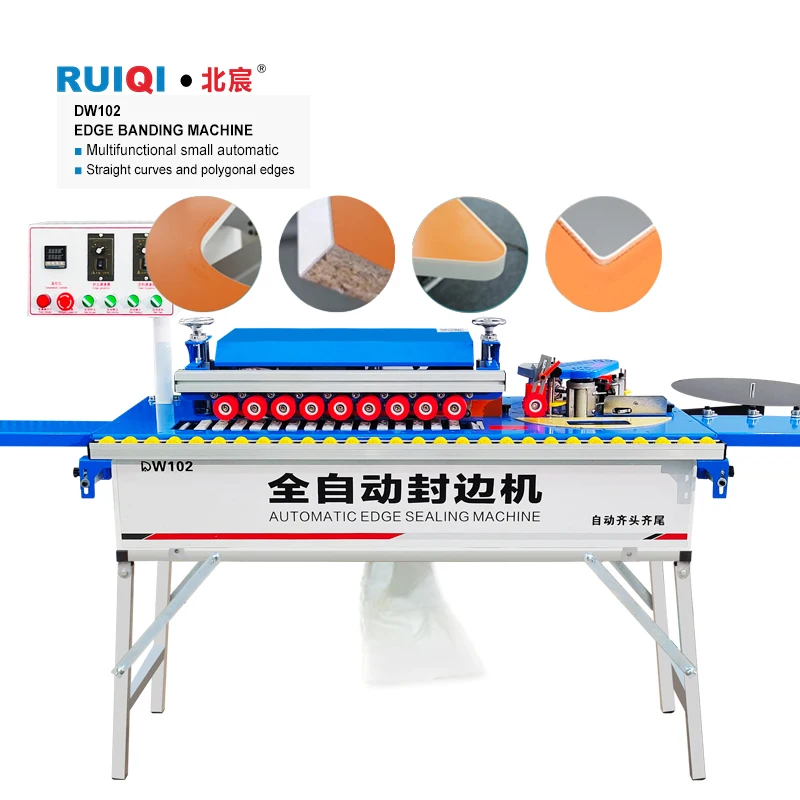
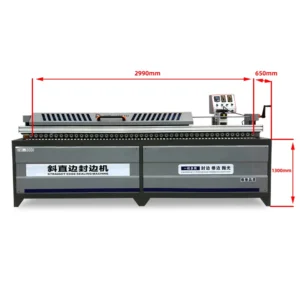
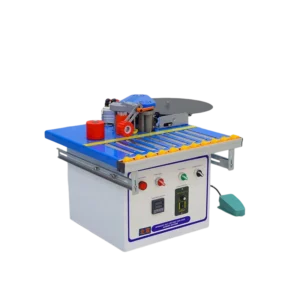
Patented Cutting Mechanisms — the DW102 Manual Edge Banding Machine is built around proprietary trimming technology that holds tolerance you can verify on the assembly bench, not just on the spec sheet.
Technical Specifications
| Parameter |
Value |
| Model |
DW102 |
| Product Type |
Manual Edge Banding Machine |
| Total Power |
3800W |
| Voltage |
220V/380V/customization |
| Edge Banding Type |
Curved and straight edge |
| Edge Banding Height |
0–50 mm |
| Edge Banding Thickness |
0.3–3 mm |
| Minimum Sheet Length |
25 cm |
| Minimum Sheet Width |
5 cm |
| Glue Pot Capacity |
1000 ml |
| Air Source Pressure |
0.5–0.8 MPa |
| Trimming Power |
650W × 2 |
| Polishing Power |
180W × 2 |
| Vacuum Power |
1200W |
| Edge Power |
20W |
| Transmission Power |
60W |
| Product Size |
128 × 47 × 69 cm |
| Product Weight |
75 kg |
| Control Panel Language |
Chinese and English (customizable to Spanish or other languages) |
| Plug Options |
EU, USA, AU, UK |
| Standards |
CE, ISO 9001 |
Application Suitability
| Application |
Material or Output |
| Custom cabinet door edge finishing |
MDF and plywood with PVC or veneer banding, curved and straight profiles |
| Small-batch furniture panel processing |
Particleboard and blockboard with double-sided adhesive tape bonding |
| Polymer door frame trimming |
Polymer panels requiring chamfering, scraping, and polishing in one pass |
| Workshop prototyping and repair work |
Solid wood panels with curved contour edge banding and manual feed control |
Why Voltage Confirmation Must Precede the Purchase Order
Every DW102 Manual Edge Banding Machine factory ships with an electrical schematic matched to your local grid, verified before production begins.
I spent years commissioning woodworking lines across Africa and South Asia, and the most expensive mistake I watched a buyer make was not about the machine itself — it was about the power supply. A workshop in Lagos received a 380V three-phase edge bander when their facility ran on a single-phase 220V generator. The machine sat crated for months while they sourced a transformer that cost nearly as much as the unit itself. [NEED_CITE: voltage and frequency standards by export market] That failure has nothing to do with the equipment and everything to do with the quotation process skipping a question that should come first.
When you source a Manual Edge Banding Machine from an OEM manufacturing facility, the voltage conversation needs to happen alongside the specification review — not after the proforma invoice is signed. The DW102 is configurable from 220V to 380V, with plug options spanning EU, USA, AU, and UK standards, but those options only matter if someone asks before the build starts.

Component Sourcing Depth and What It Means for Your Supply Chain
The DW102 Manual Edge Banding Machine is manufactured in-house, which means the trimming motors, polishing heads, vacuum unit, and glue pot are assembled from components sourced and inspected under one roof. For a distributor stocking equipment for a regional market, this matters because it consolidates the spare parts chain. You are not chasing three different subcontractors when a polishing motor needs replacement in the field.
How Four-Stage QC Translates to Distributor Confidence
Each unit passes through incoming material inspection, in-process verification, finished product testing, and a pre-shipment run that simulates actual operating conditions. The factory test record travels with the machine, so when your service team uncrates a DW102 at a customer site, they have documented evidence of how that specific unit performed before it was bolted down. [NEED_CITE: CE machinery directive requirements for industrial equipment] For an OEM partner applying private label branding, that documentation carries your name, not ours.
Reading the Specs That Actually Affect Edge Quality
The 0.3–3 mm edge banding thickness range is the working envelope that determines which materials this machine can handle without adjustment hardware swaps. Thin 0.3 mm PVC veneer demands precise glue roller pressure; thicker 3 mm solid edge stock demands more from the trimming motors, and the DW102 addresses this with dual 650W trimming units that cut both head and tail automatically. The 1000 ml glue pot capacity is sized so that a full batch of cabinet panels can be edged without stopping to refill mid-run, which is where most inconsistencies in adhesive coverage begin.
Air source pressure at 0.5–0.8 MPa drives the pneumatic pressing rollers that bond the edge to the substrate. If your workshop compressor cannot sustain the lower bound of that range, the press-off force drops and you see it as lifting on curved sections — a failure I have traced more than once to an undersized air line rather than the machine itself. The 0–50 mm edge banding height range means the DW102 handles everything from thin shelf panels to thicker worktop stock without retooling the feed path.
The Cost of Skipping the Material Compatibility Check
A furniture maker I worked with bought a manual edge bander to run curved cabinet doors and decided to push 4 mm PVC strip through a machine rated to 3 mm. The glue roller could not maintain contact pressure on the oversized stock, and the trimming knives chattered on the excess thickness. An entire batch of door panels came back with visible glue lines and lifted edges. The machine was not defective — it was asked to do something outside its design envelope. [NEED_CITE: substrate and edge banding material compatibility guidelines] When you evaluate a Manual Edge Banding Machine for your production mix, match the material list to the thickness range before you match the price to your budget.
What Manufacturing Depth Actually Delivers
In-house machining of precision-ground components means the DW102 feed table and trimming assemblies are built to verified tolerances rather than assembled from off-the-shelf subframes. Patented cutting mechanisms in the trimming station produce edge finishes that hold up under close inspection — the kind of finish that determines whether a cabinet door passes quality check or goes back to the bench. Voltage, language, and specification customization are treated as standard configuration steps, not special requests that add weeks to lead time. Factory visits are open so that distributors and OEM partners can inspect the assembly floor and QC stations directly.
Documentation & Verification
- CE declaration of conformity matched to DW102 configuration
- ISO 9001 certificate covering manufacturing process
- Electrical schematic with confirmed voltage and plug type
- Factory test record on your specified panel thickness and edge material
- Operation manual in agreed language with spare parts list
Installation, Commissioning & Support
- 220V or 380V dedicated circuit required based on confirmed configuration before shipment
- 0.5–0.8 MPa compressed air supply with regulator at the machine connection point
- 128 × 47 × 69 cm footprint fits standard workshop bench space without floor anchoring
- Dual 650W trimming motors and 180W polishing heads calibrated during pre-shipment test
- 1000 ml glue pot cleaned and flushed with recommended solvent schedule in manual
- Spare trimming knives and polishing wheels included in first-shipment parts kit
What We Need to Configure Your DW102 Correctly
Before we issue a formal quotation, send us the edge banding materials you run most often — PVC thickness, veneer type, and the substrate you bond to. Confirm your workshop voltage, frequency, and plug standard so the electrical build matches your grid from day one. If you are evaluating this unit as part of a distributor inventory or OEM private label program, let us know the branding and control panel language requirements for your target market.
Frequently Asked Questions
Q: How is the trimming tolerance verified before a DW102 leaves the factory?
A: Each unit runs a pre-shipment test on actual panel stock at the buyer’s specified thickness. The trimming result is measured and recorded in the factory test record that ships with the machine. This gives your team a baseline to reference during commissioning and ensures the cutting mechanism performs within its designed envelope before it reaches your floor.
Q: What OEM customization can I apply to the DW102 for my private label program?
A: Logo placement, control panel language, voltage configuration, and plug type are all configurable as standard options. For distributors building a regional product line, we adapt the exterior finish and documentation package to carry your branding. All customization is confirmed in the specification sheet before production begins.
Q: Can I visit the factory to see how the DW102 is assembled and tested?
A: Factory visits are welcome and encouraged. You can inspect the precision grinding stations, observe the four-stage QC process, and watch a DW102 run through its pre-shipment test cycle on the material you specify. We schedule visits around your travel plans and provide a full walkthrough of component sourcing.
Q: How do you confirm voltage compatibility for my market before building the machine?
A: We request your local voltage, frequency, and plug standard during the quotation stage and confirm it in writing on the specification sheet. The electrical schematic included with your shipment documents the exact configuration built into your DW102, preventing the commissioning failures that happen when voltage assumptions are left unverified.
Q: What spare parts and training support do you offer distributor service teams?
A: A spare parts list covering trimming knives, polishing wheels, and pneumatic components ships with every DW102. For distributors, we provide technical documentation that enables your own service team to handle first-line maintenance and troubleshooting without escalating to the factory for routine support calls.