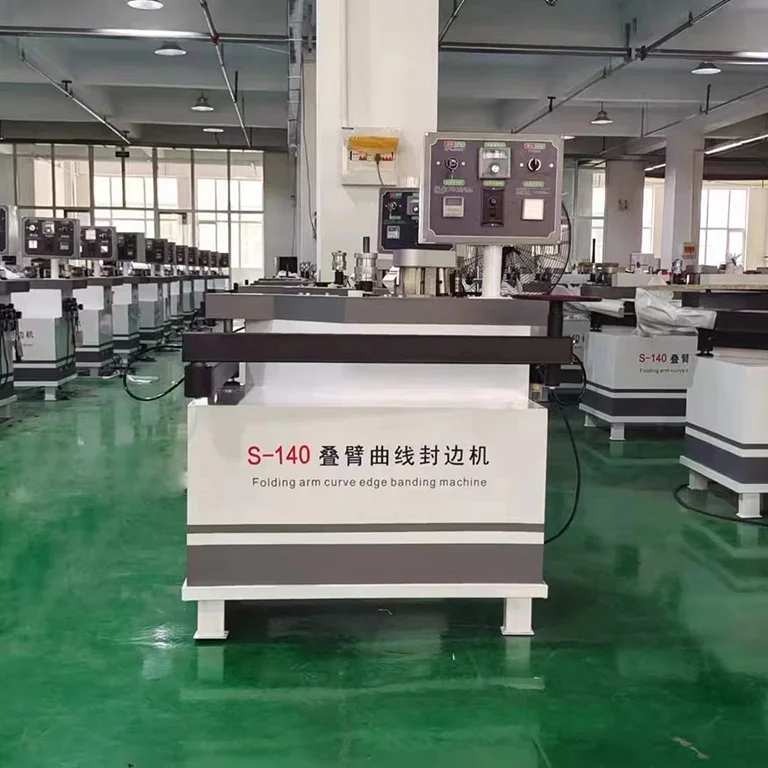
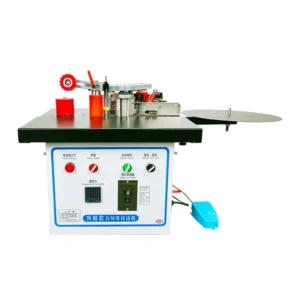
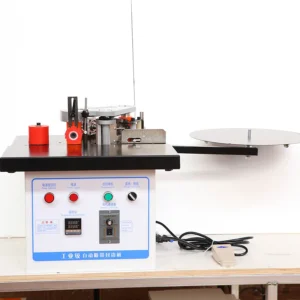
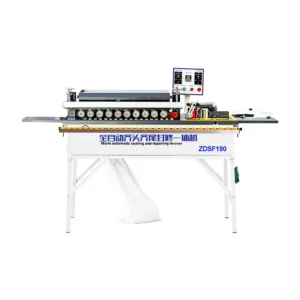
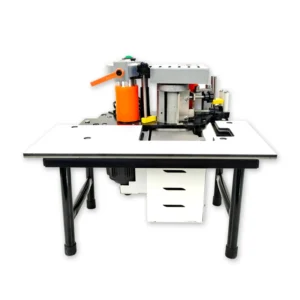
In-House Precision Assembly — Every S-140 curve edge bander is built on our own production line with proprietary tooling, four-stage inspection, and pre-shipment test records you can verify before dispatch.
Technical Specifications
| Parameter |
Value |
| Product Type |
Curve Edge Banding Machine |
| Model |
S-140 |
| Voltage |
220V (configurable from 110V to 440V) |
| Total Power |
1.4 kW |
| Air Pressure Requirement |
0.5–0.8 MPa |
| Edge Banding Speed |
0–180 mm/s |
| Overall Dimensions |
960×620×880 mm |
| Machine Size (with arm extended) |
1050×650×1200 mm |
| Net Weight |
88 kg |
| Standard Suction Cup |
200×26 mm |
| Edge Band Thickness Range |
0.4–2 mm |
| Edge Band Width Range |
8–50 mm |
| Breaking Method |
Automatic tape break via double cylinders |
| Glue Pot Capacity |
1000 ml |
| Control System |
Intelligent temperature control with speed adjustment and timer |
| Gluing Type |
Double-sided gluing |
| Motor Type |
Pure copper motor |
| Application Mode |
Straight and curved dual purpose |
| Assembly State |
Arm folding device |
Application Suitability
| Application |
Material or Output |
| Custom cabinet door edge finishing |
MDF and plywood panels with PVC or veneer banding |
| Curved wardrobe component banding |
Particleboard with 0.4–2 mm melamine or ABS edge |
| Office furniture contour edging |
Post-formed laminate panels on radiused corners |
| Small-batch decorative panels |
Solid wood and composite boards with thin veneer strips |
| Window and door profile trimming |
Narrow timber and engineered wood stock |
Why the Voltage Question Should Come Before the Price on a Curve Edge Banding Machine OEM Order
Confirming your local voltage and frequency before production begins eliminates the single most common cause of commissioning failure for imported woodworking equipment.
I have watched a distributor in Southeast Asia receive a pallet of edge banders wired for 380V three-phase when their workshop only had single-phase 220V available. The machines sat crated for weeks while transformers were sourced locally at a premium. A Curve Edge Banding Machine OEM order should never reach the shipping stage without a signed electrical schematic confirming the exact voltage, frequency, and plug configuration the buyer’s facility requires. [NEED_CITE: voltage and frequency standards by export market]

Component Sourcing and Assembly Traceability
Each S-140 curve edge bander begins with precision-ground structural plates and a pure copper motor sourced against incoming material specifications. The arm folding mechanism and double-cylinder tape break assembly are built on dedicated fixtures so that repeatability holds across production runs. For OEM partners requesting private-label builds, component provenance documentation travels with the unit, meaning your service team can trace wear parts back to their original batch.
Four-Stage Inspection Built Around Real Panel Materials
Incoming material checks verify motor winding resistance and suction cup durometer readings before assembly starts. In-process inspection covers the glue pot seal integrity and the alignment of the automatic tape break cylinders. Finished-product testing runs actual MDF and plywood samples through both straight and curved paths. Pre-shipment verification documents dimensional accuracy and electrical safety under the configured voltage, recorded in the factory test file that ships with every S-140. [NEED_CITE: CE machinery directive requirements for industrial equipment]
What the Numbers on the Spec Sheet Actually Mean for Your Operators
The 0.5–0.8 MPa air pressure range tells your compressor room what to deliver; undersized airlines cause the double-cylinder tape break to stutter, leaving ragged overhang on curved sections. The 1000 ml glue pot capacity means operators running 0.4 mm PVC on small cabinet components will not need mid-shift refills, while the intelligent temperature control with timer prevents scorching when the machine idles between batches. Edge band width from 8 to 50 mm covers everything from narrow trim strips on drawer fronts to full-width panels on wardrobe sides. The 88 kg net weight combined with the folding arm design lets a two-person team reposition the S-140 within a workshop without overhead lifting gear, which matters for joinery shops that share floor space across multiple operations.
What Happens When the Gluing System Does Not Match the Substrate
A curve edge bander that only glues one side of the banding material will struggle with porous substrates like recycled particleboard, where adhesive absorption into the panel core leaves the outer face starved. I have seen workshops blame the edge banding supplier when delamination appeared within days, only to discover the machine was never set up for double-sided application on that particular board density. The S-140 addresses this by coating both the panel edge and the banding strip simultaneously, giving consistent adhesion whether you are running virgin MDF or reconstituted chipboard. [NEED_CITE: adhesive penetration behavior on recycled versus virgin wood fiber substrates]
Manufacturing Depth That Supports Your Resale Commitments
The S-140 is assembled in our own facility, not contracted out, so engineering changes you request during OEM development are executed on the same floor where standard production runs. Custom logo placement, multilingual control panel overlays, and voltage configurations from 110V to 440V are handled in-house rather than outsourced to third-party integrators. Our four-stage QC process produces a documented inspection trail for every unit, which your regional customers can reference when they raise warranty claims. Factory visits are open so that distributor teams can observe precision grinding, assembly fixture use, and pre-shipment testing firsthand. Private-label partners receive dedicated production scheduling so that your branded units do not queue behind generic stock orders.
Documentation & Verification
- CE declaration of conformity referencing the S-140 curve edge bander configuration
- ISO 9001 certificate covering the woodworking machinery production scope
- Electrical schematic confirming your specified voltage and frequency before build
- Factory test record using your panel thickness and edge band material samples
- Packing photographs showing crate condition and component securing before dispatch
Installation, Commissioning & Support
- Requires a dedicated 220V single-phase circuit rated for at least 1.4 kW with proper grounding
- Air supply line must deliver 0.5–0.8 MPa through a filtered regulator near the 960×620 mm base footprint
- Folding arm mechanism arrives locked; release and align before first power-on sequence
- Initial glue pot fill at 1000 ml with temperature set to match your specific PVC or veneer banding grade
- Operator training covers intelligent timer settings and suction cup repositioning on curved workpieces
- Spare parts list includes replacement suction cups, glue pot seals, and cylinder wear rings
What We Need From You to Configure Your S-140 Correctly
Send us the exact panel materials you run most often — substrate type, thickness range, and the edge banding material and width you intend to use. Tell us the voltage and frequency at your facility so the motor and control panel are built to match. If you are an OEM partner, provide your logo artwork, preferred control panel language, and any branding specifications for the machine housing and crate marking.
Frequently Asked Questions
Q: What OEM and private-label customization options are available for the S-140 curve edge bander?
A: We configure voltage from 110V to 440V, apply your logo to the machine housing and packaging, and produce control panel overlays in your target market language. Glue pot capacity, suction cup sizing, and arm reach remain standard unless engineering review confirms a safe modification. Every private-label build ships with documentation under your brand name.
Q: How do you control component sourcing and precision assembly for this curve edge banding machine?
A: Structural plates are precision-ground on dedicated equipment, and incoming motors are tested for winding resistance before acceptance. Assembly fixtures hold the arm folding mechanism and double-cylinder tape break in position during build. Each component batch is traceable through our four-stage QC records, available for OEM partner review.
Q: Can you provide pre-shipment test records that verify performance before the S-140 leaves your factory?
A: Every unit undergoes a pre-shipment test using panel and edge band samples that match the buyer’s intended application. We record glue temperature behavior, tape break consistency, and electrical parameters under the configured voltage. The completed test record and packing photographs are shared before the crate is sealed.
Q: How does your four-stage QC process cover the S-140 from raw material to final inspection?
A: Incoming material checks verify motor and pneumatic component specifications. In-process inspection covers glue pot sealing and cylinder alignment during assembly. Finished-product testing runs real panel samples through straight and curved paths. Pre-shipment verification confirms electrical safety and dimensional accuracy under the buyer’s specified voltage.
Q: What technical training and spare part support do you offer distributors of the S-140?
A: Distributor service teams can attend factory training covering assembly logic, common fault diagnosis, and parts replacement procedures. We supply spare suction cups, glue pot seals, and cylinder components with each initial order. Remote troubleshooting support is available via video call during your local business hours for field commissioning questions.