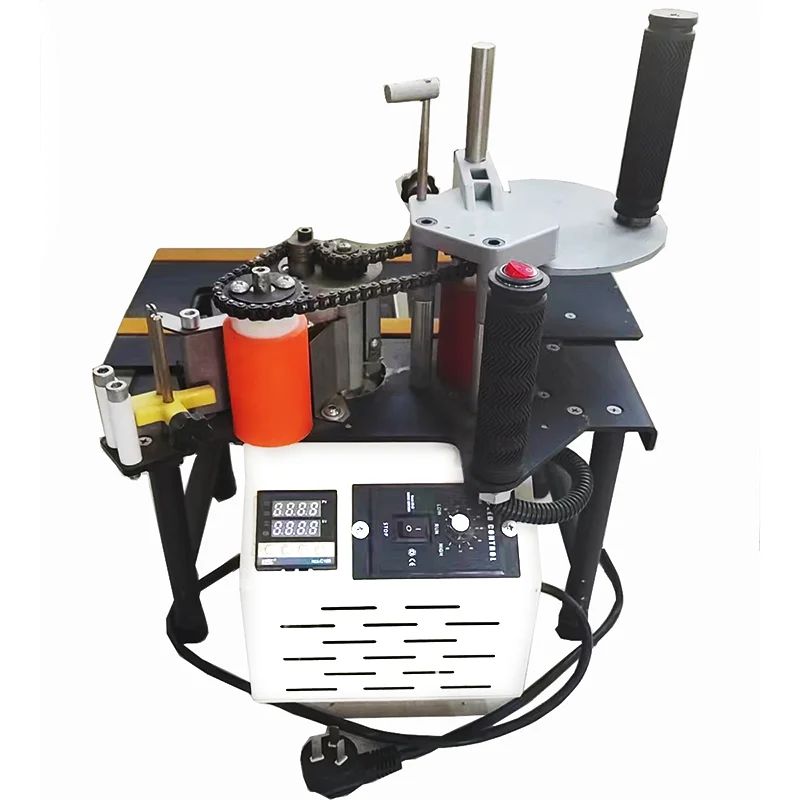
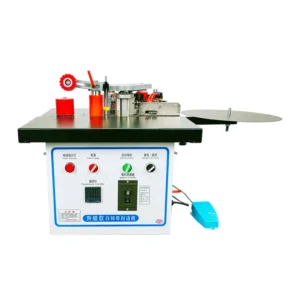
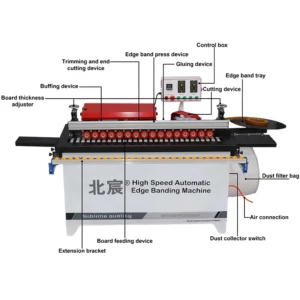
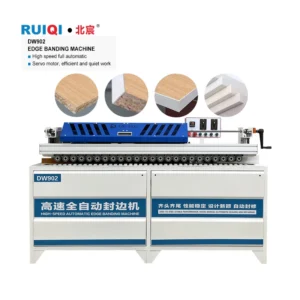
Precision Ground Components — Every portable edge banding machine leaves the factory with test records run on the buyer’s actual panel stock and edge material, verified before crating.
Technical Specifications
| Parameter |
Value |
| Product Type |
Portable Edge Banding Machine |
| Shape of Edge-banding Plates |
Curved, Straight and Special-shaped Sheet |
| Edge Thickness Range |
0.3–3 mm |
| Edge Sealing Speed |
0–6 m/min |
| Panel Thickness Range |
7–60 mm |
| Gluing Method |
Double-sided gluing |
| Glue Pot Volume |
1000 ml |
| Machine Weight |
14 kg |
| Assembly State |
Portable / Handheld |
| Plug Options |
EU / AU / UK / USA / CN |
| Logo Customization |
Available |
| Voltage & Frequency |
(basis not stated in source — confirm with manufacturer) |
| Rated Power |
(basis not stated in source — confirm with manufacturer) |
| Control System |
(basis not stated in source — confirm with manufacturer) |
| Overall Dimensions (L×W×H) |
(basis not stated in source — confirm with manufacturer) |
| Tolerance |
(basis not stated in source — confirm with manufacturer) |
| Warranty |
1 year |
Application Suitability
| Application |
Material or Output |
| Small-scale joinery workshop edge finishing |
PVC and veneer strips on MDF and particleboard panels |
| On-site curved panel edge banding |
0.3–3 mm edge banding on plywood and solid wood profiles |
| Cabinet and custom furniture prototyping |
Melamine paper and standard banding on 7–60 mm substrates |
| Manual-to-machine transition for startups |
Straight and special-shaped edge sealing on composite boards |
| OEM-branded machine distribution |
Region-specific plug and voltage configurations for resale markets |
The Wrong Plug Type Can Stop a Workshop Before It Starts
Voltage and plug configuration must be confirmed before production begins, not after the crate arrives.
A portable edge banding machine is often the first powered equipment a small joinery shop adds beyond a table saw. When that machine arrives with a European plug and the workshop runs on a different standard, the unit sits idle while the buyer sources adapters or rewires the connection. In humid or dusty workshop environments, improper electrical adaptation introduces failure points that do not appear during factory testing [NEED_CITE: voltage and frequency standards by export market]. I have watched a unit perform perfectly on PVC banding in our Shandong test bay, then struggle with adhesion when the customer switched to melamine paper strips on-site because the glue temperature curve shifted under a different supply frequency.

Manufacturing Depth Behind a Handheld Unit
The Portable Edge Banding Machine OEM factory produces this unit on the same precision-ground assembly line as our larger stationary edge banders. The gluing head mechanism undergoes the same multi-stage inspection applied to full-size models, because a 14 kg handheld unit still depends on consistent roller pressure and even adhesive distribution across its 0.3–3 mm edge thickness range. Component sourcing is consolidated in-house, meaning replacement parts for the glue pot, feed rollers, and trimming elements remain available long after the initial purchase.
OEM Branding Without Compromising Build Integrity
Private label buyers need more than a logo swap on the nameplate. This portable edge banding machine supports custom branding across the machine body, packaging, and documentation set while maintaining the underlying four-stage quality control sequence. The OEM scope covers logo placement, instruction manual translation into the target market language, and region-matched electrical configurations [NEED_CITE: CE machinery directive requirements for industrial equipment]. Distributors evaluating this unit for regional resale receive the same factory test records and pre-shipment verification documentation as direct buyers.
What the Specification Sheet Actually Means on the Shop Floor
The 7–60 mm panel thickness range covers the full span of materials a custom furniture shop encounters, from thin 7 mm MDF drawer sides to 60 mm solid wood worktops. Double-sided gluing applies adhesive to both the panel edge and the banding strip simultaneously, which matters when working with curved profiles where single-sided application leaves inconsistent contact. The 1000 ml glue pot provides enough capacity for extended run sessions without frequent refills, relevant for on-site installations where stopping to replenish adhesive interrupts workflow. Edge sealing speed up to 6 m/min is governed by the operator’s hand guidance on curved sections — pushing faster risks uneven bonding on tight radii. The 14 kg weight balances portability against the mass needed to maintain stable contact pressure without the operator fighting vibration through the handle.
The Cost of Skipping Pre-Shipment Material Testing
When a portable edge banding machine ships without being tested on the buyer’s actual substrate and banding combination, the first production run becomes the test run. Adhesion failures on melamine paper strips may not appear with PVC, and adjusting glue temperature, feed pressure, and roller alignment on an unfamiliar machine in an unfamiliar workshop extends commissioning from hours into weeks [NEED_CITE: edge banding adhesion variables across substrate materials]. I have seen this delay cascade: the furniture delivery date slips, the workshop owner questions the machine choice, and a unit that performs well under correct parameters earns an undeserved reputation for poor bonding.
Why Source This Portable Edge Banding Machine Here
In-house manufacturing means the cutting and gluing mechanisms carry proprietary design elements rather than generic sourced assemblies. The product family spans from this portable unit through full-function pre-milling edge banders, so a workshop that outgrows handheld operation can scale to a stationary model within the same supply relationship. Voltage, plug type, and control panel language are configured as standard practice before production, not treated as special requests. Four-stage quality control includes incoming material inspection, in-process checks, finished product verification, and pre-shipment testing with documented results [NEED_CITE: industrial equipment quality verification standards]. An engineer reviews each order against the buyer’s stated panel materials and production volume before issuing a formal quotation, typically within one working day.
Documentation & Verification
- CE declaration of conformity matched to the portable edge banding machine export destination
- Factory test record run on buyer-supplied panel thickness and edge banding material
- Electrical schematic confirming voltage, frequency, and plug type before production release
- Operation and maintenance manual translated into the buyer’s agreed language
- Spare parts list with part numbers for glue pot, rollers, and trimming components
- Pre-shipment photograph set showing machine condition and packaging state
Installation, Commissioning & Support
- 14 kg portable unit requires a stable workbench rather than a dedicated floor foundation
- Plug type confirmed to EU, AU, UK, USA, or CN standard before dispatch to match workshop outlets
- Unit arrives fully assembled with glue pot, rollers, and feed mechanism ready for first use
- Initial parameter setting for glue temperature and feed speed calibrated to buyer’s stated edge material
- 1000 ml glue pot capacity and double-sided gluing method covered in operator training documentation
- Wear parts including feed rollers and trimming blades listed with reorder part numbers
What We Need to Configure Your Machine Correctly
To specify the right electrical and operational setup, share your workshop’s local voltage and frequency, the edge banding materials you work with most often, and the panel substrates in your typical production mix. If you are evaluating this unit for OEM resale, let us know the target market region, preferred branding placement, and documentation language requirements. We can run your supplied material samples through a test cycle and include the parameter settings with the shipment.
Frequently Asked Questions
Q: How is voltage and plug type confirmed for different target markets before shipment?
A: We confirm your local voltage, frequency, and plug standard during the quotation stage, before production starts. The electrical schematic is updated to reflect your market’s requirements, and the machine is tested under those conditions. Plug options include EU, AU, UK, USA, and CN configurations. This prevents the situation where a machine arrives and cannot be powered on without sourcing adapters.
Q: What OEM customization scope is available for logo, packaging, and documentation?
A: Logo placement on the machine body, custom packaging design, and full documentation translation are all within the OEM scope. The operation manual, spare parts list, and maintenance guide can be produced in your target market language. We maintain the same four-stage quality control process regardless of branding configuration, so private label units carry identical build integrity and test records.
Q: How does the portable unit integrate with existing workshop production workflows?
A: At 14 kg, this machine sits on an existing workbench alongside your current equipment rather than requiring dedicated floor space. The 7–60 mm panel thickness range and 0.3–3 mm edge thickness capacity cover most joinery workshop materials. It is typically positioned as a flexible supplement for curved and special-shaped work that stationary edge banders cannot handle.
Q: What spare parts and consumables are included, and how are replacements sourced?
A: Each unit ships with a spare parts list detailing part numbers for high-wear items including feed rollers, trimming blades, and glue pot seals. The 1000 ml glue pot uses standard hot-melt adhesive compatible with widely available suppliers. Replacement components are manufactured in-house and can be ordered directly using the documented part numbers.
Q: What factory quality checks are performed before dispatch, and can buyers request test records?
A: Every unit passes through incoming material inspection, in-process assembly checks, finished product verification, and a pre-shipment test run. When buyers supply their actual panel and edge banding samples, we run the machine on those materials and document the parameter settings. The test record ships with the machine so the operator can replicate factory-verified results immediately on arrival.