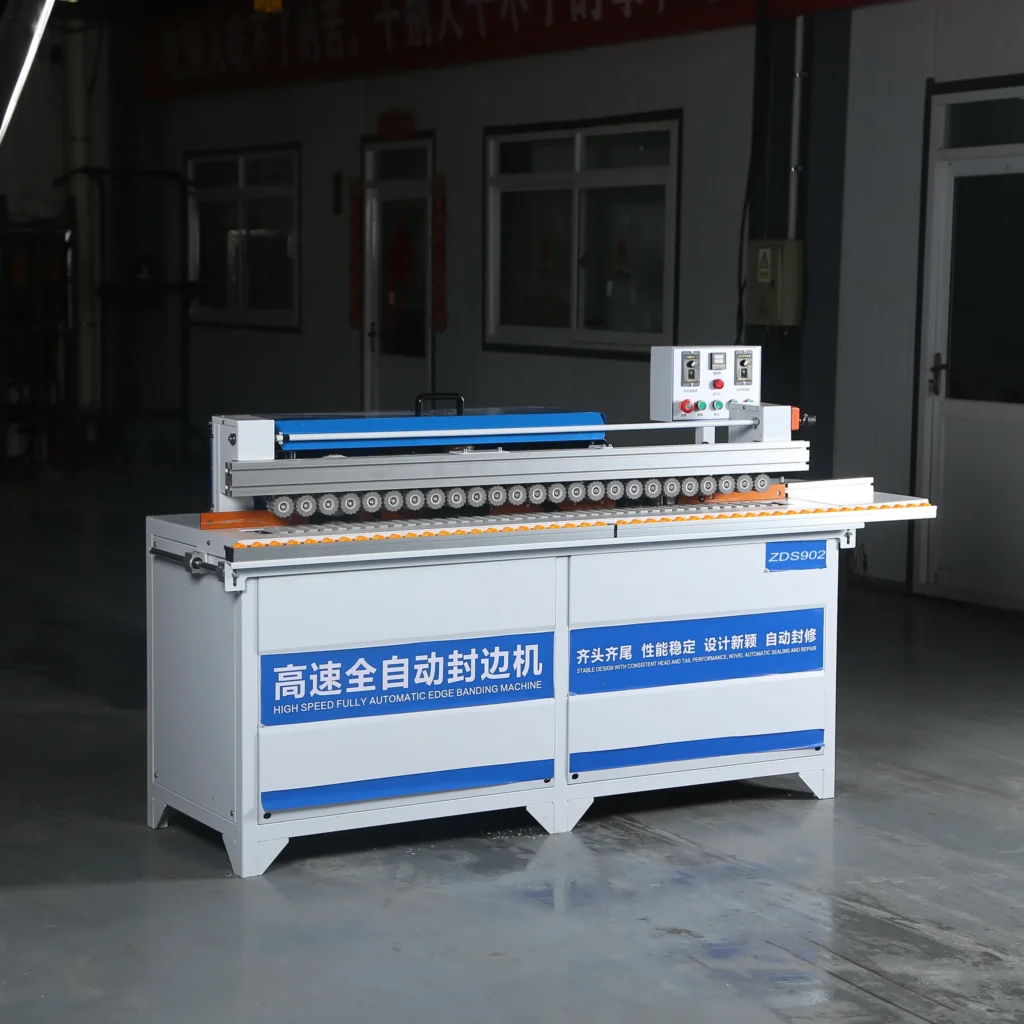
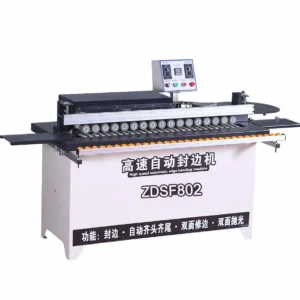
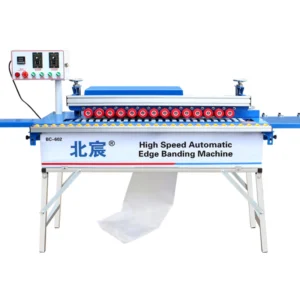
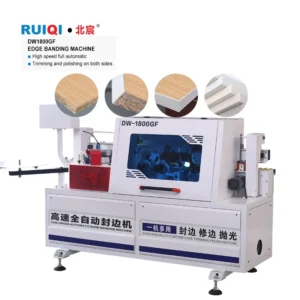
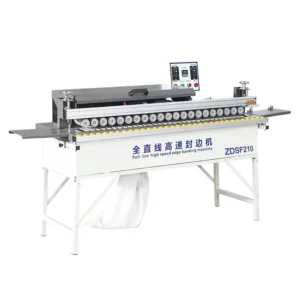
Precision-Ground Assembly — Every linear automatic edge banding machine leaves our facility with a factory test record verifying tolerance on your specified panel thickness and edge material before crating.
Technical Specifications
| Parameter |
Value |
| Product Type |
Automatic Edge Banding Machine |
| Voltage |
220V (configurable from 110V to 440V) |
| Total Power |
4200W |
| Overall Dimensions |
207 × 60 × 122 cm |
| Net Weight |
245 kg |
| Edge Band Height Range |
0–35 mm |
| Edge Band Thickness Range |
0.5–2.5 mm |
| Glue Pot Capacity |
4000 ml |
| Edge Banding Type |
Linear |
| Gluing System |
Double-sided gluing with intelligent temperature control |
| Trimming System |
Double high-speed trimming motors (up and down) |
| Polishing System |
Up and down two polishing motors |
| Pressure System |
Integrated pressure beam with double rows of pressure wheels |
| Edge Strip Cutting |
Pneumatically controlled cutting device |
| Conveyor Belt |
Silicone material |
| Assembly State |
Requires assembly; user manual and video teaching provided |
| Delivery Time |
25–30 days (basis to be confirmed) |
| Warranty |
1 year |
Application Suitability
| Application |
Material or Output |
| Custom furniture panel edge banding |
MDF, plywood, and particleboard with PVC edge banding |
| Cabinet door and carcass production |
Melamine-faced board with 0.5–2.5 mm PVC or melamine strips |
| Office and modular furniture manufacturing |
Particleboard and MDF panels requiring linear edge finishing |
| Panel processing plant batch runs |
Wood-based panels with standard linear edge profiles |
| Small workshop automation transition |
Manual-to-machine upgrade for joinery shops handling mixed substrates |
Why the Voltage Question Must Come Before the Quotation on Every Automatic Edge Banding Machine Factory OEM Order
A motor wound for 50 Hz will overheat and fail within weeks on a 60 Hz supply — no amount of on-site adjustment can fix a fundamental winding mismatch.
I have flown to installation sites where a brand-new edge bander sat silent on the factory floor because the control transformer was specified for 380V/50Hz while the local grid delivered 440V/60Hz. The buyer had compared quotations line by line but never confirmed the frequency. The cost of rewinding or replacing motors, contactors, and the PLC power supply often exceeds the shipping savings of buying direct. When you evaluate an automatic edge banding machine factory OEM partner, the first technical exchange should be a single-line diagram of your facility’s incoming supply, not the feed speed chart [NEED_CITE: voltage and frequency standards by export market].

Component Sourcing and Assembly Depth
An automatic edge banding machine factory OEM build begins with the pressure beam and conveyor bed. The integrated pressure beam on this unit uses double rows of pneumatically loaded pressure wheels, which distribute clamping force evenly across the panel width. This matters when you run warped particleboard or slightly cupped MDF — uneven pressure causes the edge band to lift at one end during trimming. The silicone conveyor belt resists hot-melt glue adhesion, reducing downtime spent scraping cured residue off the belt surface between production runs.
Private Label and Electrical Customization
Distributors building their own brand need more than a logo swap. The control panel language, safety label set, and operator manual must match the end user’s reading ability. This machine supports multilingual control panel configuration and custom voltage winding from 110V to 440V, so a regional importer can standardise a single electrical specification across their entire territory [NEED_CITE: CE machinery directive requirements for industrial equipment]. OEM logo application covers the machine body, the glue pot housing, and the electrical cabinet door — verified against your artwork proof before paint curing.
How the Glue Pot and Trimming Stations Shape Edge Quality
The 4000 ml glue pot with intelligent temperature control reduces the frequency of manual refills during long production runs, but capacity alone does not guarantee bond quality. The double-sided gluing system applies adhesive to both the panel edge and the back of the edge band simultaneously, which is critical when working with porous particleboard that absorbs glue rapidly. If the temperature curve does not match the melting point of your specific hot-melt formulation — especially when using locally sourced recycled EVA — the adhesive skins over before the pressure wheels make contact. Downstream, the double high-speed trimming motors remove overhang from both the top and bottom faces in one pass, while the two polishing motors burnish the trimmed edge to a smooth finish. Trimming quality directly affects whether the assembled cabinet carcass sits square: a 0.3 mm overhang left untrimmed compounds across every joint in a run of kitchen units.
The Hidden Cost of Skipping the Pre-Shipment Test
I once spent five days at a particleboard factory in South Asia resetting temperature zones because the glue pot curve had been calibrated on standard PVC at our facility, while the customer’s locally sourced recycled edge strip contained filler compounds that shifted the melt behaviour entirely. The panels looked acceptable at first pass, but within hours the edges began lifting in the humid warehouse. When you skip the sample processing test using your actual material, you inherit this risk. The pre-shipment verification step exists precisely to catch these substrate-specific mismatches before the machine leaves the factory floor [NEED_CITE: edge banding adhesion failure causes on porous substrates].
What This Factory Delivers Beyond the Machine Itself
The four-stage quality control process — incoming material inspection, in-process checks, finished product verification, and pre-shipment testing — means every pressure wheel alignment and glue pot sensor is logged before crating. The patented cutting mechanism design is manufactured in-house, so replacement trimming blades and pressure wheel sets remain available without depending on third-party suppliers. Voltage and control panel language are confirmed in writing before production begins, eliminating the arrival-site mismatch described earlier. The engineering team provides a formal configuration proposal within 24 hours of receiving your panel specifications, rather than quoting a catalogue standard unit and hoping it fits [NEED_CITE: ISO 9001 quality management system requirements for machinery manufacturing].
Documentation & Verification
- CE declaration of conformity covering the complete edge banding assembly
- Electrical schematic with confirmed voltage and frequency for your facility
- Factory test record run on your specified panel thickness and edge material
- Machine specification sheet with all station motor ratings and dimensions
- Operation and maintenance manual in the operator’s agreed language
- Spare parts list with part numbers for trimming blades, pressure wheels, and glue pot sensors
Installation, Commissioning & Support
- 207 × 60 × 122 cm footprint requires a level concrete pad with 500 mm clearance on all sides
- 4200W total load needs a dedicated 220V circuit with appropriate breaker rating
- Machine ships partially disassembled; video-guided reassembly covers pressure beam and conveyor alignment
- First-run commissioning includes glue temperature curve tuning for your specific edge band material
- Pneumatic cutting device requires a clean, dry compressed air supply at the rated pressure
- Silicone conveyor belt tension and tracking adjustment demonstrated during initial setup session
Preparing Your Inquiry
Before requesting a quotation, gather your typical panel thickness range, the edge band materials you run most frequently, and your facility’s incoming voltage and frequency. Note whether your operators need a specific control panel language and whether the machine will feed into an existing production line with upstream panel sizing equipment. If you are evaluating this unit for OEM branding, include your target logo placement and the electrical standard you want uniform across your market.
Frequently Asked Questions
Q: How do we confirm the correct voltage and frequency before placing the order?
A: Share a photo or single-line diagram of your facility’s incoming electrical panel. The engineering team cross-references your supply against the motor winding specification and control transformer rating, then confirms both in the electrical schematic before production starts. This prevents the common failure where a machine arrives with incompatible contactors or an overheating main motor.
Q: What can be customised under the OEM arrangement?
A: Customisation covers your logo on the machine body and electrical cabinet, control panel language selection, voltage winding from 110V to 440V, and specific mechanical adjustments such as pressure wheel configuration. Safety labels, operator manuals, and spare parts documentation are also produced in your agreed language and branding.
Q: Can we send our own panel and edge band samples for a pre-shipment test?
A: Yes. Ship a batch of your actual substrate and edge banding material to the factory. The machine is then run on your material during the pre-shipment verification stage, and the glue temperature curve, pressure wheel settings, and trimming depths are adjusted and documented before the unit is crated for export.
Q: How are spare parts supplied to distributors serving remote markets?
A: Each machine ships with a spare parts list identifying wear items such as trimming blades, polishing wheels, and glue pot sensors. Distributors receive a recommended initial stock package based on projected service intervals, and replacement parts are available for direct shipment with standard lead times matching production scheduling.