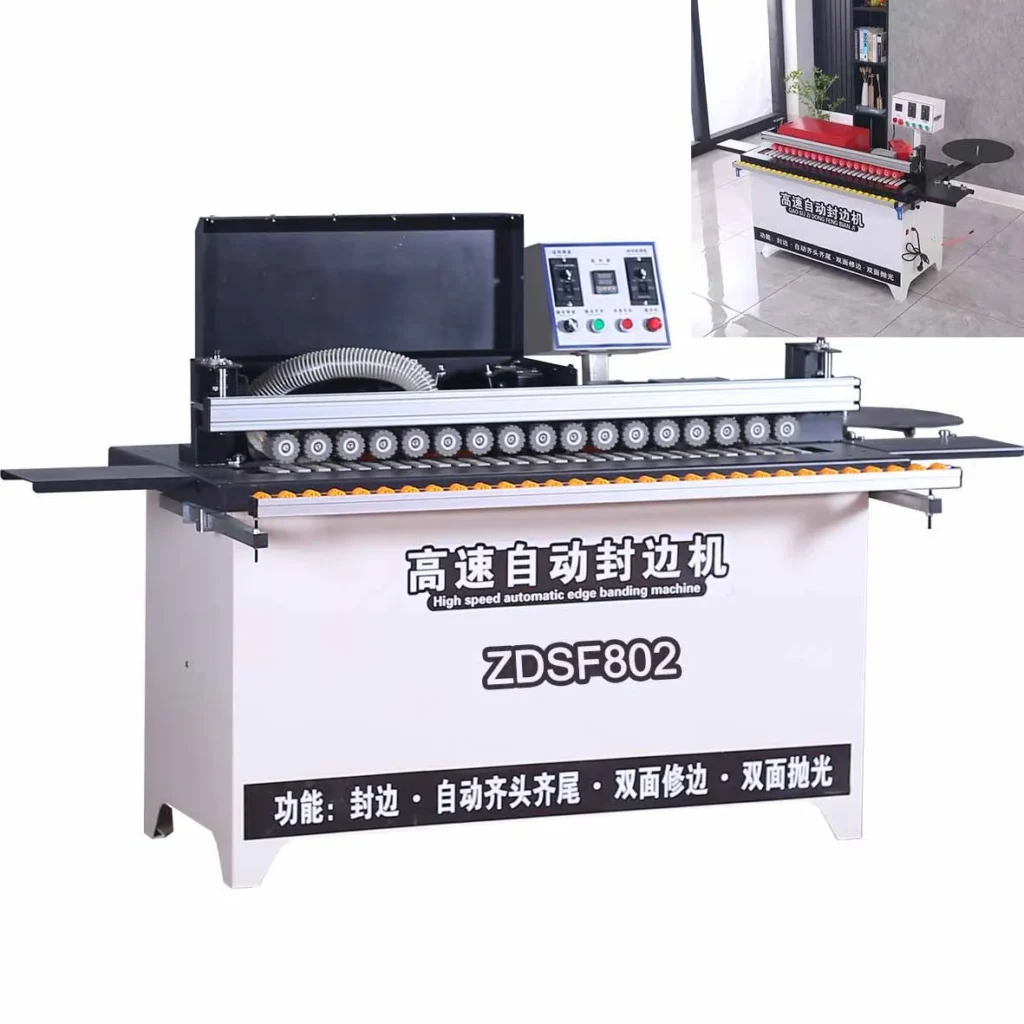
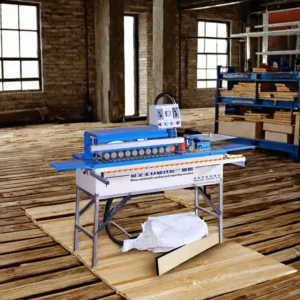
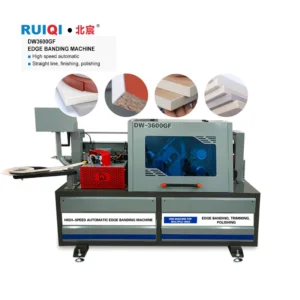
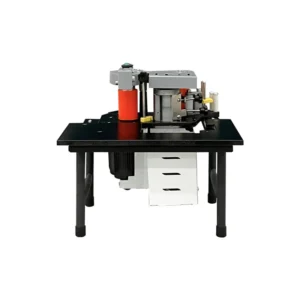
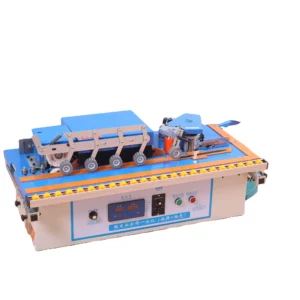
In-House Cutting Mechanism Patents — verified ±0.02mm tolerance on the Model 802, built by an edge banding machine manufacturer that controls every grinding stage from raw casting to pre-shipment test.
Technical Specifications
| Parameter |
Value |
| Model |
802 |
| Product Type |
Automatic Edge Banding Machine |
| Function Sequence |
Automatic plate feeding, end cutting, rough trimming, fine trimming, upper and lower polishing |
| Edge Type |
Straight line |
| Rated Voltage |
220V (configurable from 110V to 440V) |
| Rated Power |
4 kW |
| Trimming Power |
800 W × 2 (double high-speed motors, up and down) |
| Polishing Power |
180 W × 2 (up and down) |
| Suction Power |
1200 W |
| Heating Power |
1000 W (5–10 min heat-up) |
| Glue Capacity |
4000 ml |
| Glue Pot Control |
Digital display, independent switch |
| Strip Thickness |
0.5–2.5 mm |
| Sheet Thickness |
10–50 mm |
| Feed Speed |
0–10 m/min |
| Conveyor Belt Speed |
0–10 m/min |
| Conveyor Belt Material |
Silicone |
| Pressure Beam |
One-piece integrated, double rows of pressure wheels |
| Belt Breaking Method |
Pneumatically controlled |
| Rated Air Pressure |
0.4–0.6 MPa |
| Auxiliary Feature |
Extendable fluent strips for large plates |
| Overall Dimensions |
130 × 65 × 75 cm |
| Machine Weight |
150 kg |
Application Suitability
| Application |
Material or Output |
| Custom cabinet panel edge finishing |
MDF and particleboard with PVC or melamine edge bands |
| Small-batch furniture production |
Plywood panels with veneer or ABS strip |
| Workshop straight-line banding |
Solid wood panels up to 50 mm thickness |
| Regional distributor stock portfolio |
Mid-range automatic edge bander for local resale |
Why the Voltage Question Must Come Before the Machine Price
Every Model 802 ships only after a formal voltage confirmation matched to the destination grid.
I once watched a container arrive in the Middle East with a machine wired for 380 V when the workshop ran 440 V at 60 Hz. The contactor refused to engage, the glue pot never reached temperature, and the customer sat idle for three weeks while a replacement control cabinet was air-freighted. That edge banding machine manufacturer oversight cost more in downtime than the unit itself. Voltage mismatch is one of the most common commissioning failures in exported woodworking equipment, yet it is entirely preventable if addressed during the quotation stage rather than discovered on the factory floor [NEED_CITE: voltage and frequency standards by export market].

Precision Ground Components Under One Roof
The Model 802 is assembled from components that are precision-ground within the same facility where final testing takes place. This means the pressure beam flatness, the trimming motor alignment, and the conveyor belt tracking are all verified against a single set of manufacturing tolerances before the machine leaves the production floor. When an edge banding machine OEM factory controls both machining and assembly, the ±0.02 mm tolerance stated on the spec sheet is not an aspiration — it is a measured result logged during the four-stage QC process.
Private-Label and Branding Depth for Distributors
Beyond placing a logo on the machine housing, OEM partners can specify control panel language, packaging format, documentation set, and electrical labeling standards that match their target market. Regional importers who stock multiple units benefit from consistent branding across the entire shipment, so their end customers see a unified product identity. The glue pot digital display, the polishing motor housings, and even the spare parts list can all carry the distributor’s own part numbering scheme [NEED_CITE: CE machinery directive requirements for industrial equipment].
What the Spec Sheet Numbers Mean on the Shop Floor
The 4000 ml glue pot capacity allows a full shift of continuous banding on standard PVC strips without pausing for a refill, and the 1000 W heating element brings the adhesive to working temperature in roughly five to ten minutes. Double high-speed trimming motors at 800 W each handle the rough and fine trim passes in a single feed, which directly influences edge cleanliness on particleboard where tear-out is a constant risk. The one-piece integrated pressure beam with double rows of silicone pressure wheels keeps the panel flat against the conveyor, preventing the slight tilt that causes uneven glue spread on thinner MDF sheets. Feed speed ranges from 0 to 10 m/min, giving operators room to slow down for thick veneer or speed up for high-volume PVC runs. Pneumatically controlled belt breaking ensures the strip severs cleanly at the panel end, reducing manual touch-up work downstream.
The Cost of Skipping Configuration Verification
Distributors who order a batch of edge banders without confirming the trim motor configuration against the strip materials their customers actually use often end up shipping replacement units or absorbing return freight. A machine set up for thin PVC will chatter on 2.5 mm solid wood edging, producing visible scallop marks that no amount of polishing can hide. Similarly, a workshop running 50 mm solid wood panels needs the extendable fluent strips engaged; without them, the panel tail drops before the final polishing station, leaving an unfinished section that fails visual inspection [NEED_CITE: edge banding adhesion standards for panel furniture].
What This Factory Delivers Beyond the Machine
In-house patented cutting mechanisms mean the trimming geometry is designed and tested here, not copied from a third-party catalog. Four-stage quality control — incoming material, in-process, finished product, and pre-shipment — ensures every Model 802 is run on actual panel stock before crating. Voltage configuration from 110 V to 440 V is confirmed per order with a signed electrical schematic, so there is no guesswork at the destination port. Engineer-led configuration recommendations arrive within 24 hours of inquiry, based on the buyer’s panel material, strip type, and daily volume. Factory visits are open at any stage, letting distributors watch their own units move through assembly and test.
Documentation & Verification
- Factory test record run on buyer’s specified panel thickness and strip material before dispatch
- Electrical schematic confirming voltage and frequency matched to destination country
- Operation and maintenance manual translated into the buyer’s agreed language
- Spare parts list with OEM part numbers for local stocking planning
- Packing photographs showing crating, blocking, and container loading sequence
Installation, Commissioning & Support
- 4 kW rated power requires a dedicated circuit; confirm breaker rating before wiring the Model 802
- 0.4–0.6 MPa air supply with clean, dry air to protect the pneumatic belt-breaking cylinder
- 130 × 65 × 75 cm footprint fits standard workshop doors; verify clearance for extendable fluent strips
- Digital glue pot thermostat calibrated during pre-shipment test; re-verify after transport vibration
- Silicone conveyor belt tension checked on arrival; adjustment procedure in the manual
- Spare trimming and polishing motor brushes included in the first-ship parts kit
Start the Configuration Conversation
Provide your target panel materials, strip thickness range, and local voltage with frequency so we can confirm the correct motor and control configuration for your market. If you plan to stock multiple units, share your model mix preference from entry-level to full-function so we can align production batches. Let us know whether you require private-label documentation and which language the operation manual should carry.
Frequently Asked Questions
Q: What can be customized under an OEM or private-label agreement?
A: Logo placement, machine color, control panel language, voltage from 110 V to 440 V, packaging format, and documentation branding are all configurable. Each customization is confirmed in the specification sheet before production starts, so the finished unit matches the distributor’s market identity exactly.
Q: How deep does in-house manufacturing go on this model?
A: The cutting mechanism design is patented and machined on-site. Pressure beams are ground and inspected in-house. Motors and electrical components are sourced from specified suppliers, then assembled and tested within the same facility under four-stage QC before dispatch.
Q: What quality records accompany each shipment?
A: Every Model 802 ships with an incoming material inspection log, in-process check record, finished product test report, and pre-shipment verification document. Pre-shipment test records include actual panel run data and are shared with the buyer before the container is sealed.
Q: How do you support territory planning for new distributors?
A: We map a regional model mix from compact workshop units to full-function production line machines, all within one product family. This lets distributors offer an upgrade path to their customers without managing multiple supplier relationships or incompatible spare parts inventories.
Q: What does the spare parts supply arrangement look like?
A: A detailed spare parts list ships with every unit, listing part numbers for trimming motors, polishing brushes, conveyor belt sections, and pneumatic components. Replacement parts are produced or sourced from the same supply chain, keeping lead times consistent for ongoing distributor stock.