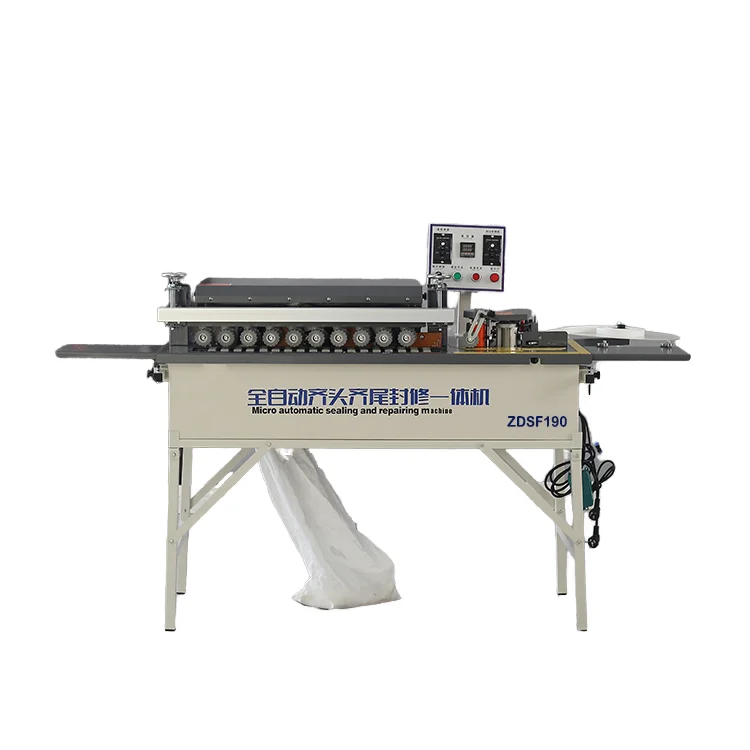
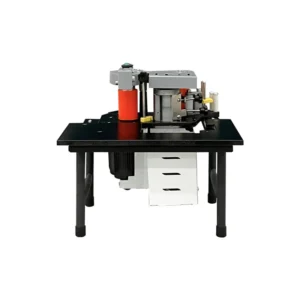
Precision-Ground Assembly — Every ZDSF190 unit is built on square slide rails with imported four-blade alloy arc knives, verified through a four-stage quality protocol before private-label branding is applied.
Technical Specifications
| Parameter |
Value |
| Model |
ZDSF190 |
| Product Type |
Miniature Fully Automatic Curved and Straight Dual-purpose Edge Banding Machine |
| Voltage & Frequency |
220V 50Hz (configurable from 110V to 440V) |
| Rated Power |
4kW |
| Heating Power |
800W |
| Suction Power |
1200W |
| Polishing Power |
180W × 2 |
| Trimming Power |
800W × 2 |
| Transmission Power |
120W |
| Belt Power |
25W |
| Feed Speed |
0–14 m/min |
| Sheet Thickness Range |
10–50 mm |
| Strip Thickness Range |
0.5–2.5 mm |
| Glue Capacity |
1000 ml |
| Rated Air Pressure |
0.4–0.6 MPa |
| Trimming Mechanism |
Imported 4-blade alloy arc knife |
| Slide Rail |
Square slide rail (profiling); steel rod slide rail (crawler) |
| Feed System |
Double-row rubber pressure wheels, automatic plate feeding |
| Edge Strip Cutting |
Pneumatically controlled with push-type limit switch |
| Curved/Straight Conversion |
180-degree rotation |
| Overall Dimensions (L×W×H) |
1900 × 560 × 1300 mm |
| Weight |
120 kg |
Application Suitability
| Application |
Material or Output |
| Small workshop straight edge banding |
MDF, particleboard, plywood panels with PVC or veneer strips |
| Curved profile edge finishing |
Shaped cabinet doors and radius-cut solid wood panels |
| Custom furniture low-volume runs |
Melamine-faced boards with 0.5–2.5 mm edge banding |
| Joinery prototype and sample work |
Mixed substrates requiring frequent curved-to-straight changeover |
Why the Voltage Question Must Precede Every Edge Banding Machine OEM Factory Order
Confirming local supply voltage before production starts prevents weeks of commissioning delay and avoids transformer procurement headaches at the destination.
I watched a Middle East customer wait almost a month for a step-down transformer because the machine left our floor at 380V while the site ran 415V. The downtime cost the installer credibility and the distributor a replacement shipment. [NEED_CITE: voltage and frequency standards by export market] When sourcing from an Edge Banding Machine OEM factory, the electrical configuration is not a line-item afterthought — it determines whether the machine powers on at all when it reaches the workshop floor. Every order should begin with a confirmed electrical schematic matching the destination grid, not a generic factory-default plate.

How OEM Partners Evaluate Component Sourcing Depth
Private-label buyers look past the outer shell to ask where the square slide rail, arc knives, and pneumatic cutters originate. The ZDSF190 uses an imported brand four-blade alloy arc knife for profiling and trimming, paired with a square slide rail that maintains alignment during curved-edge passes. When an Edge Banding Machine OEM factory sources these components through controlled supplier channels rather than spot-market procurement, batch-to-batch consistency in edge finish follows naturally. This is the manufacturing depth that separates a rebrand exercise from a genuine OEM partnership.
Four-Stage Quality Control as a Contractual Deliverable
Incoming material inspection, in-process assembly checks, finished-product testing, and pre-shipment verification form the sequence that every unit passes through before crating. For OEM partners, these stages are documented — not merely stated in a brochure. Factory test records capture the actual panel thickness, strip material, and feed speed used during verification runs, giving the distributor evidence to show their own customers. [NEED_CITE: CE machinery directive requirements for industrial equipment] Without that paper trail, a private-label brand carries the reputational risk of every unit that leaves the loading dock.
Reading the Specs That Actually Govern Edge Quality
Feed speed on this unit ranges from 0 to 14 m/min, which positions it for low-to-moderate workshop volumes rather than continuous production lines. At the lower end of that range, the double-sided gluing system and adjustable glue roller maintain film uniformity on both the panel edge and the strip back, reducing visible glue lines on porous substrates like particleboard. The 10–50 mm sheet thickness range covers standard cabinet panels up to thick solid-wood stock, but attempting to run material outside that window risks pressure-beam deflection and uneven trimming. The pneumatically controlled cutting device with its push-type limit switch delivers a repeatable end-cut, which matters when operators switch between straight and curved profiles multiple times per shift. Dust collection relies on two large-diameter ports rated for 1200W suction, keeping the trimming zone clear and preventing chip buildup from scoring the finished edge.
What Happens When a Compact Edge Bander Is Pushed Beyond Its Design Envelope
Distributors sometimes slot an entry-level machine into a production schedule it was never dimensioned for, then wonder why the trimming knives dull prematurely and the glue roller cannot keep pace with back-to-back shifts. The ZDSF190’s 4kW total rated power and 1000 ml glue pot are sized for workshop pacing — running eight-hour shifts at maximum feed speed will exhaust the glue supply and thermal capacity faster than the heating element can recover. [NEED_CITE: thermal recovery limits in small-capacity glue pots] The consequence is not catastrophic failure but a gradual drift in adhesion quality that operators blame on the strip material instead of the machine duty cycle.
Why OEM Buyers Commit Production Runs Here
In-house manufacturing with a proprietary cutting mechanism means the trimming geometry is designed and validated under the same roof, not outsourced and rebranded. Voltage, control-panel language, and color specifications are configurable as standard options, not treated as special requests that delay scheduling. The four-stage QC protocol produces documentation that OEM partners can audit before containers are sealed. Factory visits are welcomed at any production phase, allowing buyers to witness assembly benches and test stations firsthand. An engineer-led configuration proposal with a formal quotation arrives within one working day of inquiry, keeping the OEM partner’s own project timeline intact.
Documentation & Verification
- CE declaration of conformity listing the ZDSF190 model family and applicable directives
- ISO 9001 certificate covering the manufacturing and quality-management scope
- Factory test record run on buyer-specified panel thickness and edge strip material
- Electrical schematic confirming configured voltage, frequency, and breaker ratings
- Operation and maintenance manual translated into the agreed control-panel language
- Pre-shipment photograph set showing packing, labeling, and OEM logo placement
Installation, Commissioning & Support
- Confirm a dedicated 220V circuit (or locally configured voltage) with appropriate breaker sizing for the 4kW load
- Allow minimum 2000 × 800 mm clear floor space around the 1900 × 560 mm footprint for material staging
- Supply compressed air at 0.4–0.6 MPa through a filtered regulator for pneumatic edge-strip cutting
- Verify dust-extraction ducting matches the two large-diameter ports before first startup
- Schedule a remote or on-site commissioning session to set glue volume and feed speed for local substrates
- Stock replacement four-blade alloy arc knives and rubber pressure wheels as first-line spares
Before You Request a Quote
Share the panel materials, thickness range, and edge strip types your workshop processes most frequently, along with the local voltage and frequency at the installation site. If curved-edge work is part of your regular output, note the smallest radius you need to band so the profiling station can be validated before shipment. Specify the control-panel language and any private-label requirements so they enter the production schedule from day one.
Frequently Asked Questions
Q: What OEM and private-label customization is available for the ZDSF190?
A: Logo placement, machine color, voltage from 110V to 440V, multilingual control panels, and specification tailoring are all standard customization options. Each configuration is confirmed via an electrical schematic and specification sheet before production begins, ensuring the private-label partner reviews and approves every parameter prior to assembly.
Q: How does the factory verify manufacturing quality on OEM orders?
A: Every unit passes through four QC stages: incoming material inspection, in-process assembly checks, finished-product functional testing, and pre-shipment verification. Component sourcing is controlled, and precision-ground parts such as the square slide rail are measured against tolerance specifications before installation on the ZDSF190 frame.
Q: What documentation ships with an OEM-configured edge bander?
A: Standard documentation includes the CE declaration of conformity, ISO 9001 certificate, factory test record on buyer-specified materials, electrical schematic with confirmed voltage, operation manual in the agreed language, and a spare parts list. Packing photographs and customs documentation support are provided before the container is sealed.
Q: Can the factory produce a sample unit before bulk commitment?
A: Yes. A sample ZDSF190 can be built to the OEM partner’s exact specifications, including logo, voltage, and control-panel language, and tested on buyer-supplied panel materials and edge banding stock. The sample run generates a full factory test record that serves as the quality benchmark for subsequent production runs.
Q: How are large OEM production runs scheduled?
A: After sample approval, the production schedule is agreed based on order quantity and component lead times. The engineer-led configuration proposal ensures every unit in the batch shares the same specification, and pre-shipment verification is performed on each machine before dispatch to maintain consistency across the entire run.