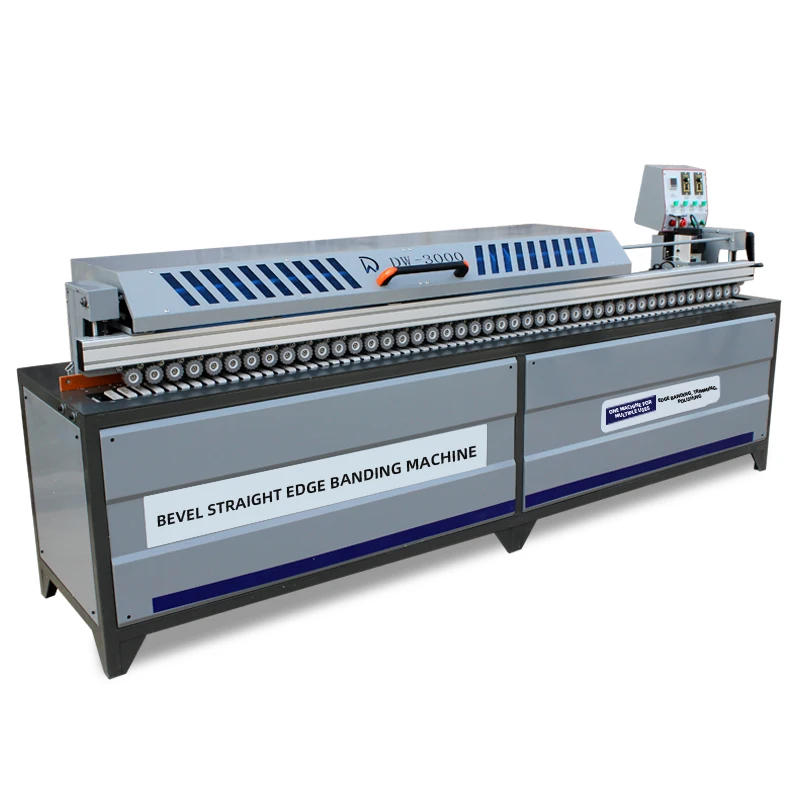
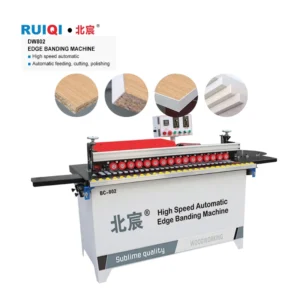
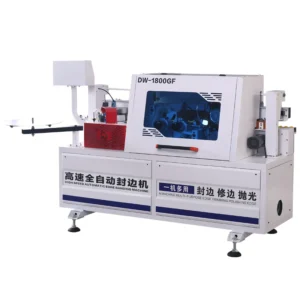
Precision-Verified Build — every DW3000 unit ships with factory test records documenting ±0.02mm tolerance on your specified panel material, not just a spec sheet claim.
Technical Specifications
| Parameter |
Value |
| Model |
DW3000 |
| Product Type |
Fully Automatic Slant and Straight Edge Banding Machine |
| Rated Power |
11 kW |
| Voltage & Frequency |
380V / 415V (50Hz/60Hz to be confirmed per destination market) |
| Overall Dimensions (L×W×H) |
299 × 65 × 130 cm |
| Net Weight |
430 kg |
| Feed Speed |
0–12 m/min |
| Minimum Panel Length |
30 cm |
| Minimum Panel Width |
15 cm |
| Edge Banding Height Range |
0–50 mm |
| Edge Banding Thickness Range |
0.3–3 mm |
| Pre-milling Motor |
2.2 kW |
| Heating Power |
2.2 kW × 2 (double heat gun) |
| Trimming Power |
2.2 kW × 2 (spindle trimming, 3 spindle motors total) |
| Polishing Power |
0.4 kW × 2 |
| Vacuum Power |
550 W |
| Glue Pot Capacity |
4000 ml |
| Air Source Pressure |
0.5–0.7 MPa |
| Oblique Pressure Wheels |
8 groups, angle adjustable 30–90° |
| Feeding Mechanism |
Double cylinder feeding belt with auxiliary slide |
| Trimming Stations |
Pre-milling, 30–90° slant edge banding, trimming, scraping, polishing |
| Language Options |
Chinese and English (configurable to Spanish or other languages) |
| Plug Options |
EU, USA, AU, UK |
Application Suitability
| Application |
Material or Output |
| Custom furniture panel edge sealing |
MDF board, particleboard, plywood |
| Cabinet door slant edge finishing |
30–90° bevel profiles on MDF and veneer panels |
| Straight edge banding for shelving |
PVC and veneer edge banding materials |
| Joinery workshop panel processing |
Solid wood panels and composite substrates |
Why the Voltage Question Must Precede Every Other Specification
An edge banding machine OEM factory that skips electrical confirmation before quoting is selling you a liability, not a production asset.
I watched a Middle Eastern cabinet manufacturer lose three full weeks of production because the bevel edge bander they received was wired for a frequency their workshop could not supply. The motor overheated on the first shift, the PLC locked out, and the on-site electrician had no schematic in a language he could read. For heavy-load equipment like a slant edge bander running 11 kW across three spindle motors, the power mismatch does not show up in a glossy brochure — it shows up as a stopped line [NEED_CITE: voltage and frequency standards by export market].
That incident reshaped how I approach every quotation. Before any configuration is finalized, the electrical confirmation document is locked in with the buyer, matching the DW3000 to the actual panel board at the installation site.

How OEM Manufacturing Depth Affects Your Private Label Commitment
When a regional distributor commits to an edge banding machine OEM factory partnership, the real question is whether the factory controls its own precision grinding or outsources critical components. The DW3000 is built with proprietary cutting mechanisms where the spindle trimming stations are ground in-house to hold tight dimensional tolerances across the pre-milling, trimming, and scraping sequence. This matters when you are placing your own brand on the machine — the edge finish your customers see reflects your name, not ours.
What Four-Stage QC Actually Looks Like on the Assembly Floor
Incoming material inspection catches bearing and motor variances before they enter the build. In-process checks verify the 8-group oblique pressure wheel alignment across the full 30–90° adjustment range. Finished product testing runs actual MDF and particleboard panels through all stations at varying feed speeds. Pre-shipment verification produces a documented factory test record that travels with the machine [NEED_CITE: ISO 9001 quality management documentation requirements]. Every stage is traceable, and every record is available for distributor audit before the crate is sealed.
Reading the Specs That Determine Edge Quality Downstream
The 3 spindle motors replacing a conventional single trimming motor mean the cutting load is distributed across multiple passes, producing a smoother edge profile on MDF where fiber tear-out is a constant risk. The double heat gun design at 2.2 kW each ensures the glue reaches working temperature across the full 0.3–3 mm banding thickness range, which matters when switching between thin PVC and thicker veneer strips on the same shift. The 8-group oblique pressure wheels, adjustable from 30° to 90°, apply consistent contact pressure along bevel profiles where a standard straight-edge pressure system would leave gaps. The double cylinder feeding belt with auxiliary slide prevents panel drift at the lower end of the 0–12 m/min feed speed range, keeping minimum-width panels at 15 cm stable through the pre-milling station.
The Hidden Cost of Piecemeal Machine Procurement
A workshop that buys a slant edge bander without confirming how it matches the upstream panel saw and downstream boring station often discovers the feed height does not align or the throughput creates a bottleneck. The DW3000 processes panels as short as 30 cm and as narrow as 15 cm, but if the preceding saw cannot hold the cut accuracy that the pre-milling station expects, the edge quality degrades before the banding even reaches the glue pot. These integration failures are not visible in a single-machine quotation [NEED_CITE: production line throughput matching in panel processing].
Why Procurement Teams Source the DW3000 Here
In-house precision grinding on spindle components means the trimming stations are not dependent on third-party tolerances. The four-stage QC protocol delivers documentation, not promises — incoming, in-process, finished, and pre-shipment records accompany every unit. OEM scope covers logo application, voltage adaptation from 110V to 440V, multilingual control panels, and mechanical specification changes, all confirmed within a formal quotation. Factory visits are open for distributors who want to inspect the assembly line and component sourcing directly. Engineer-led configuration ensures the DW3000 is matched to actual production requirements rather than sold as a standalone unit into an incompatible line [NEED_CITE: CE machinery directive compliance for export equipment].
Documentation & Verification
- CE declaration of conformity covering the full DW3000 assembly and electrical system
- ISO 9001 certificate applicable to manufacturing and quality management processes
- Factory test record run on your specified panel material and thickness range
- Electrical schematic with confirmed voltage and frequency for your installation site
- Operation and maintenance manual in your agreed language with illustrated spare parts list
Installation, Commissioning & Support
- Floor space planning for the 299 × 65 × 130 cm footprint with operator clearance zones
- Dedicated electrical circuit matching confirmed 380V/415V input with correct frequency
- Uncrating and leveling procedure for the 430 kg frame with adjustable foot pads
- First-run parameter setting across all trimming stations at your target feed speed
- Operator training on control panel functions in the configured display language
- Spare parts list covering wear items for the 8-group pressure wheels and scraping blades
Before You Send the Inquiry
Provide your primary panel material, the range of board thicknesses you run, and whether your production includes bevel profiles or straight edges only. Confirm the voltage and frequency available at your installation site, and the control panel language your operators require. If you are evaluating the DW3000 as part of a broader line, share the upstream and downstream equipment models so throughput compatibility can be checked at the quotation stage.
Frequently Asked Questions
Q: What does the full OEM customization scope include for the DW3000?
A: The scope covers logo application on the machine body, voltage adaptation anywhere from 110V to 440V, control panel language configuration, plug type selection, and mechanical specification changes to match your market requirements. Each customization point is confirmed on a formal electrical and specification confirmation document before production begins, with a detailed quotation delivered within 24 hours of finalizing the configuration.
Q: How is manufacturing quality verified before the DW3000 leaves the factory?
A: Every unit passes through four QC stages: incoming material inspection, in-process assembly checks, finished product functional testing, and pre-shipment verification. The pre-shipment stage includes a factory test run on panel material matching your specification, producing a documented test record that ships with the machine alongside the electrical schematic, operation manual, and spare parts list.
Q: Can the factory adapt the DW3000 to custom drawings or regional requirements?
A: Yes. The engineering team reviews custom drawings and regional compliance requirements before confirming feasibility. This includes adapting the pressure wheel configuration, adjusting the glue pot capacity, or modifying the control system to meet local standards. A formal technical review and quotation follow the drawing submission, with any design changes documented before production authorization.
Q: How does the factory support distributor partners after the sale?
A: Distributor partnerships include technical training for your service team, either at the factory or on-site depending on order volume. Spare parts backup is arranged with recommended stock levels for wear components specific to your market’s usage patterns. Territory arrangements and model mix recommendations are discussed during the initial partnership evaluation to align inventory with regional demand.