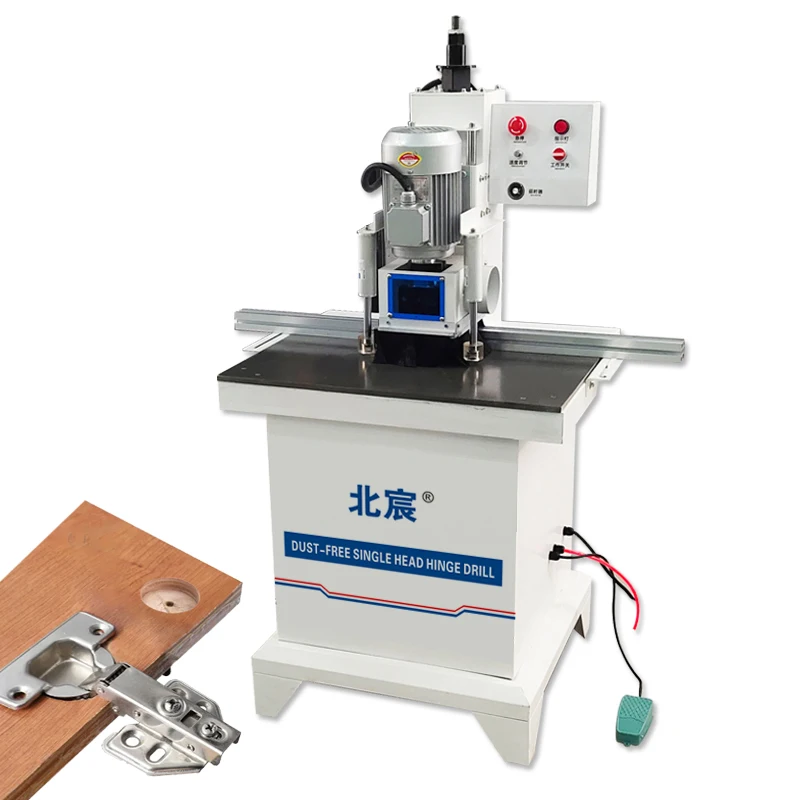
Precision-verified hinge drilling — Every JL-1 unit undergoes a four-stage inspection protocol from incoming component checks to pre-shipment factory test records, ensuring the drilling tolerance your cabinet assembly depends on is met before it leaves our floor.
Technical Specifications
| Parameter |
Value |
| Model |
JL-1 |
| Product Type |
CNC Wood Boring and Hinge Drilling Machine |
| Total Power |
1.5 kW |
| Voltage & Frequency |
380V/415V three-phase four-wire (50Hz/60Hz configurable) |
| Control System |
Foot switch control |
| Drill Capacity |
Large drill 35 mm, small drill 3 mm |
| Guide Rail |
Precision guide rails for vertical and horizontal sliding |
| Motor Type |
Pure copper motor |
| Noise Level |
Low noise operation (dB value basis to be confirmed) |
| Vacuum System |
External vacuum connection |
| Overall Dimensions (L×W×H) |
70 × 56 × 145 cm |
| Net Weight |
55 kg |
| Standard Application |
Cabinet door hinge hole opening |
| Language Options |
Chinese and English standard; additional languages configurable |
| Assembly State |
Fully assembled at factory prior to dispatch |
| Certification |
CE |
Application Suitability
| Application |
Material or Output |
| Cabinet door hinge drilling |
MDF, particleboard, and plywood panels for wardrobe and kitchen cabinetry |
| Furniture hinge hole positioning |
Laminated board and melamine-faced chipboard in custom furniture production |
| Door industry hinge boring |
Solid wood panels and veneered substrates in interior door manufacturing |
| Workshop-scale hinge processing |
Small to medium woodworking shops requiring repeatable hinge hole accuracy |
Why the Voltage Question Must Come Before the Quotation
Confirming local supply voltage and phase configuration is the single most important step before a CNC Wood Boring Machine OEM factory ships your unit.
I once arranged delivery of a hinge boring machine to a small cabinet operation in West Africa. The local supply was 220V single-phase, but the unit had been wound for 380V three-phase based on an assumption nobody verified. The machine sat silent on the workshop floor for weeks while a step-up transformer was sourced locally. That kind of delay costs a small factory real money in missed delivery deadlines and idle workers [NEED_CITE: common voltage mismatches in industrial equipment exports]. The JL-1 is configurable across voltage ranges, but the correct configuration has to be locked in before the motor is wound and the control panel is wired.

Component Sourcing and Traceability on the JL-1
The precision guide rails on this CNC Wood Boring Machine OEM factory build are selected and inspected during incoming material verification, the first stage of our four-stage QC protocol. Copper motor windings are verified for conductivity and insulation resistance before they reach the assembly bench. Every sourced component carries a supplier lot reference that can be traced back through our inspection records. For distributors evaluating whether our manufacturing depth supports a private label program, this traceability is the foundation of a credible OEM partnership.
What the Four-Stage QC Process Actually Catches
The second and third QC stages — in-process inspection and finished product verification — are where most tolerance and alignment issues surface. On the JL-1, this means checking that the large 35 mm and small 3 mm drill positions register consistently across repeated cycles, and that the precision guide rails hold their alignment under the lateral forces of hinge boring [NEED_CITE: typical failure modes in small-format wood boring machines]. The fourth stage, pre-shipment verification, involves running the machine on actual panel stock and documenting the results in a factory test record that ships with the unit.
Reading the Specs Through a Production Lens
The 1.5 kW total power rating on the JL-1 places it squarely in the hinge-drilling category rather than multi-spindle structural boring. That power level is appropriate for drilling 35 mm hinge cup holes and 3 mm pilot or dowel holes in MDF, particleboard, and plywood panels typical of cabinet door production, but it would struggle with deep structural boring into thick hardwood. The pure copper motor construction matters here because copper windings dissipate heat more effectively than aluminum alternatives, which directly affects how many consecutive drilling cycles the machine can sustain before thermal protection engages. The foot switch control keeps the operator’s hands free to position and clamp the panel, a practical choice for workshops that haven’t yet moved to fully automated feed systems. The 70 × 56 × 145 cm footprint is compact enough to fit into a small joinery workshop without requiring dedicated floor space reallocation, while the 55 kg weight keeps the unit stable during drilling without needing anchor bolts in a concrete slab. External vacuum connection means the machine doesn’t carry its own extraction motor, reducing both power draw and maintenance points, but it does require the buyer to have a centralized dust collection system or a portable extractor already in place.
The Real Cost of Skipping Specification Verification
When a buyer specifies a hinge drilling machine without confirming the control panel language or the voltage-frequency match, the consequences don’t show up in the quotation — they show up at commissioning. An operator who can’t read the interface makes setup errors that compromise drilling accuracy, and a motor running on the wrong frequency overheats prematurely. For an importer reselling into a regional market, these failures become warranty claims that erode margin and damage reputation [NEED_CITE: post-installation failure causes in imported woodworking machinery]. The JL-1 supports multilingual control panel configuration and voltage customization precisely because we’ve seen what happens when those details are left to assumption.
Why OEM Buyers Source This Machine Here
Our in-house manufacturing means the JL-1 isn’t a trading company rebrand — every precision-ground guide rail and copper-wound motor passes through our own assembly floor. Custom logo application and private label packaging are handled on the same production line, not outsourced to a third party after the fact. Voltage configuration from 110V to 440V is standard capability, not a special request requiring extended lead times. The four-stage QC protocol with documented factory test records gives distributors verifiable evidence to present to their own customers. And because our CNC Wood Boring Machine OEM factory handles configuration engineering in-house, specification changes for a particular market’s requirements can be confirmed and quoted within one working day.
Documentation & Verification
- CE declaration of conformity covering the JL-1 hinge drilling configuration
- Factory test record drilled on your specified panel thickness and material before dispatch
- Electrical schematic confirming voltage, phase, and frequency matched to your local supply
- Spare parts list with part numbers for drill bits, guide rail components, and motor consumables
- Operation and maintenance manual written in your operator’s working language
Installation, Commissioning & Support
- Confirm 380V/415V three-phase supply with dedicated circuit breaker rated for 1.5 kW draw before delivery
- External vacuum connection requires your existing dust extraction system to be operational at commissioning
- Unit ships fully assembled — position on level floor and verify stability before first power-on
- First-cycle test run should verify both 35 mm and 3 mm drill depths on scrap panel stock from your production
- Foot switch placement and guide rail travel should be adjusted to match your operator’s working position
- Schedule guide rail lubrication and drill bit inspection at regular intervals based on your daily cycle count
Preparing Your Inquiry
To receive a configuration proposal for the JL-1, share the panel materials and thicknesses you typically drill for hinge applications, your workshop’s confirmed voltage and phase supply, and the language your machine operators read. If you are evaluating this unit for a private label or distribution program, indicate your target market and any branding requirements so the quotation covers OEM specifications from the start.
Frequently Asked Questions
Q: How is drilling tolerance verified and documented during manufacturing?
A: Each JL-1 goes through in-process alignment checks and a pre-shipment test run on actual panel stock. The resulting factory test record documents drill position repeatability and hole quality on the material thickness you specify. This record ships with the machine so you can verify performance against your assembly requirements.
Q: What OEM customization options are available for the JL-1?
A: We configure voltage across the 110V to 440V range, apply custom logos and private label branding, and produce control interfaces and manuals in your operator’s language. Structural parameter adjustments are available for distributors requiring market-specific configurations, all handled on our own production line.
Q: Can you provide component sourcing documentation for due diligence?
A: Incoming material inspection records are maintained for every JL-1 build, covering guide rail batch origin, motor winding verification results, and drill assembly component traceability. Distributors evaluating our manufacturing depth can review these records during a factory visit or request documentation packages relevant to their market compliance requirements.
Q: What does the four-stage QC process cover specifically?
A: Stage one inspects incoming components like motors and guide rails. Stage two checks assembly accuracy during build. Stage three verifies the completed machine against specification. Stage four runs the JL-1 on panel stock to produce a documented pre-shipment test record. Each stage generates inspection documentation retained in our quality files.
Q: Is a factory visit possible before placing an OEM order?
A: Factory visits are welcomed for distributors and OEM partners evaluating our manufacturing capability. You can observe the JL-1 assembly line, review QC documentation, and discuss private label requirements directly with our engineering team. Visits can be arranged alongside a sample drilling test on your chosen panel material.