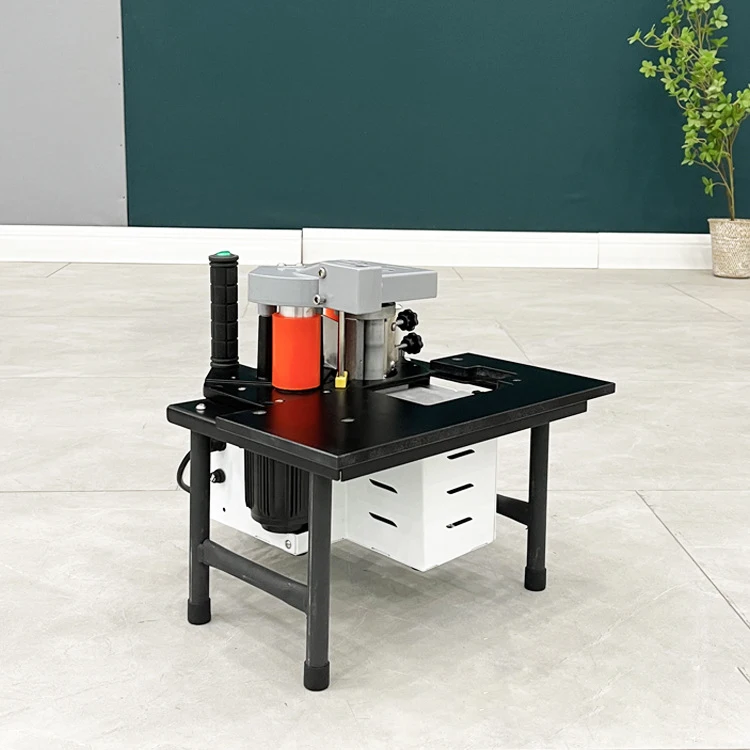
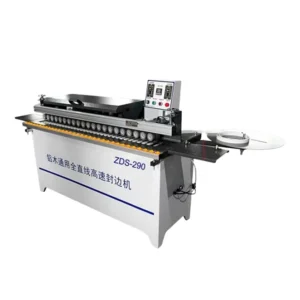
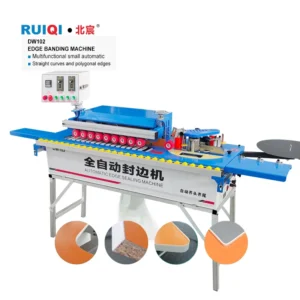
OEM-Ready Manufacturing — every portable edge bander leaves the factory with confirmed voltage, plug type, and control language before the crate is sealed.
Technical Specifications
| Parameter |
Value |
| Product Type |
Portable Edge Banding Machine |
| Shape of Edge-banding Plates |
Curved, Straight and Special-shaped Sheet |
| Edge Thickness |
0.3–3mm |
| Edge Sealing Speed |
0–6m/min |
| Edge Sealing Height |
7–60mm |
| Gluing Method |
Double-sided gluing |
| Glue Pot Volume |
1000ml |
| Machine Weight |
14kg |
| Assembly State |
Portable / Handheld |
| Plug Options |
EU / AU / UK / USA / CN |
| Voltage & Frequency |
Configurable — confirm with manufacturer (basis not stated in source) |
| Rated Power |
Confirm with manufacturer (basis not stated in source) |
Application Suitability
| Application |
Material or Output |
| Small workshop furniture production |
MDF and plywood panels with PVC edge banding |
| On-site joinery and custom cabinetry |
Particleboard and blockboard with veneer banding |
| Curved and shaped panel finishing |
Solid wood panels with thin ABS or PVC profiles |
| Prototype and sample edge sealing |
Special-shaped sheets requiring manual feed control |
Why the Voltage Question Should Come Before the Price
A portable edge banding machine OEM factory must confirm electrical standards before building, not after the unit arrives at the distributor’s warehouse.
I spent years commissioning furniture lines across the Middle East, and the most expensive mistake I ever made had nothing to do with mechanical tolerances. A PVC edge bander was shipped to a cabinet factory in Saudi Arabia without verifying their 220V/60Hz supply. The motor burned out on the first start. We waited three weeks for a replacement stator while their panel line sat idle. That delay cost more than the machine itself. A portable edge banding machine OEM factory worth partnering with asks for voltage and frequency before quoting, not after. [NEED_CITE: voltage and frequency standards by export market]
Distributors stocking for multiple markets face this problem multiplied. One warehouse may need 110V/60Hz units for North American resellers, while another requires 220V/50Hz configurations for Southeast Asian customers. Ordering without locked-down electrical specifications creates dead inventory that cannot be resold without rewiring.

Private-Label Configuration Beyond a Sticker
OEM branding on a portable edge banding machine OEM factory order extends further than printing a logo on the housing. Distributors need control panel overlays in the target market’s language, color-matched housings that align with existing product lines, and packaging artwork approved through a formal proofing cycle. This factory supports customization across those dimensions as part of the standard production workflow, not as an afterthought or premium add-on.
Quality Gates That Protect the Distributor’s Reputation
When a distributor sells under their own brand, every field failure lands on their name. The four-stage QC process here — incoming material inspection, in-process verification, finished product testing, and pre-shipment validation — means each portable edge banding machine OEM factory unit is checked against the specification sheet before it is crated. Factory test records and packing photographs are shared with the buyer before the shipment leaves the floor, giving the distributor a documented baseline if a warranty claim arises later. [NEED_CITE: CE machinery directive requirements for industrial equipment]
Reading the Spec Sheet Against Real Workshop Conditions
The double-sided gluing method applies adhesive to both the panel edge and the banding strip simultaneously, which matters when working with curved profiles where single-sided gluing often leaves starved joints on the inside radius. The 0.3–3mm edge thickness range covers standard PVC, thin veneer, and light ABS materials that small workshops use daily. Edge sealing height from 7–60mm accommodates the full spectrum of panel thicknesses from thin MDF shelving stock up to thick blockboard worktops.
The 0–6m/min feed speed is operator-controlled, allowing the user to slow down on tight curves and speed up on long straight runs. For a handheld unit weighing 14kg, portability means the machine can be carried to the workpiece rather than moving large panels through a stationary feed system — a practical advantage in cramped workshops or on installation sites where a full-size edge bander cannot reach.
What Happens When Configurations Are Guesswork
Distributors who order portable edge banders without confirming plug type and voltage per destination market end up with units that require aftermarket adapters or transformer boxes. Operators bypass safety features to make mismatched electrical connections work, creating liability exposure for the distributor. Machines quoted without voltage confirmation sometimes arrive with motors wound for a frequency that does not match the local grid, causing overheating within the first hour of operation. [NEED_CITE: industrial motor failure causes related to electrical mismatch]
Control panels printed in a language the end user cannot read stall commissioning entirely. The distributor’s technician spends hours on calls walking the operator through basic functions that should have been labeled clearly from the start.
Why Distributors Source This Line
In-house manufacturing with patented mechanisms means the factory controls the build from machining to final test, not assembling purchased sub-components under a label. Voltage, plug type, and language customization are treated as standard order parameters, ensuring each market receives equipment that runs on arrival. The product family spans from this compact portable unit up through full-function automatic edge banders, so a distributor can expand their catalog without qualifying a second supplier. Pre-shipment testing with documented records and photographs provides evidence the unit met specification before it was packed. Engineer-led configuration recommendations with formal quotations typically arrive within one working day of receiving the buyer’s requirements.
Documentation & Verification
- CE declaration of conformity covering portable edge bander electrical and mechanical safety requirements
- ISO 9001 certificate validating the quality management system behind each production batch
- Machine specification sheet with confirmed voltage, plug type, and edge thickness parameters
- Factory test record on the buyer’s specified edge banding material before dispatch
- Operation and maintenance manual produced in the distributor’s agreed language
- Packing photographs showing crate condition and accessory completeness before shipment
Installation, Commissioning & Support
- Power supply verification against the confirmed voltage and frequency before first plug-in
- Glue pot initial fill procedure using the specified 1000ml capacity and recommended adhesive type
- Operator training on variable feed speed control across straight, curved, and special-shaped profiles
- Edge thickness adjustment walkthrough covering the 0.3–3mm range for PVC and veneer materials
- Spare parts list with part numbers for glue roller, trimming blade, and pressure shoe assemblies
- Routine maintenance schedule for glue pot cleaning and feed mechanism lubrication
Starting the Specification Conversation
Distributors evaluating this portable edge bander for private-label or bulk inventory should provide the target markets and their electrical standards, the edge banding materials their customers commonly use, and the language requirements for control panels and documentation. If the unit will be bundled into a larger equipment package, share the other machines in the line so compatibility in workflow and voltage can be confirmed. Sample processing tests on specific panel and banding combinations can be arranged before committing to a production run.
Frequently Asked Questions
Q: What elements can be customized under an OEM agreement?
A: Logo placement, housing color, control panel language, and packaging artwork are all configurable. The factory provides digital proofs for approval before production begins. Custom voltage and plug configurations are treated as standard parameters, not premium options, ensuring each destination market receives compliant equipment.
Q: How are voltage and plug type confirmed before production?
A: The buyer provides the target market’s voltage, frequency, and plug standard during the inquiry stage. The factory’s engineering team validates compatibility and includes the confirmed electrical specification on the formal quotation. No unit ships without this parameter locked in writing.
Q: Is there a minimum order quantity for OEM branding runs?
A: OEM branding is available on orders from single units through large production batches. Artwork setup and proofing follow the same process regardless of volume. Distributors building initial inventory can start small and scale without changing suppliers or renegotiating terms.
Q: How are spare parts and technical support handled for distributors?
A: A spare parts list with numbered components ships with every unit. Distributors can stock high-wear items like glue rollers and trimming blades based on the factory’s recommended inventory list. Technical training for the distributor’s service team can be arranged during factory visits or through remote sessions.