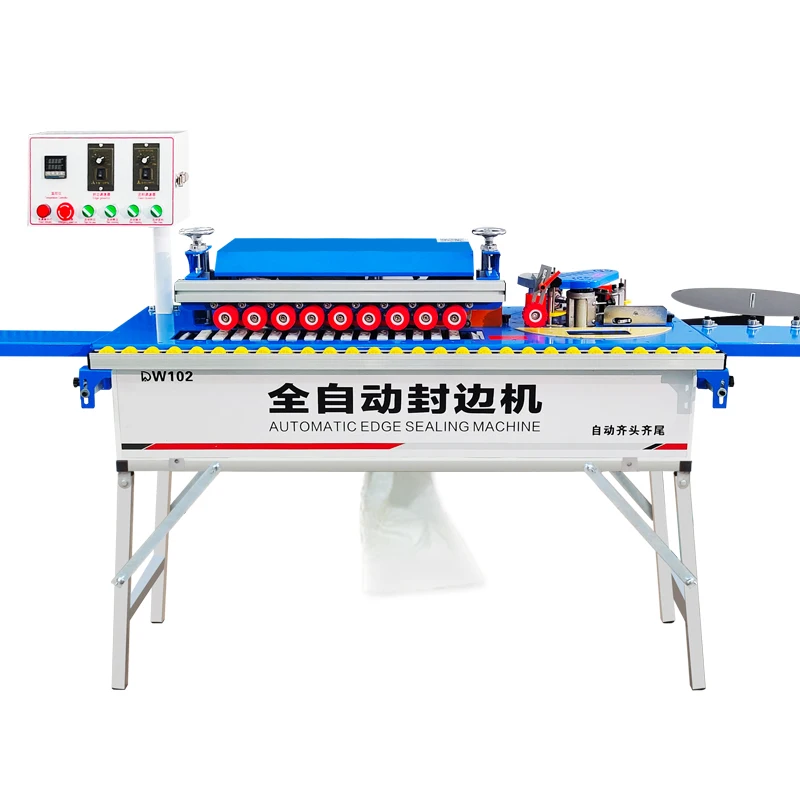
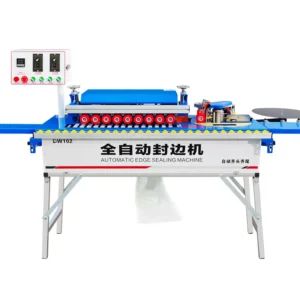
In-house manufacturing — The DW102 edge banding machine is built on our own assembly floor with OEM capability, supporting custom logos, regional voltage configurations, and localized control languages.
Technical Specifications
| Parameter |
Value |
| Model |
DW102 |
| Product Type |
Automatic Edge Banding Machine |
| Total Power |
3800W |
| Voltage |
220V (configurable to regional standards) |
| Air Source Pressure |
0.5-0.8 MPa |
| Glue Pot Capacity |
1000ml |
| Edge Banding Height |
0-50mm |
| Edge Banding Thickness |
0.3-3mm |
| Minimum Sheet Length |
25cm |
| Minimum Sheet Width |
5cm |
| Trimming Power |
650W x 2 |
| Polishing Power |
180W x 2 |
| Vacuum Power |
1200W |
| Transmission Power |
60W |
| Edge Power |
20W |
| Product Size |
128 x 47 x 69cm |
| Product Weight |
75kg |
| Control Language |
Chinese, English (customizable) |
| Plug Type |
EU, USA, AU, UK |
Application Suitability
| Application |
Material or Output |
| Cabinet door panel finishing |
MDF and particleboard with PVC edge banding |
| Curved profile banding |
Plywood and blockboard substrates |
| Small workshop edge processing |
Polymer doors and wood panels |
| Furniture component detailing |
Straight and curved edge trimming on veneer |
Why the Voltage Question Should Come Before the Price
An edge banding machine OEM build is only viable when electrical specifications are locked to the destination grid before fabrication begins.
I once visited a workshop in Lagos where a brand-new edge bander sat in the corner, still wrapped in plastic. The importer had ordered it without confirming the local 50Hz frequency, and the motor burned out within the first hour of operation. That machine was a paperweight. When we configure an edge banding machine for export, the voltage and frequency discussion happens during the quotation stage, not after the unit is crated.
Every DW102 order ships with a confirmed electrical schematic matched to your local grid. [NEED_CITE: voltage and frequency standards by export market]
How Component Sourcing Depth Affects Your OEM Label
When you are evaluating an edge banding machine factory for private label partnership, the question is not just whether a logo can be printed on the side panel. The real depth comes from understanding where each component originates and how that affects your lead times. The DW102 assembly uses a dedicated 1000ml glue pot, a 1200W vacuum system for stable workpiece hold-down, and dual 650W trimming motors. Each of these subsystems is sourced and tested independently before final integration on the line.
This matters for an OEM partner because component-level testing means that if a distributor needs a specific plug standard or a customized control panel faceplate, the modification is integrated at the sub-assembly level rather than retrofitted on the finished machine.
Private Label Scope Beyond the Nameplate
An edge banding machine OEM arrangement typically starts with logo placement, but the configuration choices go much deeper. The DW102 control panel can be produced in Chinese, English, or a third language specified at order. The plug type is selectable from EU, USA, AU, or UK standards. For a distributor building a regional brand, this means the operator in Nairobi or Dhaka opens a machine whose interface they can actually read.
We have seen situations where machines arrived with Chinese-only menus, and the local technician spent weeks trying to decode error codes through translation apps [NEED_CITE: CE machinery directive requirements for industrial equipment]. That delays commissioning and erodes trust in the distributor who supplied it.
Reading the Specs That Actually Matter
The 0.3–3mm edge banding thickness range on the DW102 covers both thin PVC strips and thicker veneer materials, which determines what product mix a workshop can process without switching machines. The dual 650W trimming motors provide the torque needed for clean cuts on denser substrates like blockboard, where a weaker motor would chatter and leave visible marks on the edge profile.
The glue pot capacity of 1000ml is sized for continuous runs on medium-volume production without requiring constant refills that interrupt the feed cycle. Meanwhile, the minimum sheet dimensions of 25cm length and 5cm width set the boundary for the smallest offcuts this machine can handle — useful information for a cabinet shop that processes a lot of narrow drawer fronts and small shelf panels. The 0.5–0.8 MPa air pressure requirement is standard for pneumatic clamping and needs a dedicated compressor line to maintain consistency across the trimming and polishing stations.
What Happens When Configuration Gets Skipped
When a distributor sources machines purely on listed specifications without verifying how those specs interact with local conditions, the downstream problems accumulate. A machine rated for 220V might technically run on a 230V supply, but the trimming motors will run hotter and the glue pot thermostat will cycle differently, shortening component life over time.
I have seen edge banders of this class fail in humid workshops where the air source pressure was never calibrated to the local compressor output, causing intermittent clamping failures that the operator blamed on the machine itself [NEED_CITE: pneumatic system calibration for tropical humidity environments]. These are not manufacturing defects — they are configuration gaps.
Manufacturing Accountability at Each Stage
The DW102 production process follows a four-stage quality control sequence: incoming material inspection, in-process assembly checks, finished product testing, and pre-shipment verification. For an OEM partner, this means every private label unit goes through the same checkpoints as a factory-branded machine, with the test record reflecting the specific voltage and language configuration ordered.
The patented cutting mechanisms used in our broader edge banding line inform the trimming precision on models like the DW102. Factory visits are welcomed, and a distributor evaluating manufacturing depth can inspect component sourcing records and assembly procedures directly. The edge banding machine factory operates on the principle that an OEM partner needs verifiable documentation, not marketing claims.
Documentation & Verification
- CE declaration of conformity covering the DW102 electrical and mechanical safety scope
- ISO 9001 certificate for the manufacturing facility producing this unit
- Machine specification sheet matching the exact voltage and language configuration ordered
- Electrical schematic confirming plug type, frequency, and circuit protection ratings
- Factory test record documenting edge quality on the buyer’s specified material thickness
- Operation and maintenance manual in the agreed control panel language
Installation, Commissioning & Support
- 0.5-0.8 MPa air supply must be on a dedicated line to maintain consistent pneumatic clamping pressure
- 220V single-phase circuit with appropriate breaker sizing for the 3800W total power draw
- Compact 128 x 47 x 69cm footprint requires level flooring with clearance for sheet feed and discharge
- First-run calibration of the 1000ml glue pot temperature to match the specific PVC or veneer material
- Trimming motor speed and polishing wheel pressure set to the buyer’s panel thickness range before dispatch
- Spare parts list covering consumable polishing wheels, trimming blades, and glue pot heating elements
What We Need to Configure Your Unit
To prepare an accurate quotation, we need to know the destination country and local voltage and frequency standard so the electrical system is built correctly from the start. Share the primary panel materials you will be processing — MDF, particleboard, plywood, or a mix — and the edge banding thickness range you use most often. If you require a specific control panel language beyond Chinese or English, indicate that in your inquiry so the interface is produced accordingly.
Frequently Asked Questions
Q: What is included in the OEM and private label customization for this machine?
A: The DW102 OEM scope covers custom logo application, selectable plug types across EU, USA, AU, and UK standards, and control panel language customization. Voltage is configured to match the destination market electrical grid. Packaging can also be adjusted to carry the distributor’s branding and product literature.
Q: How can I verify edge quality before placing a volume order?
A: We recommend sending a sample of your actual panel material to our facility so we can run a test on the DW102 using your specified edge banding thickness and glue type. The factory test record, including photographs of the finished edge, is shared before you commit to production quantities.
Q: What is the process for confirming voltage and frequency for my market?
A: During the quotation stage, we request your local voltage and frequency specification. The electrical schematic is then prepared to match those parameters, and the confirmation document is included with the shipment. This prevents the machine from arriving with incompatible motor or heating element ratings.
Q: How deep does the in-house manufacturing capability go?
A: The DW102 is assembled in our own facility with component-level quality checks at each stage. We handle precision grinding of critical surfaces, pneumatic system integration, and final electrical testing on-site. Distributors evaluating our edge banding machine factory are welcome to visit and review the assembly process directly.