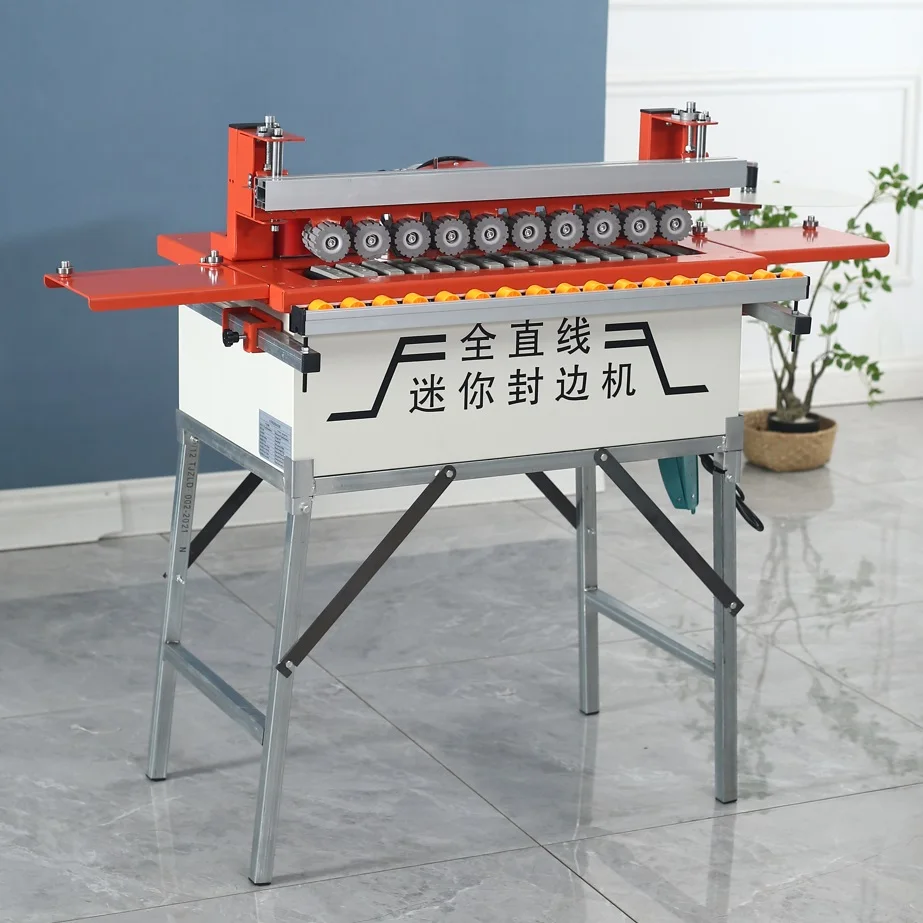
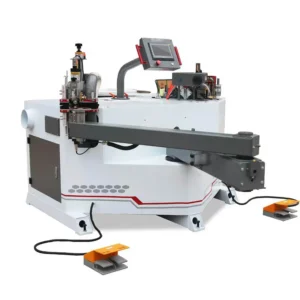
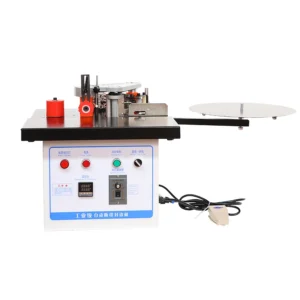
Precision-Ground Components — Every ZDSF750 curved and straight edge banding machine leaves our facility with a factory test record documenting actual sealing performance on your specified panel material before dispatch.
Technical Specifications
| Parameter |
Value |
| Model |
ZDSF750 |
| Product Type |
Curved and Straight Edge Banding Machine |
| Function |
Curved and Straight Edge Banding |
| Edge Banding Speed |
6m/min |
| Rated Voltage |
220V (source value — verify against manufacturer catalog) |
| Power |
1000W |
| Overall Dimensions (L×W×H) |
1200×500×500mm |
| Weight |
60kg |
| Glue Capacity |
1000ml |
| Working Method |
Semi-auto |
| Core Components |
Motor, Engine |
| Assembly State |
Portable body, can be loaded into car trunk |
| Table Top |
360° free rotation |
| Feeding System |
Automatic plate sealing caterpillar feeding |
| Press Mechanism |
Multi-wheel profiling press |
| Extension Plate |
Both sides with 30cm stretch bracket |
| Warranty |
1 Year |
Application Suitability
| Application |
Material or Output |
| MDF furniture production |
MDF panels with PVC or wood veneer edge banding |
| Kitchen cabinet edge sealing |
Particleboard and plywood substrates with melamine or PVC edges |
| Custom furniture workshops |
Solid wood panels and shaped curved components |
| Small-scale joinery |
Plywood and blockboard with thin veneer or ABS edge banding |
| Home-use and on-site work |
Compact panels where portability and 220V power are required |
Why the Voltage Question Should Come Before the Price on a Curved and Straight Edge Banding Machine OEM factory
A machine that arrives with the wrong voltage configuration is not a production asset — it is a 60kg paperweight sitting on your workshop floor.
I have watched commissioning stall for days because a compact edge bander was shipped with a 220V/50Hz motor to a region running on 110V/60Hz. The buyer assumed the supplier would ask. The supplier assumed the buyer would specify. Nobody asked until the machine was uncrated and the motor hummed without turning. For a Curved and Straight Edge Banding Machine OEM factory serving export markets, confirming voltage and frequency at the quotation stage is not optional courtesy — it is the first real test of whether the supplier actually builds what they sell or merely relabels catalog items [NEED_CITE: voltage and frequency standards by export market].
Sourcing Depth That Goes Beyond the Nameplate
When a distributor evaluates a Curved and Straight Edge Banding Machine OEM factory, the question is never just whether the machine works — it is whether the factory controls how it works. The ZDSF750 is assembled from in-house manufactured precision components, including a proprietary multi-wheel profiling press mechanism designed to maintain firm edge adhesion across curved and straight profiles simultaneously. The automatic caterpillar feeding system is sourced and matched at our facility, not purchased as a generic sub-assembly and bolted on.
Private-Label Configuration for Regional Markets
Private-label partnerships require more than a logo swap on the control panel. A regional distributor serving North American workshops needs 110V/60Hz wiring, UL-compatible components, and English-language operation manuals. A Middle Eastern importer may require 220V/60Hz with Arabic control labels and glue pot temperature profiles calibrated for high ambient workshop temperatures. Our configuration process documents every voltage, language, and branding decision in the formal quotation, so the machine that ships matches the machine the end-user expects to install [NEED_CITE: CE machinery directive requirements for industrial equipment].
Reading the Spec Sheet Against Your Actual Production
The ZDSF750 runs at 6m/min edge banding speed with a 1000W motor — numbers that place it firmly in the portable, semi-auto category rather than the continuous production line segment. The 1000ml glue capacity is sufficient for intermittent workshop use but requires monitoring during full-day production runs. The 360° free-rotation table top with dual-side extension plates and 30cm stretch brackets supports panels that would otherwise sag and produce uneven edge contact. For a workshop processing curved cabinet doors and straight shelving panels on the same machine, the semi-auto working method demands operator attention at the feed point but rewards that attention with flexibility that fully automatic machines cannot match at this footprint.

The Hidden Cost of Skipping the Material Trial
A curved and straight edge banding machine that performs flawlessly on standard PVC edge banding can fail visibly when switched to thin wood veneer. The glue temperature that bonds PVC cleanly will scorch a 0.6mm veneer strip. The feed pressure that seats a rigid ABS edge will crush a delicate wood edge into the substrate. I have spent two full days on a video call walking a customer through temperature and speed adjustments because we shipped a machine tested only on the material in our sample rack, not the material in their production schedule. Every configuration decision — glue pot range, feed speed, press wheel durometer — must be validated against the buyer’s actual substrate and banding material before the machine leaves the factory floor [NEED_CITE: edge banding adhesion standards for wood veneer and PVC substrates].
Manufacturing Accountability You Can Audit
Our four-stage quality control process covers incoming material inspection, in-process assembly verification, finished product testing, and pre-shipment validation. For the ZDSF750, this means the motor is bench-tested before installation, the caterpillar feed alignment is checked under load, the glue pot reaches and holds target temperature across a full cycle, and the finished machine runs your specified panel material before crating. The 60kg portable body is not simply a weight number — it reflects a design constraint that required every component to earn its place in the assembly, eliminating unnecessary mass while preserving rigidity at the press mechanism.
Documentation & Verification
- Factory test record documenting edge sealing quality on your specified panel material and banding type
- Electrical schematic confirming voltage, frequency, and plug configuration for your destination market
- CE declaration of conformity and ISO 9001 certificate included in the shipment documentation package
- Operation and maintenance manual produced in your agreed language with illustrated adjustment procedures
- Spare parts list with part numbers matching the exact components installed in your machine
- Packing photographs showing machine condition and crate configuration before dispatch
Installation, Commissioning & Support
- 1200×500×500mm footprint requires a stable bench surface; no dedicated foundation or floor anchoring needed
- 220V single-phase power with a dedicated 10A circuit; confirm local frequency before energizing the motor
- Portable 60kg body allows two-person bench placement; verify bench load rating before positioning
- First commissioning includes glue pot temperature calibration against your banding material and ambient conditions
- Multi-wheel press mechanism requires initial pressure adjustment for your specific panel thickness and edge profile
- 1000ml glue pot capacity supports intermittent runs; schedule refill intervals for continuous production days
What We Need to Configure Your Machine
Tell us the exact substrate materials you process — MDF, particleboard, plywood, or solid wood — and the edge banding types you run, including thickness and material composition. Specify your workshop voltage and frequency so we configure the motor and heating elements correctly. Let us know your preferred control panel language and whether you require OEM branding, custom color, or private-label documentation.
Frequently Asked Questions
Q: What is included in the OEM private-label customization for this edge bander?
A: Customization covers your logo on the machine body and control panel, voltage configuration from 110V to 440V matched to your market, operation manuals in your selected language, and custom color options. Each configuration decision is documented in the formal quotation and verified during pre-shipment inspection so the machine arriving at your warehouse matches the specification you approved.
Q: How are precision components manufactured and verified before assembly?
A: Critical components including the multi-wheel profiling press and caterpillar feed mechanism are precision-ground in-house and inspected at multiple stages before assembly. Each component is matched to its mating part to ensure alignment under load. The assembled mechanism is then tested with actual edge banding material to verify adhesion quality and feed stability before the machine proceeds to final assembly.
Q: What does the pre-shipment test record actually document?
A: The test record captures the machine running your specified panel material and edge banding type at production settings. It documents glue temperature, feed speed, press pressure, and the visual quality of the finished edge including glue line visibility and trim accuracy. This record ships with the machine so your technicians can reference the baseline settings during their own commissioning process.
Q: Can I visit the factory to audit the manufacturing process before ordering?
A: Factory visits are welcomed and encouraged. You can walk through the component machining area, observe the four-stage quality control process in operation, and witness a live test run of the ZDSF750 on your material. We schedule dedicated time with our engineering team so you can discuss configuration options and inspect build quality firsthand before committing to an order.
Q: What spare parts and technical training support do distributors receive?
A: Distributors receive a comprehensive spare parts list with matching part numbers, recommended stocking quantities for your regional market, and technical training for your service team covering adjustment procedures, common fault diagnosis, and component replacement. Training can be conducted at our facility or at your warehouse, and we provide ongoing remote technical support for field service questions your team encounters.