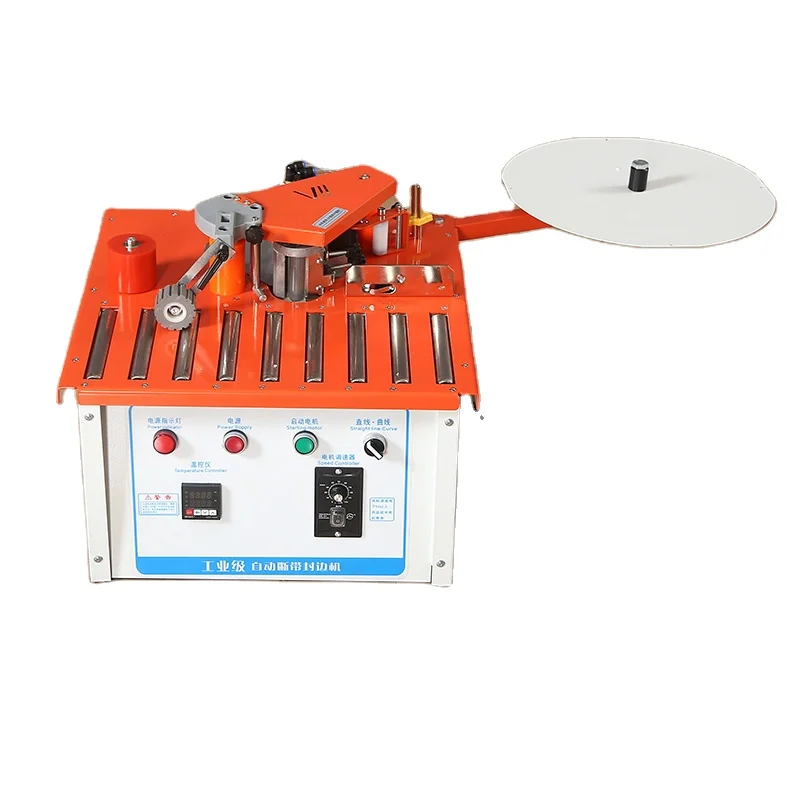
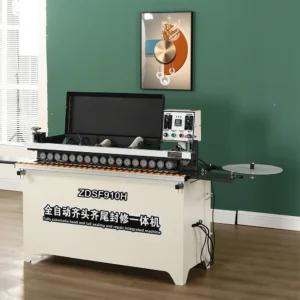
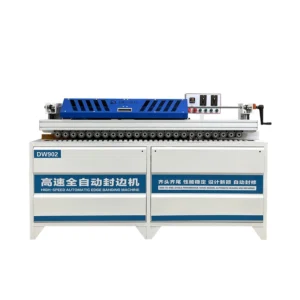
Verified Assembly Quality — ZDSF50 Mini Edge Banding Machine units undergo four-stage inspection from incoming component checks to pre-shipment verification, supporting OEM branding and regional voltage requirements for distributor partners.
Technical Specifications
| Parameter |
Value |
| Model |
ZDSF50 |
| Product Type |
Mini Portable Edge Banding Machine |
| Rated Voltage |
220V / 110V configurable |
| Rated Power |
1.2 kW |
| Function |
Double side gluing for straight, curved, and shaped edges |
| Rated Air Pressure |
0.4–0.6 MPa |
| Edge Strip Thickness Range |
0.5–1.5 mm |
| Board Thickness Range |
10–60 mm |
| Glue Pot Capacity |
1000 ml |
| Heating Time |
5–10 min |
| Edge Banding Speed |
0–6 m/min |
| Overall Dimensions |
54 × 54 × 56 cm |
| Net Weight |
26 kg |
| Glue Application |
Double-sided glue-coated rollers |
| Pressure Roller Adjustment |
Manual adjustable to board thickness |
| Edge Strip Transport |
Adjustable bayonet for strip height |
| Belt Breaking |
Pneumatically controlled with foot switch and travel switch |
| Pressing Roller Material |
Rubber |
| Glue Pot Heating |
4 heating tubes |
| Assembly State |
Portable, table-top format |
| Certification Standards |
CE, ISO 9001 |
Application Suitability
| Application |
Material or Output |
| Small workshop edge finishing |
MDF, plywood, and particleboard panels with PVC edge banding |
| Custom furniture shops |
Solid wood panels with veneer edge strips on curved profiles |
| Home decoration contractors |
On-site edge banding of shaped cabinet components and shelving |
| Manual-to-machine upgrade operations |
Entry-level production runs on straight and curved board edges |
| Joinery startups |
Low-volume batch processing of 10–60 mm thick sheet stock |
Why Voltage Confirmation Must Precede the Mini Edge Banding Machine Factory OEM Order
Most portable edge banders fail at commissioning not because of mechanical defects, but because voltage and frequency were never verified against the buyer’s actual shop supply.
I once shipped a full-auto edge bander to a cabinet shop in Vietnam and discovered on arrival that their 220V/60Hz supply was incompatible with the machine’s default configuration. The unit sat on the floor for three weeks waiting for a transformer swap before it could run its first panel. Since then, I confirm voltage and frequency before anything leaves the factory — and I see the same oversight repeated constantly in portable machine purchases [NEED_CITE: voltage and frequency standards by export market]. A Mini Edge Banding Machine factory OEM order without locked-in electrical specifications creates downstream delays, unnecessary equipment costs, and commissioning disputes that sour distributor relationships before the first production run.

Component Sourcing Depth Behind the Compact Format
The ZDSF50 is assembled on a dedicated table-top line where precision-ground rollers, pneumatic cylinders, and heating elements are sourced to documented specifications before entering production. Incoming components pass dimensional verification and material hardness checks before advancing to assembly — a gate that filters out marginal parts before they reach the glue roller mechanism. This manufacturing discipline is what separates a Mini Edge Banding Machine factory OEM partner from a trading company relabeling finished goods from multiple unknown sources.
Private-Label and Regional Configuration Capability
OEM partners can specify custom branding placement on the machine body, packaging artwork, and multilingual operation manuals matched to their distribution territory. Voltage is configurable between 110V and 220V at the order stage, with frequency matched to the destination market’s grid standard [NEED_CITE: CE machinery directive requirements for industrial equipment]. Control panel labeling can be produced in the operator’s local language, eliminating the commissioning stall that happens when a shop technician cannot read basic parameter readouts. This configuration flexibility applies to single-unit sample orders as well as larger batch commitments.
Spec Interpretation for Production Relevance
The 1.2 kW rated power positions this machine for intermittent production rather than continuous high-throughput line work — a deliberate design choice matching the table-top format and 26 kg weight. The 10–60 mm board thickness range covers standard MDF, plywood, and particleboard stock used in cabinet and furniture fabrication, while the 0.5–1.5 mm strip thickness accommodates both PVC and thin veneer materials. The four-tube glue pot heating system brings the 1000 ml reservoir to operating temperature in 5–10 minutes, reducing wait time between shift starts. Pneumatic belt breaking with both foot switch and automatic travel switch gives the operator hands-free control on curved workpieces where manual feed rhythm varies. The 0.4–0.6 MPa air pressure requirement is within reach of standard workshop compressors, avoiding the need for dedicated pneumatic infrastructure [NEED_CITE: pneumatic pressure standards for light industrial workshop equipment].
The Cost of Skipping Configuration Verification
When a distributor sources portable edge banders without confirming board thickness compatibility, machines arrive at customer sites unable to process the stock the shop actually uses — thick particleboard panels get rejected at the feed point while thin veneer strips slip past the pressure roller without adhesion. Mismatched voltage configurations compound the problem, leaving machines non-functional until transformers or rewiring work is completed at the buyer’s expense. These failures damage the distributor’s local reputation far more than they cost in hardware [NEED_CITE: common commissioning failure causes in imported woodworking machinery].
Why Distributors Source This Machine From the Factory
Every ZDSF50 unit carries factory test records documenting actual edge banding performance on specified board thickness ranges before dispatch. The four-stage QC process covers incoming material inspection, in-process assembly checks, finished product verification, and pre-shipment testing — documented and available for review. OEM logo application, custom packaging, and private-label manuals are built into the standard order workflow rather than treated as special requests. Factory visits and sample processing tests are welcomed before order commitment, giving distributor partners direct verification of manufacturing depth. Engineer-led configuration recommendations address voltage, frequency, and language requirements within the quotation stage.
Documentation & Verification
- Factory test record covering double-sided glue adhesion on buyer-specified board thickness
- CE declaration of conformity for portable edge banding machinery export compliance
- Electrical schematic confirming configured voltage and frequency at order stage
- Operation and maintenance manual produced in agreed language with illustrated parts list
- Pre-shipment photograph set showing machine, accessories, and packing condition
Installation, Commissioning & Support
- 54 × 54 × 56 cm footprint fits standard workbench; no floor anchoring required
- 1.2 kW draw operates on a standard 110V or 220V dedicated circuit with proper grounding
- Table-top format requires no assembly; connect power and pneumatic supply before first run
- Glue pot heating verification and pressure roller calibration performed during initial setup
- Spare edge strip transport bayonets and replacement rubber pressing rollers included in standard spare parts kit
- 0.4–0.6 MPa air supply connects to existing workshop compressor via standard pneumatic fitting
Inquiry Preparation for Production Configuration
To receive an accurate configuration proposal, provide your target market voltage and frequency standard, the primary board materials and thickness range your customers process, preferred operator language for control panel labeling, and whether private-label branding or standard factory marking is required. Sample processing tests on your actual panel stock can be arranged before order commitment.
Frequently Asked Questions
Q: What OEM and private-label customization options are available for this portable edge banding machine?
A: Custom logo placement on the machine body and packaging, voltage configuration between 110V and 220V matched to your market, multilingual control panel labeling, and branded operation manuals are all available as standard customization options. Single-unit sample orders carry the same configuration flexibility as larger production batches.
Q: How does the four-stage QC process verify edge banding quality before shipment?
A: Incoming components are checked dimensionally, assembly stages include roller alignment and pneumatic function tests, finished units undergo edge banding runs on specified board thickness ranges, and pre-shipment verification documents glue adhesion consistency and pneumatic belt-breaking response. Test records accompany each machine.
Q: Can the ZDSF50 be configured for specific regional voltage and frequency standards?
A: Yes. Voltage is confirmed at order stage and configured at the factory before dispatch. The machine supports 110V and 220V configurations with frequency matched to the destination market’s grid standard, eliminating transformer requirements and commissioning delays at the customer site.
Q: What spare parts backup does the factory provide to distributor partners?
A: Each machine ships with replacement rubber pressing rollers, spare transport bayonets, and a documented spare parts list. Distributors ordering multiple units can specify additional spare part kits scaled to their regional service inventory requirements, with replenishment available through standard ordering channels.