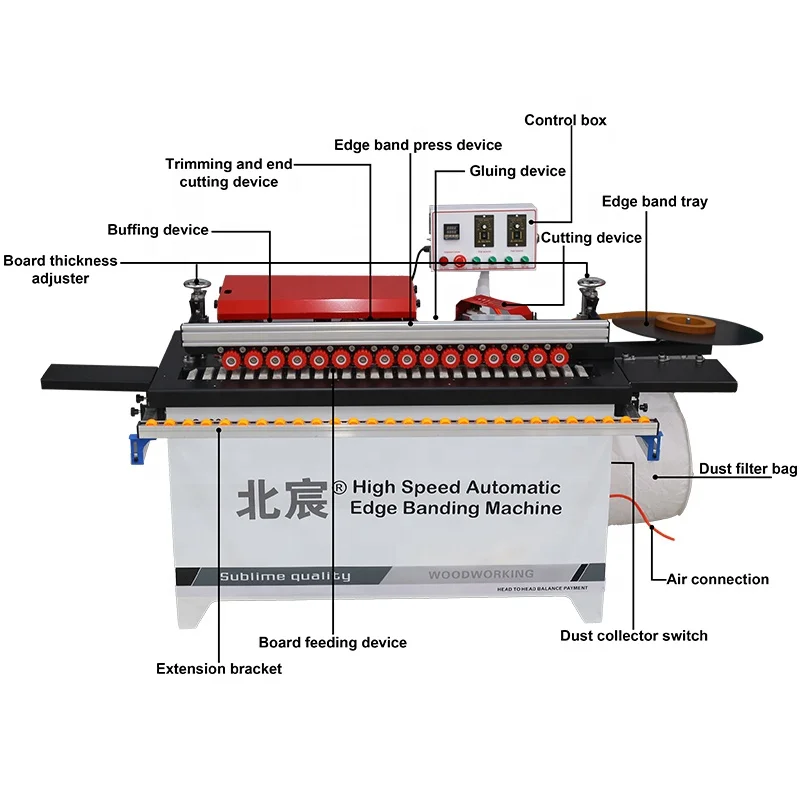
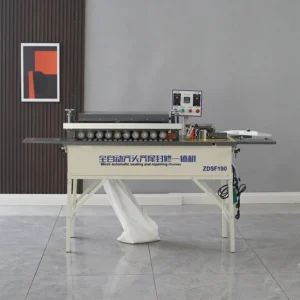
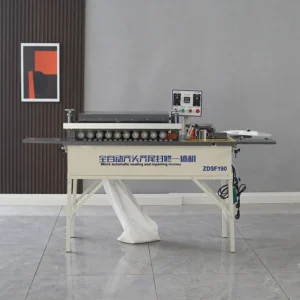
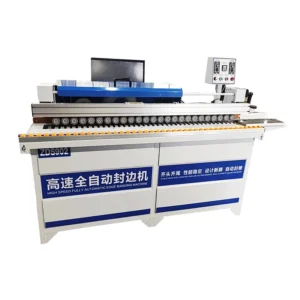
Precision-Ground Build — Every DW802 unit undergoes four-stage QC with pre-shipment electrical verification matched to the destination grid before the crate is sealed.
Technical Specifications
| Parameter |
Value |
| Model |
DW802 |
| Product Type |
Automatic Edge Banding Machine |
| Total Power |
4200 W |
| Edge Feed Power |
140 W |
| Transmission Power |
140 W |
| Trimming Power |
800 W × 2 |
| Polishing Power |
180 W × 2 |
| Vacuum Power |
1200 W |
| Voltage |
220 V / 380 V / Customizable (frequency to be confirmed at order) |
| Air Source Pressure |
0.4 – 0.8 MPa |
| Glue Pot Capacity |
4000 ml |
| Minimum Sheet Length |
250 mm |
| Minimum Sheet Width |
100 mm |
| Edge Banding Height |
0 – 50 mm |
| Edge Banding Thickness |
0.3 – 3 mm |
| Product Size |
1300 × 600 × 950 mm |
| Product Weight |
135 kg |
| Control System |
To be confirmed (PLC or manual) |
| Language Options |
Chinese and English standard; other languages customizable |
| Key Features |
Edge banding, trimming, polishing, automatic head and tail cutting, vacuum-assisted feed |
Application Suitability
| Application |
Material or Output |
| Cabinet door edge sealing |
MDF and melamine-faced particleboard |
| Custom furniture panel edging |
Plywood and ecological board |
| Small-batch joinery production |
Solid wood panels up to the machine’s thickness range |
| Home decoration workshop output |
PVC and veneer edge banding strips 0.3 – 3 mm thick |
| OEM-labelled machine lines for regional distributors |
Private-label packaging with market-specific documentation |
Why the Voltage Question Must Come Before the Quotation
A machine wired for the wrong grid is a heavy paperweight, not a production asset.
I have stood in workshops where a brand-new edge bander sat silent because the factory floor ran on 415 V three-phase while the machine was configured for 380 V. The contactor failed within minutes of energizing, and the operator had no way to diagnose the fault without a schematic in a language he could read. That kind of avoidable failure costs weeks of downtime and erodes trust before the first panel is edged [NEED_CITE: voltage and frequency standards by export market]. The DW802 is available with voltage configurable from 110 V to 440 V, but only when the buyer confirms local supply and frequency before production begins does that flexibility translate into a machine that actually runs on arrival.

In-House Manufacturing Under One Roof
The DW802 Automatic Edge Banding Machine is built entirely within a single facility, from frame welding to final trimming-station alignment. This vertical integration means the OEM partner can request changes to the machine colour, control panel layout, and logo placement without negotiating with third-party assemblers. Every modification is documented in the production drawing set and verified at the pre-shipment inspection stage.
Private-Label Scope Beyond a Sticker
Private-label partnerships often stop at a logo decal on the guard panel. Here the scope extends to multilingual HMI screens, plug-type selection for the destination country, and operation manuals translated and typeset in the distributor’s language. The electrical schematic shipped with each DW802 reflects the exact voltage and frequency confirmed at order, so the local service team can trace circuits without guessing [NEED_CITE: CE machinery directive requirements for industrial equipment].
Reading the Specs That Matter
The 4000 ml glue pot allows continuous runs across multiple panels without pausing to refill, which is important when a workshop batches cabinet components in a single shift. The 0.3 – 3 mm edge banding thickness range covers PVC, melamine, and real-wood veneer strips, so a furniture maker does not need separate machines for different finish specifications. Trimming power is split across two 800 W motors, one for each end of the panel, ensuring the head and tail cuts are symmetrical without manual adjustment. Vacuum power at 1200 W holds lighter sheets of MDF and particleboard flat on the feed bed, preventing the lateral drift that causes visible glue lines on thinner substrates.
The Hidden Cost of Skipping Configuration Checks
When an edge bander arrives without confirmed air-pressure requirements, the workshop may connect it to a compressor that delivers below 0.4 MPa, causing the pneumatic cylinders to stutter and the trimming blades to leave ragged ends. If the control panel language does not match the operator’s working language, fault codes become guesswork and commissioning stalls. These are not warranty claims — they are configuration failures that could have been prevented with a single pre-production checklist [NEED_CITE: common causes of commissioning failure in exported woodworking machinery].
Why Source the DW802 From This Line
In-house patented cutting mechanisms hold trimming tolerance within a verifiable range, so the edge finish you see on the sample panel is the finish you get in production. Voltage, plug standard, and control language are confirmed in writing before metal is cut, eliminating on-site surprises. Four-stage QC covers incoming material, in-process assembly, finished-product testing, and pre-shipment verification with photographic records. Factory visits are open to OEM partners who want to witness build stages or run their own panel stock through the machine before committing to a production batch.
Documentation & Verification
- CE declaration of conformity applicable to the DW802 series
- Factory test record showing edge finish on buyer’s specified panel thickness
- Electrical schematic confirming voltage and frequency for the destination market
- Operation and maintenance manual delivered in the agreed language
- Spare parts list with OEM part numbers for distributor inventory planning
- Pre-shipment packing photographs for logistics and insurance records
Installation, Commissioning & Support
- Requires a dedicated circuit matching the confirmed voltage and a 4200 W total load capacity
- Compressed air supply must deliver 0.4 – 0.8 MPa at the machine inlet with a inline moisture trap
- Machine ships fully assembled; position on a level floor with 1300 × 600 mm clearance plus operator space
- First-run parameter setting includes glue temperature, feed speed, and trimming offset calibration
- Wear-part schedule covers trimming blades, polishing wheels, and feed-belt tension checks
- Remote guidance available for initial commissioning with video-supported troubleshooting
What to Include in Your Enquiry
Specify the panel materials and maximum sheet thickness you intend to edge, along with the edge banding strip type and thickness range. Confirm your workshop’s supply voltage, phase configuration, and frequency so the electrical package is built correctly from the start. If you are an OEM partner, indicate the branding scope, control-panel language, and any documentation translation requirements so the quotation reflects the full private-label package.
Frequently Asked Questions
Q: What can be customised under an OEM or private-label agreement?
A: Beyond logo placement, the DW802 supports custom machine colour, plug type, voltage from 110 V to 440 V, and multilingual control interfaces. Operation manuals and spare-parts documentation can be translated into the distributor’s language. All customisations are recorded in the production drawing set and verified at pre-shipment inspection.
Q: How is local voltage and frequency confirmed before production?
A: The buyer provides the destination market’s supply voltage, phase, and frequency in writing. The engineering team cross-references this against IEC or local grid standards and issues a voltage confirmation document. The electrical schematic and motor nameplate are then produced to match, preventing on-site commissioning failure.
Q: What inspection records ship with each unit?
A: Every DW802 is accompanied by a factory test record documenting edge finish quality on the buyer’s specified panel material, a pre-shipment verification report, and packing photographs. Incoming-material inspection and in-process assembly checks are retained on file and available for OEM partner audits.
Q: How are spare parts managed for distributor networks?
A: A detailed spare-parts list with OEM part numbers ships with each machine. Distributors can stock wear items such as trimming blades, polishing wheels, and pneumatic seals against this list. Replenishment orders reference the same part numbers, ensuring consistency across the service territory.
Q: Can buyers visit the factory or send panels for a test run?
A: Factory visits are welcome at any production stage. Buyers may also ship panel samples and edge banding material for a test run on the DW802, with video documentation of edge quality, glue-line appearance, and trimming accuracy provided before the purchase order is finalised.