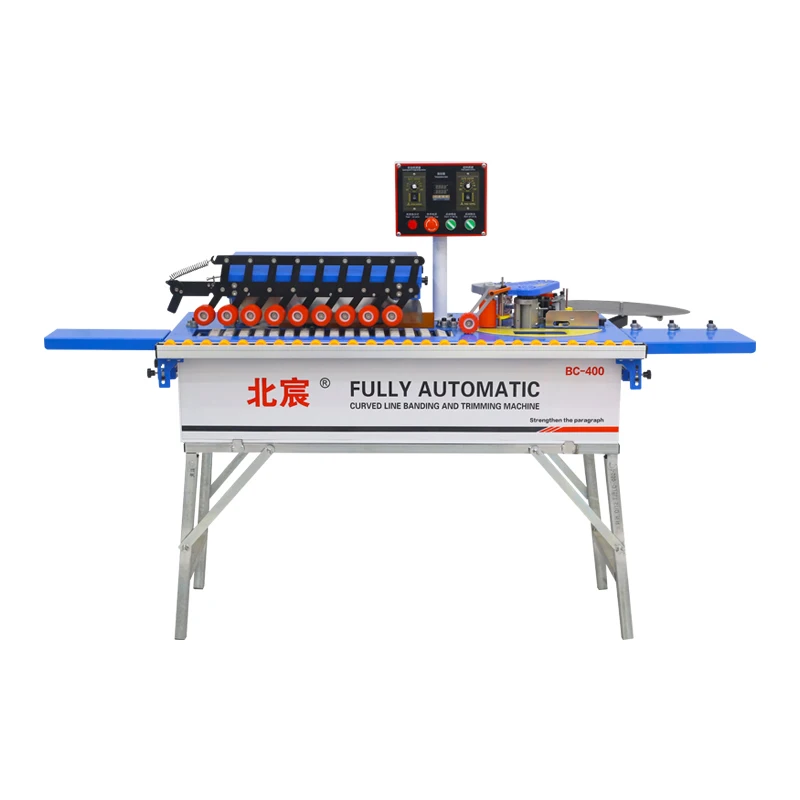
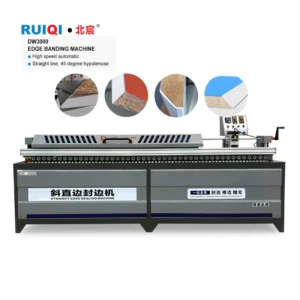
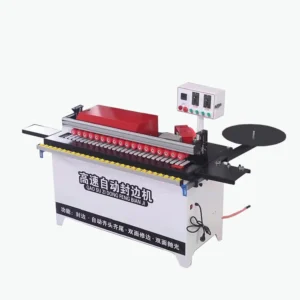
Voltage-Verified Production — Every DW400 economical edge banding machine order starts with a formal electrical schematic and grid compatibility check before assembly begins, preventing the costly on-site failures that stall container-loaded production lines.
Technical Specifications
| Parameter |
Value |
| Model |
DW400 |
| Product Type |
Economical Edge Banding Machine |
| Total Power |
3800W |
| Voltage Configuration |
220V/380V/customization (frequency and phase to be confirmed per market) |
| Edge Banding Thickness Range |
0.3-3MM |
| Edge Banding Height |
0-50MM |
| Minimum Sheet Length |
25CM |
| Minimum Sheet Width |
10CM |
| Glue Pot Capacity |
1000ml |
| Trimming Power |
650W×2 |
| Vacuum Power |
1200W |
| Polishing Power |
180W×2 |
| Transmission Power |
60W |
| Edge Power |
20W |
| Air Source Pressure |
0.5-0.8Mpa |
| Machine Dimensions |
116×47×69CM |
| Machine Weight |
70KG |
| Control Language Options |
Chinese, English, customizable (Spanish and other languages available) |
| Plug Standards |
EU, USA, AU, UK |
| Key Features |
Straight edge banding, trimming, polishing, fully assembled delivery |
Application Suitability
| Application |
Material or Output |
| Cabinet door edge finishing |
MDF and particleboard with PVC or veneer banding |
| Custom furniture panel edging |
Plywood and blockboard up to 50MM thickness |
| Polymer door profile trimming |
Polymer substrates with 0.3-3MM edge material |
| Small-batch joinery production |
Solid wood panels for workshop-scale output |
| Medium-volume furniture manufacturing |
Mixed panel types in a sequential production workflow |
Why the Voltage Question Should Come Before the Price on Any Economical Edge Banding Machine Factory Order
A machine wired for the wrong grid is a machine that never runs — and the cost of discovering this on-site dwarfs any savings from a quick quotation.
I spent three weeks in a Brazilian workshop watching a production line sit idle because an edge bander arrived configured for 380V when the facility only had 220V/60Hz available. The transformer retrofit alone consumed the margin on the entire container shipment [NEED_CITE: voltage and frequency standards by export market]. When sourcing from an economical edge banding machine factory, the electrical specification must be locked down with a formal schematic before the frame is welded — not assumed from a catalog line item.

Inside the 10,000㎡ Facility Where Every DW400 Is Built
The DW400 economical edge banding machine moves through a facility where precision grinding is performed in-house rather than outsourced to third-party machine shops. This means the trimming stations and guide rails are held to the same tolerance standard as the patented cutting mechanisms used in higher-tier models. Component sourcing is consolidated under one roof, which matters when a distributor needs consistent quality across a mixed order of entry-level and production-grade units.
Four-Stage QC From Raw Material to Crate
Incoming steel and castings are inspected before they enter machining. In-process checks verify tolerance at each station. Finished units undergo a full functional run with test panels. Pre-shipment verification includes a voltage-specific power-on test matching the destination grid [NEED_CITE: pre-shipment inspection standards for industrial woodworking machinery]. The documented pass rate across all stages reflects the discipline required when an OEM partner puts their own brand on the machine.
How the Numbers on the Spec Sheet Translate to the Workshop Floor
The 1000ml glue pot capacity keeps the DW400 running through extended panel batches without mid-run refills that cause temperature fluctuation and inconsistent adhesion. Dual 650W trimming motors handle the full 0.3-3MM edge thickness range, producing a clean cut on both PVC and veneer without the tear-out that forces manual rework downstream. The 1200W vacuum system maintains banding contact through the trimming zone — critical when working with thinner substrates where air gaps cause visible glue lines. At 0.5-0.8Mpa air source pressure, the pneumatic feed stays stable across the minimum 25CM sheet length, which is where smaller edge banders often lose grip and produce misaligned trim cuts [NEED_CITE: pneumatic pressure requirements for edge banding equipment].
What Happens When the Wrong Machine Enters the Wrong Workshop
An economical edge bander pushed into continuous production volumes it was never designed for will show its limits through inconsistent trim quality and premature bearing wear — not through an immediate failure, but through a slow erosion of panel quality that goes unnoticed until assembly rejects climb. When a distributor stocks a single machine class for all customer segments, the entry-level buyer gets a unit they will outgrow within months, while the mid-volume buyer gets a unit that degrades under their workload [NEED_CITE: equipment sizing guidelines for furniture manufacturing scale].
Why Distributors and OEM Partners Source This Line Here
In-house manufacturing with patented cutting mechanisms means the DW400 shares core precision technology with the full product family, so a distributor’s catalog maintains consistent quality positioning from entry-level to production-grade. Voltage customization from 220V to 380V with frequency confirmation is handled as a standard step in the order process, not an afterthought. The control panel language is configurable — Spanish, Portuguese, or any target market language — which eliminates the commissioning stall when an operator cannot read the interface. OEM partners receive private-label capability covering logo, color, and packaging without minimum order quantities that block a trial shipment. A four-stage QC process with pre-shipment verification provides the documentation trail that importers need for customs and compliance.
Documentation & Verification
- CE declaration of conformity matching the DW400 configuration shipped
- ISO 9001 certificate covering the manufacturing process for this product line
- Electrical schematic confirming voltage, frequency, and phase for your destination market
- Factory test record run on panel thickness within your specified edge banding range
- Machine specification sheet with all tolerance values verified at pre-shipment inspection
Installation, Commissioning & Support
- Requires a dedicated circuit matching the confirmed voltage — the 3800W total power draw needs appropriate breaker sizing
- Fully assembled delivery at 70KG; two personnel can position the 116×47×69CM footprint without overhead lifting equipment
- Air supply must deliver 0.5-0.8Mpa continuously; undersized compressors cause feed instability during trimming
- First-run calibration of glue pot temperature and vacuum pressure for your specific banding material thickness
- Operator manual provided in your confirmed language with illustrated maintenance intervals for all wear components
What We Need to Quote Your DW400 Accurately
Provide your target market voltage, frequency, and phase so the electrical configuration is locked before production. Share the panel materials and edge banding thickness range you intend to run so the factory test matches your actual workflow. Confirm your preferred control panel language and plug standard. If you are evaluating this as an OEM or distributor, specify your branding requirements and initial order quantity so we can align production scheduling.
Frequently Asked Questions
Q: What can be customized under an OEM or private-label arrangement?
A: Logo placement, machine color, control panel language, plug standard, and packaging can all be specified to your brand identity. There is no minimum order quantity blocking a single-unit trial, and the customization is documented in the order specification so every subsequent reorder matches the original build configuration exactly.
Q: How is voltage and frequency confirmed before production starts?
A: You provide the destination grid specification at inquiry stage. Our engineering team issues a formal electrical schematic confirming voltage, frequency, and phase. This document must be approved before assembly begins, ensuring the motor windings, control transformer, and plug standard all match your facility’s actual supply.
Q: What does the four-stage QC process cover for each DW400 unit?
A: Incoming raw materials are inspected before machining. In-process checks verify tolerance at each assembly station. A full functional test runs the machine with test panels. Pre-shipment verification confirms voltage compatibility, trimming quality, and all pneumatic functions, producing a factory test record that ships with the machine.
Q: How do you support distributor service teams after delivery?
A: We supply a complete spare parts list matched to your DW400 configuration, along with technical documentation in your team’s language. For distributors establishing regional service capability, we offer training on common fault diagnosis, glue pot maintenance, and trimming station calibration procedures.
Q: Can I visit the factory and run a sample test before placing a bulk order?
A: Factory visits are welcomed at any stage. You can bring your own panel samples and edge banding material for a live processing test on a DW400 configured to your target voltage. The test results and tolerance measurements are documented and included with your formal quotation.