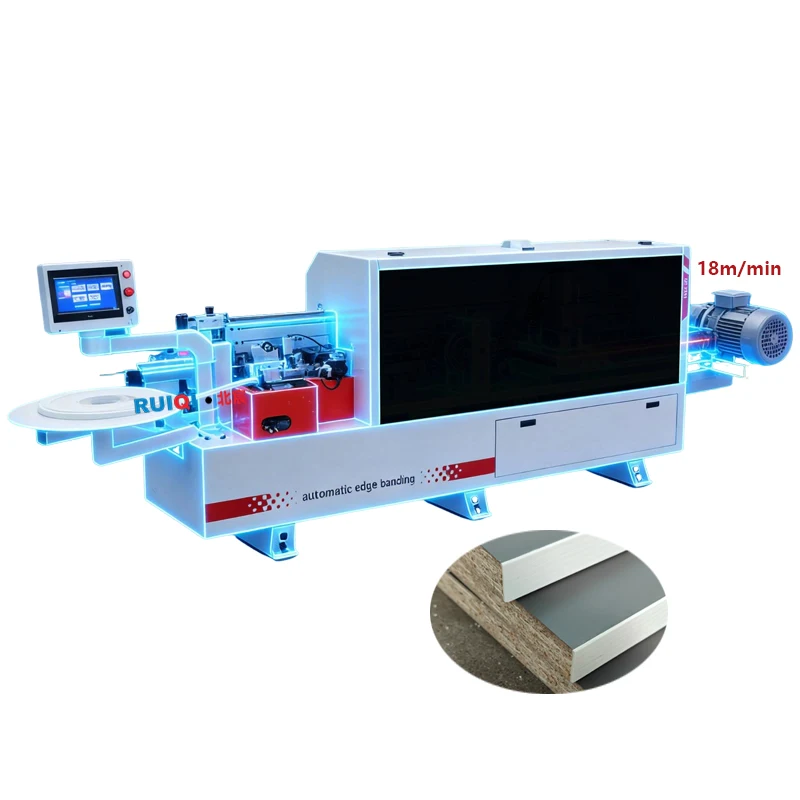
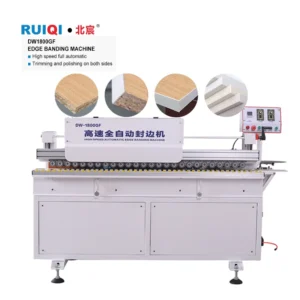
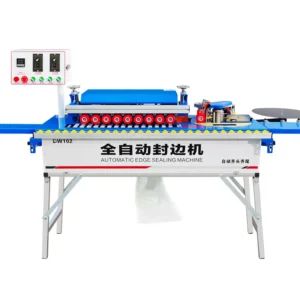
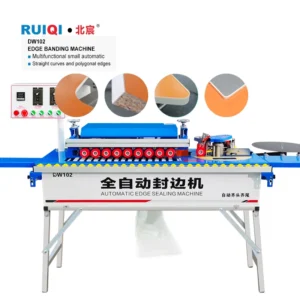
In-House Precision Grinding — every DW330 edge banding machine leaves our facility with a factory test record verifying cutting accuracy on your specified substrate.
Technical Specifications
| Parameter |
Value |
| Model |
DW330 |
| Product Type |
Automatic Edge Banding Machine |
| Conveying Motor |
1.5 kW |
| Trimming Motor |
0.55 kW × 2 |
| Glue Feeding Motor |
0.37 kW × 2 |
| End Cutting Motor |
0.37 kW × 2 |
| Polishing Motor |
0.37 kW × 2 |
| Heating Rod |
380V, 300W × 4 |
| Feed Speed |
18 m/min |
| Minimum Board Width |
120 mm |
| Minimum Machining Size |
200 mm × 100 mm × 9 mm |
| Maximum Plate Thickness |
50 mm |
| Outline Dimension |
350 × 71 × 122 cm |
| Net Weight |
750 kg |
| Gross Weight |
800 kg |
| Control System |
7-inch PLC panel, multi-language, optional push-button box |
| Beam Adjustment |
Digital display hand crank |
| Pressure System |
Double-row rollers, aluminum profile beam |
| Glue Pot |
Enlarged capacity, large gluing shaft, single-sided |
| Transmission |
1500W motor, 1:40 speed ratio |
Application Suitability
| Application |
Material or Output |
| Cabinet door edge banding |
MDF and particleboard with PVC or ABS edge tape |
| Custom furniture panel processing |
Plywood and melamine-faced boards up to 50 mm thick |
| Workshop-scale production runs |
Solid wood panels with veneer edge banding |
| Contract furniture components |
High-density substrate requiring consistent glue temperature |
Why the Substrate Question Comes Before the Quotation
An edge bander that performs on standard particleboard may fail on high-density board if the glue system cannot maintain temperature under continuous load.
I learned this after a Middle Eastern customer received a machine that ran perfectly during factory testing on standard particleboard, then encountered repeated edge lifting when processing high-density substrate on-site. The glue temperature dropped below threshold under sustained operation, and an entire batch of panels was rejected before the root cause was identified. That edge banding machine factory oversight cost both time and material. When evaluating an OEM edge banding machine, the first question should never be price — it should be what you are actually running through the machine [NEED_CITE: thermal demand variance across engineered wood substrates].

Component Traceability from Incoming Material to Assembly
Every component entering our assembly line is logged and inspected before it reaches a workstation. The DW330 uses precision-ground shafts and alloy trimming knives sourced against verified material certificates. For distributors evaluating manufacturing depth, this traceability means you can stand behind every machine you place in your territory. Our OEM edge banding machine production includes private-label branding, custom logo application, and voltage adaptation — but the mechanical integrity underneath remains consistent because we control the sourcing chain.
Four-Stage Quality Control Built into the Production Rhythm
Quality verification on the DW330 is not a single final inspection. Incoming materials are checked against specification. In-process checks confirm assembly tolerances at each station. Finished units undergo functional testing under load. Pre-shipment verification includes running your specified panel material through the complete edge banding cycle — gluing, trimming, scraping, and polishing — and documenting the result. This four-stage approach means that when a DW330 arrives at a distributor’s warehouse or an OEM partner’s facility, the machine has already processed real material under documented conditions [NEED_CITE: ISO 9001 process audit requirements for manufacturing facilities].
How Feed Speed, Glue Capacity, and Pressure Interact on the Shop Floor
The 1500W transmission motor with a 1:40 speed ratio delivers feed speeds up to 18 m/min, but sustained throughput depends on what happens at the glue station. The enlarged glue pot with its large gluing shaft maintains adhesive temperature across long production runs — critical when processing high-density substrates that draw heat from the glue film faster than standard boards. The double-row pressure rollers on aluminum profile beams hold the edge tape firmly against the panel edge, handling board widths down to 120 mm without slippage. Digital beam height adjustment via hand crank with display readout means operators set the correct clearance for panel thicknesses up to 50 mm without guesswork. The contour trimming with alloy knives and curved scraper with contouring device produce a clean edge profile that reduces downstream sanding. An edge banding machine factory must design these subsystems to work in balance — oversizing one station while undersizing another creates a bottleneck that no amount of operator skill can overcome.
What Happens When Voltage Is Confirmed After the Machine Ships
A machine configured for the wrong voltage and frequency arrives at a job site and fails to start, or worse, runs with degraded heating performance that only becomes apparent when edge tape begins lifting mid-production. The DW330 heating system uses four 380V 300W rods, and adapting this system for markets with 110V, 220V, or 440V supply requires confirming both voltage and frequency before production begins — not after the crate is opened. An OEM edge banding machine shipped without this confirmation creates installation delays that no amount of remote troubleshooting can resolve quickly [NEED_CITE: voltage and frequency standards by export market].
Why Buyers Commit to This Manufacturing Partner
Distributors and OEM partners evaluating the DW330 can visit the factory to inspect precision grinding stations, assembly lines, and QC documentation in person. The patented cutting mechanisms are manufactured in-house, not sourced from third-party suppliers, which means replacement parts and technical knowledge remain available long after the initial sale. Voltage and language customization is treated as standard configuration rather than a special request — the 7-inch PLC panel can be set to the operator’s language before shipment. Formal quotations are provided within 24 hours of receiving your factory scale, processing requirements, and budget. Factory visits are actively welcomed for buyers who want to verify manufacturing depth before committing to a regional partnership [NEED_CITE: machinery export documentation and compliance standards].
Documentation & Verification
- CE declaration of conformity covering the DW330 automatic edge banding machine
- ISO 9001 certificate available for distributor and OEM partner review
- Factory test record on your specified panel material and edge tape before dispatch
- Electrical schematic with voltage and frequency confirmed for your destination country
- Operation and maintenance manual in your operator’s language with spare parts list
- Packing photographs and customs documentation support provided before shipment
Installation, Commissioning & Support
- Requires level concrete floor capable of supporting 750 kg net machine weight across the 350 × 71 cm footprint
- Dedicated electrical circuit matching confirmed voltage, with four heating rods drawing 380V 300W each
- Machine ships fully assembled; reconnection of conveyor, glue system, and dust extraction on arrival
- First-run commissioning includes setting glue temperature, feed speed, and trimming depth for your substrate
- 7-inch PLC control panel configured in operator language before shipment to reduce setup time
- Enlarged glue pot and alloy trimming knives listed in spare parts documentation with reorder intervals
What We Need to Prepare Your Quotation
To configure a DW330 for your production environment, share the panel materials and thicknesses you process most frequently, the edge banding tape types and widths you use, and your local voltage and frequency supply. If you are evaluating this machine as part of a distributor partnership or OEM arrangement, let us know your target market requirements for branding, documentation language, and certification. Sample processing tests on your actual substrate can be arranged before you commit to an order.
Frequently Asked Questions
Q: What customization options are available for OEM branding and private label?
A: The DW330 supports custom logo placement on the machine body, control panel language configuration for your target market, and voltage adaptation across 110V to 440V ranges. Specification tailoring for regional safety standards is also available. Each OEM edge banding machine order includes branding confirmation before production begins.
Q: How does the four-stage quality control process work in practice?
A: Incoming components are inspected against material certificates. Assembly tolerances are verified at each station during build. Completed machines undergo functional load testing. Pre-shipment verification runs your specified panel material through the full edge banding cycle with documented results included in the shipment.
Q: What documentation arrives with the machine?
A: Each DW330 ships with a CE declaration, factory test record, electrical schematic matching your confirmed voltage, operation manual in the agreed language, spare parts list, and packing photographs. Customs documentation support is provided to facilitate clearance at your destination port.
Q: Can I visit the factory before placing an order?
A: Factory visits are welcomed at any stage of your evaluation. You can inspect the precision grinding stations, assembly lines, and QC processes in person. Sample processing tests on your specific substrate material can be arranged during your visit to verify performance before commitment.
Q: What is the typical lead time from order to shipment?
A: Lead time depends on order volume and customization scope. Single-unit sample orders through large production runs are supported, with formal quotation provided within 24 hours of receiving your specifications. Production scheduling is confirmed at the time of order placement.