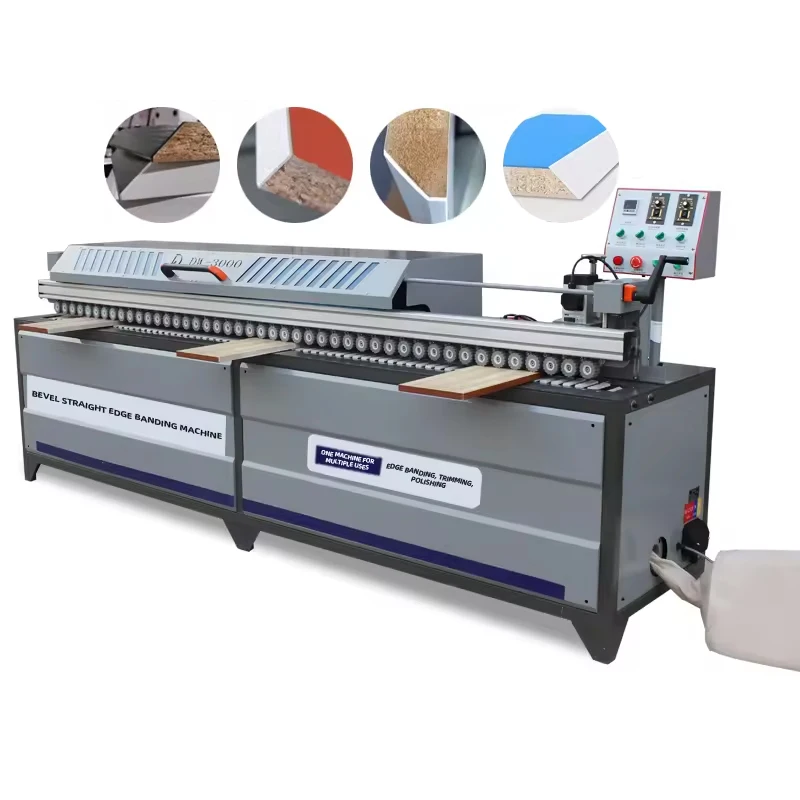
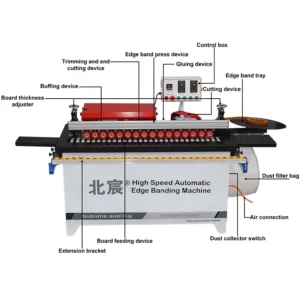
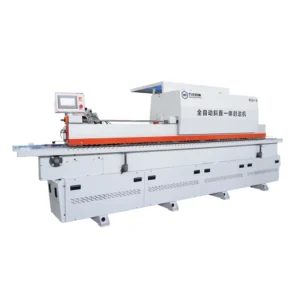
Precision-ground trimming spindles with in-house manufacturing depth — the DW3000 bevel edge bander is built on a line where component tolerances are verified before assembly, not after a customer complaint, supporting OEM partners who need repeatable output across private-label fleets.
Technical Specifications
| Parameter |
Value |
| Model |
DW3000 |
| Product Type |
Fully Automatic 45 Degree Oblique Straight Edge Banding Machine |
| Total Installed Power |
11 kW |
| Pre-milling Motor |
2.2 kW |
| Heating Configuration |
2.2 kW × 2 (dual heat gun) |
| Trimming Motors |
2.2 kW × 2 (spindle type) + 1 additional spindle |
| Polishing Motors |
0.4 kW × 2 |
| Edge Feed Drive |
160 W / 0–12 m/min |
| Transmission Drive |
180 W / 0–12 m/min |
| Vacuum Extraction |
550 W |
| Glue Pot Capacity |
4000 ml |
| Edge Banding Height Range |
0–50 mm |
| Edge Banding Thickness Range |
0.3–3 mm |
| Minimum Panel Length |
300 mm |
| Minimum Panel Width |
150 mm |
| Oblique Pressure Wheel Groups |
8 sets (30°–90° adjustable) |
| Feed Speed |
0–12 m/min |
| Air Supply Pressure |
0.5–0.7 MPa |
| Voltage |
Configurable 380V / 415V (verify local frequency) |
| Control Language |
Chinese / English (custom language available) |
| Overall Dimensions (L×W×H) |
299 × 65 × 130 cm |
| Net Weight |
430 kg |
Application Suitability
| Application |
Material or Output |
| Custom cabinet door edging |
MDF and plywood with PVC or ABS banding |
| Beveled furniture components |
Particleboard requiring 30°–90° oblique profiles |
| Joinery workshop production |
Solid wood panels with veneer edge banding |
| Contract furniture batch runs |
Melamine-faced boards with pre-milled edge prep |
| Panel sizing downstream of saws |
Boards from 150 mm minimum width upward |
Why Voltage Verification Matters Before the Edge Banding Machine OEM Commitment
A bevel edge banding machine that cannot match local supply is an expensive static load until a transformer arrives.
I have stood in workshops in West Africa watching a brand-new edge bander sit idle because the facility ran 415V three-phase while the unit was wired for 380V. Three weeks of lost production while a step-down transformer was sourced locally — and the furniture line behind it stalled completely. Voltage mismatch ranks among the most preventable commissioning failures across exported woodworking equipment [NEED_CITE: voltage and frequency standards by export market]. The DW3000 supports configurable input from 110V to 440V, but the correct configuration must be locked before the edge banding machine OEM production run begins, not assumed from a catalog default.

Component Sourcing and Assembly Traceability
Every DW3000 begins with incoming material inspection where spindle bearings, pressure wheel shafts, and feed belt cylinders are verified against dimensional tolerances before release to the assembly floor. This is where manufacturing depth separates an edge banding machine factory with real process control from one that merely bolts together purchased sub-assemblies.
The 8 sets of oblique pressure wheels and the 3 spindle trimming motors are assembled in-house, meaning replacement parts carry the same sourcing traceability as the original build. Distributors evaluating this equipment for regional stock can audit the component supply chain directly rather than relying on catalog claims [NEED_CITE: industrial equipment supply chain audit standards].
Private Label Production Without Sacrificing Build Integrity
OEM branding on the DW3000 extends beyond a logo plate. Control panel language, electrical schematics, safety labeling, and operation manuals are all producible in the target market language as part of the same production run. A distributor importing into Francophone Africa receives French HMI screens and documentation without a secondary localization step.
The four-stage quality control process — incoming, in-process, finished, and pre-shipment — applies identically to private-label units and factory-branded inventory. No separate quality tier exists for OEM orders, which matters when a distributor’s reputation depends on field performance they did not personally witness during assembly.
Reading the Numbers That Actually Affect Edge Quality
The 2.2 kW pre-milling motor removes saw marks and minor edge damage before the glue station, which directly affects how cleanly PVC and ABS banding adheres to MDF and particleboard substrates. Without pre-milling, edge defects telegraph through the banding and become visible after trimming.
The dual 2.2 kW heat guns maintain consistent glue temperature across the 4000 ml pot, preventing the viscosity fluctuations that cause glue starve on the trailing edge of longer panels. The 0–12 m/min feed speed range means the operator can slow transport for thick 3 mm banding or accelerate for high-volume runs on 0.3 mm PVC — though throughput at upper speed depends on panel dimensions and operator handling rhythm.
The 8 pressure wheel groups adjustable between 30° and 90° give the machine its oblique capability, allowing bevel profiles that standard straight-edge banders simply cannot produce. This is the functional core of what makes the DW3000 suitable for furniture designs requiring chamfered or angled edge treatments rather than simple square profiles.
The Cost of Skipping Configuration Confirmation
Distributors who order standard configurations without mapping them to their regional customer base end up holding inventory that does not match local demand. A market where workshops predominantly process thin PVC on particleboard needs different pressure wheel calibration and glue temperature defaults than one processing thick veneer on solid wood [NEED_CITE: edge banding material selection by regional market].
Specifying the wrong minimum panel dimensions can mean the machine physically cannot handle the small offcuts that constitute a significant portion of custom cabinet work. Discovering this after shipment means either restricting the customer’s product range or arranging a secondary machine — neither of which builds distributor confidence.
Manufacturing Accountability Behind the Specification Sheet
The 10,000 square meter production facility houses the precision grinding and assembly stations where the DW3000’s tolerance claims originate, verified through four-stage QC with pre-shipment testing rather than sampling.
Custom voltage from 110V to 440V is standard configuration, not a special-order exception, meaning an edge banding machine factory with genuine production control accommodates global electrical diversity without extended lead times.
OEM partners receive complete private-label documentation packages — electrical schematics, safety declarations, and operation manuals — produced within the same manufacturing workflow as the hardware itself.
Factory visits are welcomed and sample processing tests on buyer-supplied materials are available before order confirmation, putting verification in the buyer’s hands rather than in marketing claims.
Documentation & Verification
- CE declaration of conformity covering the DW3000’s full electrical and mechanical safety scope
- ISO 9001 certificate for the manufacturing quality management system producing this edge bander
- Factory test record generated on your specified panel thickness and edge banding material before dispatch
- Electrical schematic reflecting the confirmed voltage and frequency configuration for your destination market
- Operation and maintenance manual produced in your agreed language with spare parts cross-reference list
- Pre-shipment photographic record of the specific unit packed and labeled for your consignment
Installation, Commissioning & Support
- The 299 cm footprint requires a clear floor area with level concrete substrate and anchor provisions for the 430 kg net weight
- Dedicated three-phase circuit matching confirmed voltage (380V or 415V) with isolated breaker rated for the 11 kW total load
- Machine ships fully assembled; air supply connection at 0.5–0.7 MPa and dust extraction ducting to the 550 W vacuum port required at site
- Initial commissioning includes pressure wheel angle calibration across the 30°–90° range on buyer’s actual panel stock
- Operator training covers dual heat gun temperature management for the specified edge banding thickness range 0.3–3 mm
- Spare parts list identifies wear items for the 8 oblique pressure wheel sets and spindle trimming motor consumables
Request a Configuration Assessment
To receive a specification and voltage confirmation for the DW3000, provide your workshop’s local voltage and frequency, the primary panel substrates and edge banding materials you process, and whether you require custom control panel language. If you are evaluating this machine for OEM or distributor inventory, specify the target market region and any private-label documentation requirements.
Frequently Asked Questions
Q: What OEM and private label options does the DW3000 support?
A: The edge banding machine factory produces the DW3000 with custom logo application, control panel language in the buyer’s market language, voltage configuration from 110V to 440V, and color or cosmetic panel modifications. All private-label documentation — manuals, schematics, safety labels — is generated within the same production run, maintaining consistency across the fleet.
Q: How does the four-stage QC process verify manufacturing precision?
A: Inspection covers incoming component dimensional checks, in-process assembly verification, finished product functional testing, and pre-shipment operation on buyer-specified materials. Each stage generates documented records. The pre-shipment test specifically runs the buyer’s panel thickness and edge banding material to confirm trimming quality and pressure wheel calibration before packing.
Q: Can distributors visit the factory before committing to volume orders?
A: Factory visits are actively welcomed. Prospective OEM partners and distributors can observe the assembly floor, witness sample processing tests on their own material samples, and review the component sourcing documentation. This direct verification supports informed purchasing decisions for regional market model mix planning.
Q: What spare parts and technical training support distributor service teams?
A: A complete spare parts list accompanies every DW3000 shipment, identifying wear components for the oblique pressure wheels, spindle trimming motors, and feed belt system. Technical training for distributor service personnel covers maintenance intervals, pressure wheel calibration procedures, and troubleshooting the dual heat gun and pneumatic systems.
Q: What lead time should OEM production runs expect?
A: Typical multi-week lead times apply from order confirmation through pre-shipment verification, with the timeline depending on customization scope and order volume. Voltage configuration, custom language panels, and private-label documentation are integrated into the standard production workflow rather than treated as post-build modifications.