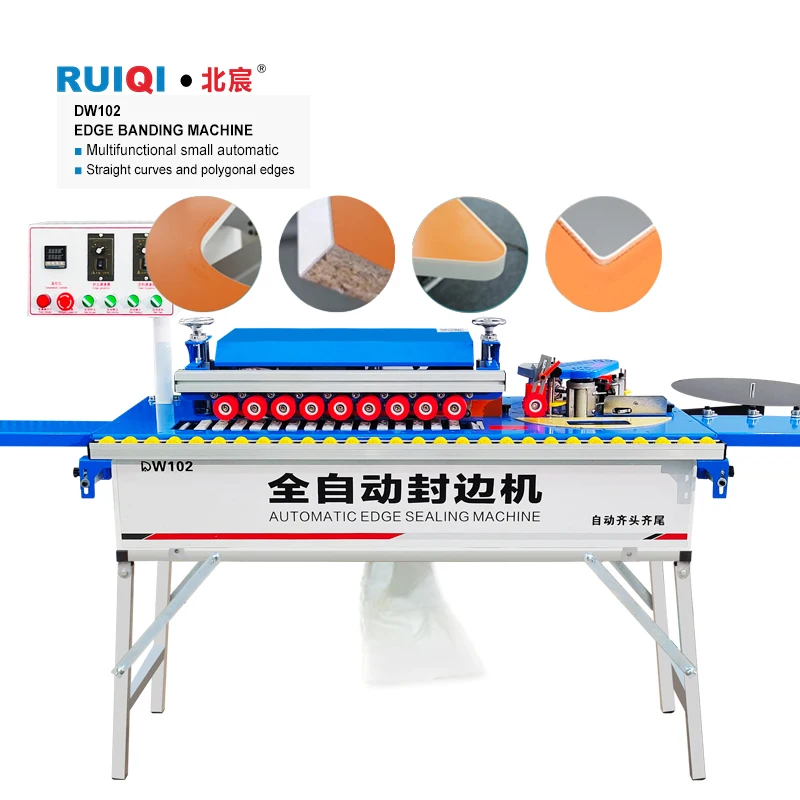
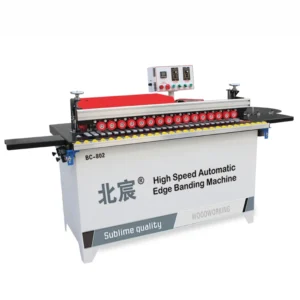
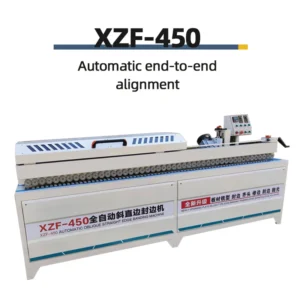
Four-stage factory QC with pre-shipment verification — every DW102 manual edge banding machine is tested on the buyer’s actual panel stock before crating, ensuring glue penetration and trimming parameters match the substrate you will run in your own workshop.
Technical Specifications
| Parameter |
Value |
| Model |
DW102 |
| Product Type |
Manual Edge Banding Machine |
| Total Power |
3800W |
| Voltage |
220V/380V/customization (frequency to be confirmed for target market) |
| Control System |
Manual operation with basic electrical control |
| Overall Dimensions (L×W×H) |
128×47×69 cm |
| Net Weight |
75 kg |
| Minimum Sheet Length |
25 cm |
| Minimum Sheet Width |
5 cm |
| Edge Banding Height Range |
0–50 mm |
| Edge Banding Thickness Range |
0.3–3 mm |
| Edge Feed Power |
20W |
| Transmission Power |
60W |
| Trimming Power |
650W × 2 |
| Polishing Power |
180W × 2 |
| Vacuum Power |
1200W |
| Air Source Pressure |
0.5–0.8 MPa |
| Glue Pot Capacity |
1000 ml |
| Standard Functions |
Curved and straight edge banding, edge trimming, polishing, automatic head and tail cutting, vacuum hold-down |
| Panel Materials |
MDF, blockboard, wood panels, particleboard, plywood, polymer doors |
| Edge Banding Materials |
PVC, double-sided adhesive tape, solid wood, veneer |
| Language Options |
Chinese and English (other languages customizable) |
| Plug Options |
EU, USA, AU, UK (customizable) |
| Assembly State |
Fully assembled |
| Certification |
CE, ISO 9001 |
Application Suitability
| Application |
Material or Output |
| Custom whole-house furniture panel edging |
MDF and plywood with straight and curved profiles, 0.3–3 mm PVC or veneer banding |
| Cabinet door and drawer front finishing |
Particleboard and blockboard with solid wood or PVC edge banding |
| Small-to-medium workshop transition from hand tools |
Polymer door panels and MDF components requiring both curved and straight edge processing |
| Regional distributor stock for resale |
Compact entry-level edge bander with OEM branding and localized voltage configurations |
Why Voltage Confirmation Must Precede the Purchase Order
A manual edge banding machine that arrives with the wrong voltage and frequency is a 75 kg paperweight sitting on your workshop floor.
We have seen it happen — a buyer sources a compact edge bander based on price alone, the machine ships with a standard 380V/50Hz motor, and the destination workshop runs 220V/60Hz. The motor overheats during the first trimming pass, the glue pot never reaches stable temperature, and the vacuum hold-down cannot maintain suction on the panel surface. The unit is then blamed for "poor build quality" when the real failure happened before it ever left the factory loading dock. [NEED_CITE: voltage and frequency standards by export market]
This is why our quotation process for the DW102 Manual Edge Banding Machine begins with confirming your local supply characteristics and ends with an electrical schematic and voltage confirmation document in the shipment paperwork. Frequency differences affect motor RPM and therefore trimming blade speed, which directly affects edge finish quality on PVC and veneer banding materials.

Built at the Factory, Not Assembled from Catalogue Parts
When you source a Manual Edge Banding Machine factory OEM unit directly from the production floor, the advantage is not simply pricing — it is traceability. The DW102 components pass through incoming material inspection before they reach the assembly bench. The trimming motors, vacuum pump, and glue pot heater elements are each checked against rated specifications. If a batch of polishing motors arrives with bearing play outside tolerance, the entire batch is rejected before a single unit is wired. This level of incoming inspection is difficult to guarantee when machines are assembled from sourced sub-assemblies by trading companies without manufacturing control.
Private-Label and Specification Customization as Standard Practice
For distributors and importers building a regional brand around entry-level woodworking equipment, the DW102 supports full OEM and private-label configuration. Logo placement, machine color, control panel language, plug type, and voltage specification are all adjustable at the order level. A single-unit sample order can be produced with your branding for market testing before committing to a container load. [NEED_CITE: CE machinery directive requirements for industrial equipment] We have shipped manual edge banders with Arabic control panel overlays for Middle Eastern distributors and with UL-compatible plug configurations for North American resellers — each configuration documented with its own electrical schematic for local compliance verification.
How Trimming Power and Vacuum Pressure Shape the Finished Edge
The DW102 uses two 650W trimming motors working in sequence to cut excess banding material flush with the panel surface. On a manual edge bander, trimming quality depends on the operator feeding the panel steadily against the fence while the cutters engage — if the panel shifts even slightly, the trim leaves a visible step on the edge. The 1200W vacuum hold-down system addresses this by pulling the panel flat against the worktable surface during the entire trimming and polishing pass. At the specified 0.5–0.8 MPa air source pressure, the vacuum cups maintain consistent grip on MDF, particleboard, and plywood surfaces without marring the panel face. The 180W × 2 polishing motors then buff the trimmed edge to a smooth finish, which is particularly important on PVC banding where rough trimming leaves micro-scratches that catch light and become visible after installation. The 1000 ml glue pot provides sufficient capacity for continuous banding sessions without frequent refills, maintaining stable glue temperature across multiple panels.
The Hidden Cost of Skipping the Sample Panel Test
Early in my career at the factory, we shipped a curve-capable edge bander to a Middle Eastern customer who had approved the machine based on our test results using standard-density MDF. The test panels looked excellent — clean trimming, strong adhesion, no visible glue lines. When the machine arrived and the customer ran their own stock, which was a lower-density particleboard, the glue penetrated the substrate differently and the banding lifted on contact. The problem was not the machine; it was the mismatch between our test material and the customer’s actual production material. [NEED_CITE: substrate density effect on hot-melt adhesive penetration in edge banding] Now every DW102 leaving our facility is tested on the buyer’s actual panel stock before crating, with parameters adjusted and recorded.
Why Procurement Through Our Factory Floor Makes Sense
The DW102 is manufactured in-house with proprietary assembly processes, meaning engineering changes can be applied at the order level without waiting for a supplier to update their catalogue. Our four-stage QC protocol — incoming material, in-process, finished product, and pre-shipment verification — applies to every unit regardless of order size, so a single sample order receives the same inspection documentation as a full container shipment. [NEED_CITE: ISO 9001 quality management system requirements for manufacturing] Voltage and plug customization is handled during production rather than through aftermarket modification, eliminating the warranty gaps that occur when a local electrician rewires a machine after delivery. Factory visits are welcomed and encouraged, allowing buyers to witness the assembly bench and test procedure firsthand before committing to production orders.
Documentation & Verification
- CE declaration of conformity matched to DW102 specifications and export destination
- ISO 9001 certificate covering the manufacturing process for this product line
- Factory test record run on your specified panel material and banding thickness before dispatch
- Electrical schematic and voltage confirmation document for local compliance verification
- Operation and maintenance manual produced in your agreed language with illustrated parts diagrams
- Spare parts list with part numbers for trimming blades, vacuum cups, and glue pot heater elements
Installation, Commissioning & Support
- The 128×47×69 cm footprint requires a level floor area with clearance for operator movement on the feed side
- Dedicated electrical circuit matching the confirmed voltage and frequency, with appropriate breaker rating for the 3800W total load
- DW102 ships fully assembled — remove crate, connect compressed air at 0.5–0.8 MPa, and power on
- First-run parameter calibration performed together with the operator, including glue temperature and feed speed adjustment
- Trimming blade and polishing wheel replacement intervals documented in the maintenance manual
- Wear parts stock recommendation provided based on your expected weekly processing volume
Starting Your DW102 Inquiry
To provide an accurate configuration and quotation for your workshop, we need to understand your production environment. Please share your primary panel materials and their typical thickness range, the edge banding materials you plan to run, and your local voltage and frequency specification. If you require OEM branding or a control panel language other than Chinese or English, note this in your initial inquiry so the engineering team can confirm availability and lead time. Buyers who want to validate the DW102 against their own panel stock before placing a bulk order can arrange a sample panel test or schedule a factory visit to observe the production and QC process directly.
Frequently Asked Questions
Q: Can the DW102 handle my daily production volume?
A: The DW102 is a manual edge banding machine designed for small-to-medium workshops processing custom furniture panels. Its realistic throughput depends on operator speed and panel complexity rather than a fixed cycle time. For workshops running continuous high-volume production, we recommend evaluating a semi-automatic or fully automatic edge bander from our range instead. Our engineering team can advise on the volume threshold where stepping up makes sense.
Q: What voltage and plug configurations can I specify?
A: The DW102 supports 220V and 380V configurations with customization available for other voltages. Plug options include EU, USA, AU, and UK types, with other regional standards available on request. Voltage and frequency are confirmed during the quotation stage and documented with an electrical schematic included in the shipment. This prevents the common problem of machines arriving with incompatible electrical specifications.
Q: How does OEM and private-label branding work?
A: OEM branding on the DW102 covers logo placement, machine color, control panel language, and specification adjustments. Single-unit sample orders with full branding can be produced for market testing before committing to larger quantities. Each OEM configuration receives its own CE documentation and electrical schematic reflecting the customized specifications. Our factory team handles all branding integration during production rather than through aftermarket modification.
Q: Which panel and banding materials are verified compatible?
A: The DW102 is specified for MDF, blockboard, particleboard, plywood, and polymer door panels. Compatible banding materials include PVC, veneer, solid wood, and double-sided adhesive tape within the 0.3–3 mm thickness range. We verify compatibility by running your actual panel stock during the pre-shipment test, adjusting glue temperature and feed parameters to match your specific substrate characteristics.
Q: Can I visit the factory or order a sample for testing?
A: Factory visits are welcomed at our Shandong facility, where you can observe the DW102 assembly process and four-stage QC procedure. Buyers who cannot travel can send their panel stock to the factory for a sample processing test, with results documented in the factory test record. Sample unit orders are available for distributors evaluating the machine for regional resale before placing bulk orders.