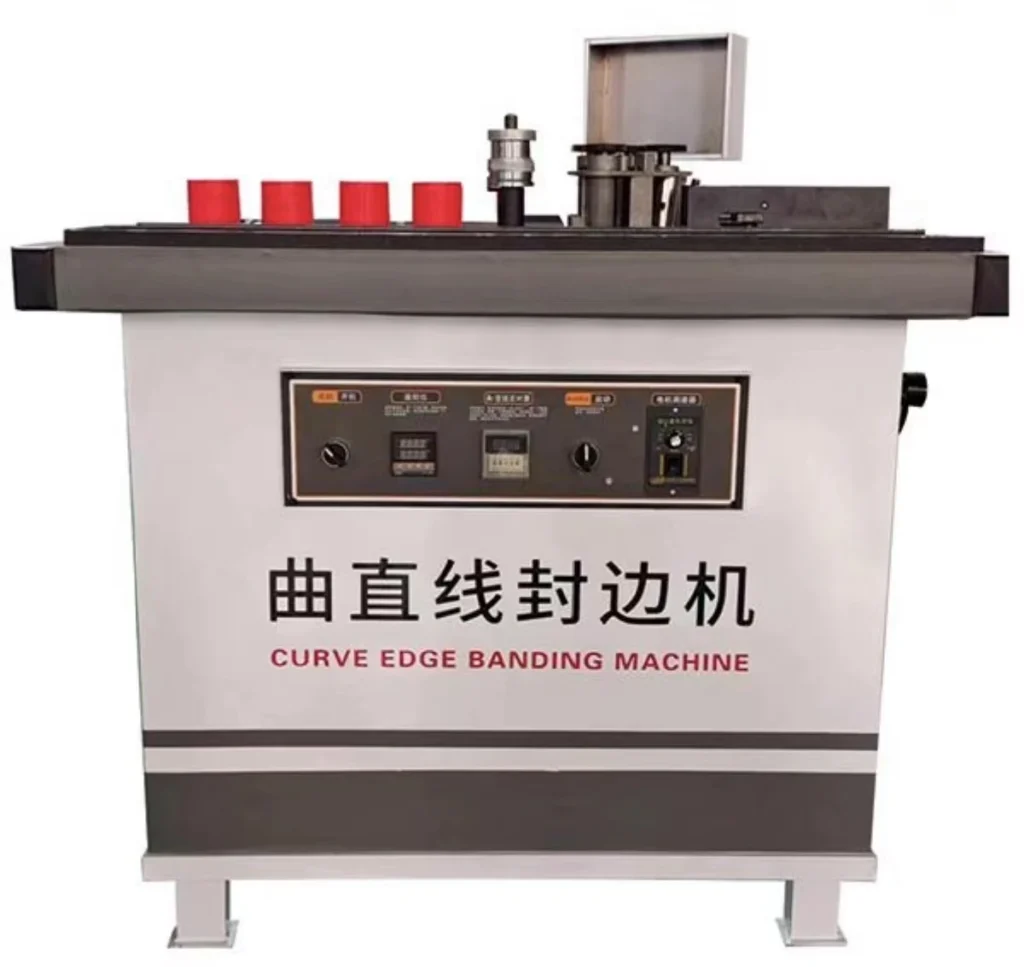
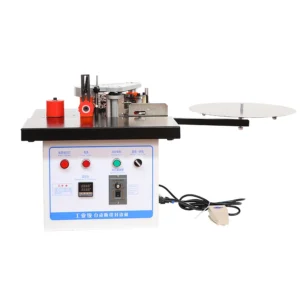
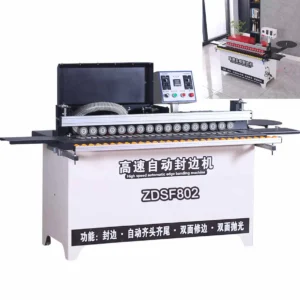
Verified Tolerance at ±0.02mm — every ZDS702 unit undergoes four-stage inspection with documented pre-shipment testing on buyer-supplied edge banding samples.
Technical Specifications
| Parameter |
Value |
| Model |
ZDS702 / 802 |
| Product Type |
Double-Sided Glue Edge Banding Machine |
| Rated Voltage |
220V |
| Rated Power |
1.4 kW (ZDS702) / 4 kW (802) |
| Trimming Height |
10–50 mm |
| Rated Air Pressure |
0.6–0.8 MPa (ZDS702) / 0.4–0.6 MPa (802) |
| Glue Capacity |
2000 ml (ZDS702) / 4000 ml (802) |
| Edge Banding Type |
Curved & Straight dual-purpose |
| Gluing Method |
Double-sided gluing |
| Belt Breaking |
Automatic breaking belt |
| Applicable Edge Materials |
PVC, Wood Veneer, Melamine, Plastic |
| Control System |
Time memory function (source value — verify against manufacturer catalog) |
| Overall Dimensions |
100×75×95 cm (ZDS702) / 130×65×75 cm (802) |
| Machine Weight |
120 kg (ZDS702) / 150 kg (802) |
| Assembly State |
Requires assembly with user manual or video teaching |
| Warranty |
1 year |
Application Suitability
| Application |
Material or Output |
| Cabinet door edge banding |
MDF and particleboard with PVC or melamine edge strips |
| Furniture panel finishing |
Plywood and blockboard with wood veneer banding |
| Custom wardrobe production |
Curved and straight profiles on shaped panel components |
| Wooden door manufacturing |
Solid wood panels with plastic or veneer edge protection |
| Small-batch joinery work |
Mixed substrate runs requiring quick material changeover |
Why Claimed Tolerance Disappears After Assembly
Tolerance only matters when it survives the journey from factory floor to your assembly bench.
A buyer once received a batch of edge-banded panels that looked perfect at the machine but opened up at the seams within a week. The glue line had failed because the supplier never tested with the buyer’s actual edge banding thickness. The edge banding was 0.3 mm thicker than the sample used during factory commissioning, and the glue volume could not bridge the gap. Two full batches of panels were scrapped before the root cause was identified. This is the kind of failure that never appears on a specification sheet but destroys production schedules. [NEED_CITE: common edge banding adhesion failure causes in furniture manufacturing]
How the Double-Sided Glue Edge Banding Machine Is Built for Consistency
The ZDS702 double-sided glue edge banding machine is manufactured in-house with proprietary cutting mechanisms that maintain dimensional control across curved and straight profiles. Precision-ground components are fitted during assembly and verified at each stage rather than only at final inspection. The double-sided gluing system applies adhesive to both the panel edge and the banding strip simultaneously, reducing the risk of uneven coverage that leads to delamination in humid conditions.
OEM Customization from the Production Line Up
For distributors and private-label partners, the ZDS702 offers customization that goes beyond logo placement. Voltage can be configured from 110V to 440V to match the destination market’s electrical standards before the machine leaves the assembly bench. Control panels are produced in the buyer’s required language so that operators can read settings without translation guesswork. Color, branding, and packaging specifications are integrated into the production order rather than applied as afterthoughts. [NEED_CITE: CE machinery directive requirements for industrial equipment]
What the Specification Numbers Mean for Your Production
The trimming height range of 10–50 mm covers the majority of panel thicknesses used in cabinet and furniture manufacturing, from thin shelving stock to heavy worktops. Air pressure requirements differ between the ZDS702 and 802 variants, which affects compressor sizing in the workshop — undersized air supply causes intermittent glue flow and inconsistent trimming force. The glue capacity of 2000 ml on the ZDS702 is sufficient for continuous small-batch runs, while the 802’s 4000 ml reservoir supports longer production cycles without refill interruptions. Automatic belt breaking eliminates the manual snipping step that slows down curved-profile work and introduces uneven end finishes.

The Hidden Cost of Skipping Pre-Shipment Verification
When a machine arrives at a port without having been tested on the buyer’s actual materials, the first commissioning run becomes a diagnostic session rather than a production start. Glue temperature, feed pressure, and trimming alignment all shift when edge banding thickness or substrate density changes. Without a documented factory test on the buyer’s own samples, operators spend days adjusting parameters that should have been preset before crating. In some cases, incompatibility between the machine’s feed height and the panel stock is only discovered after unpacking, requiring mechanical modification that voids warranty coverage. [NEED_CITE: typical commissioning delays caused by untested equipment configurations]
Why Distributors Source This Double-Sided Glue Edge Banding Machine Here
The manufacturing depth behind the ZDS702 means distributors can verify every claim before committing to a regional supply agreement. Patented cutting mechanisms are produced and inspected on-site, not outsourced from third-party workshops. Four-stage quality control covers incoming raw materials, in-process assembly checks, finished product testing, and pre-shipment verification with the buyer’s actual edge banding and panel samples. OEM partners receive full private-label capability including custom logo application, voltage adaptation, and multilingual documentation. Factory visits are welcomed at any production stage, allowing buyers to inspect precision grinding stations and assembly lines directly. Each unit ships with a factory test record documenting performance on the buyer’s specified materials and thicknesses.
Documentation & Verification
- Factory test record on buyer-supplied PVC or veneer edge banding before dispatch
- CE declaration of conformity with electrical schematic matching destination voltage
- ISO 9001 certificate covering the ZDS702 manufacturing and assembly process
- Operation and maintenance manual produced in the buyer’s agreed language
- Spare parts list with part numbers matching the shipped configuration
Installation, Commissioning & Support
- Requires workshop assembly with supplied manual and video guidance for the 120 kg ZDS702 frame
- Dedicated 220V circuit required; compressor must meet 0.6–0.8 MPa air pressure for ZDS702 variant
- Glue pot temperature calibration performed on first startup using buyer’s actual edge banding material
- Curved and straight profile test runs verified before operator handover and training completion
- Automatic belt breaking mechanism adjusted during commissioning to match specified banding thickness
- One-year warranty with spare parts list and sourcing guidance for local replacement components
What to Include in Your Inquiry
Specify the edge banding materials you plan to run — PVC thickness, veneer type, and melamine width — so the correct glue volume and trimming setup can be confirmed. Provide your workshop voltage and frequency so the electrical configuration is built correctly from the start. If you are evaluating this double-sided glue edge banding machine for OEM distribution, indicate your target market and branding requirements so private-label documentation can be prepared alongside the production order.
Frequently Asked Questions
Q: What OEM and private-label options are available for this machine?
A: Logo placement, machine color, voltage configuration from 110V to 440V, and multilingual control panels are all integrated during production rather than added afterward. Packaging and documentation can be customized to match distributor branding. Each OEM order includes electrical schematics and manuals reflecting the exact shipped configuration.
Q: How is the ±0.02 mm tolerance verified before shipment?
A: Each ZDS702 undergoes pre-shipment testing using the buyer’s actual panel samples and edge banding materials. Measurement records document trimming accuracy and glue line consistency across both curved and straight profiles. These test records are included with the shipping documentation for buyer review.
Q: What does the four-stage QC process cover?
A: Incoming material inspection verifies component quality before assembly begins. In-process checks confirm precision grinding and fitting tolerances during build. Finished product testing validates full machine operation, and pre-shipment verification runs the machine on buyer-supplied materials. Buyers are welcome to witness any stage.
Q: What spare parts backup is provided to distributor service teams?
A: A detailed spare parts list with numbered components ships with every unit. Distributors can arrange technical training for their service teams covering glue system maintenance, trimming mechanism adjustment, and pneumatic system servicing. Replacement parts are sourced from the same production line that builds the original machine.