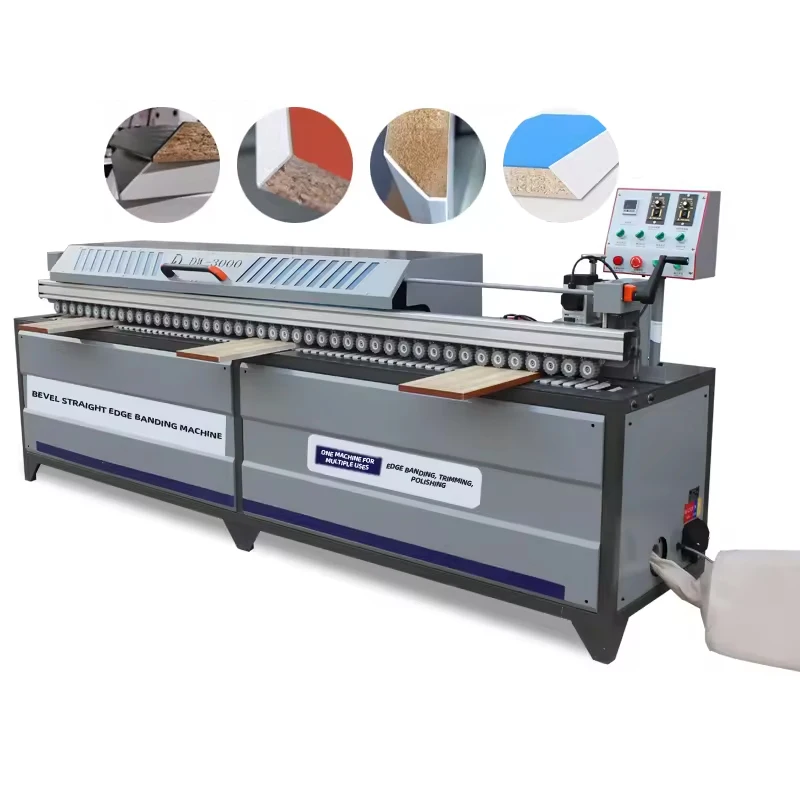
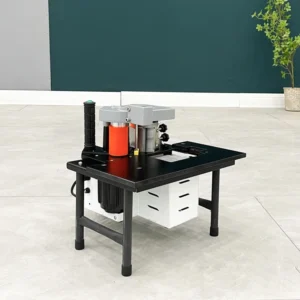
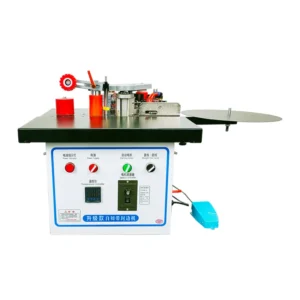
Patented Precision Mechanisms — Every DW3000 edge bander leaving our Ningjin floor carries a cutting mechanism born from in-house tooling, not a copied assembly, which matters when your name goes on the machine.
Technical Specifications
| Parameter |
Value |
| Product Type |
Fully Automatic Edge Banding Machine with 45-Degree Oblique & Straight Edge Capability |
| Total Power |
11 kW |
| Voltage & Frequency |
380V / 415V (configurable from 110V to 440V) |
| Overall Dimensions (L×W×H) |
299 × 65 × 130 cm |
| Net Weight |
430 kg |
| Minimum Panel Length |
30 cm |
| Minimum Panel Width |
15 cm |
| Edge Banding Height Range |
0–50 mm |
| Edge Banding Thickness Range |
0.3–3 mm |
| Feed Speed |
0–12 m/min |
| Pre-milling Motor |
2.2 kW |
| Heating System |
2.2 kW × 2 (double heat gun) |
| Trimming Motors |
2.2 kW × 2 (3 spindle motors total) |
| Polishing Motors |
0.4 kW × 2 |
| Vacuum Power |
550 W |
| Edge Feed Power |
160 W |
| Transmission Power |
180 W |
| Glue Pot Capacity |
4000 ml |
| Air Source Pressure |
0.5–0.7 MPa |
| Pressure Wheel Configuration |
8 groups, 30–90° adjustable |
| Standard Functions |
Pre-milling, 30–90° edge banding, trimming, scraping, polishing, high-power vacuuming |
| Language Options |
Chinese and English standard; multilingual available |
Application Suitability
| Application |
Material or Output |
| Custom cabinet door edging |
MDF and particleboard with PVC or veneer banding |
| Office furniture panel finishing |
Plywood and melamine-faced board, straight and bevel edges |
| Wardrobe and shelving production |
Chipboard panels up to 50 mm edge height |
| Joinery workshop batch runs |
Solid wood panels requiring clean scrape and polish finish |
| 45-degree oblique decorative edges |
MDF and plywood for display and retail fixtures |
Why Voltage Verification Must Come Before the Quotation
A machine that cannot plug in is a machine that does not work, regardless of how well it was built.
I spent years on the assembly floor before moving into technical sales, and one early shipment still stings — an edge bander sent to a Middle East workshop without locking down the local frequency standard. The unit sat idle for two weeks while a transformer was sourced. That failure had nothing to do with engineering quality and everything to do with a missing checklist item. Every Edge Banding Machine factory OEM order we build now starts with a confirmed electrical schematic matching the destination grid, because the cost of a missed voltage check falls entirely on the buyer. [NEED_CITE: voltage and frequency standards by export market]

Component Sourcing and In-House Machining Depth
When a distributor evaluates an Edge Banding Machine factory OEM partner, the first question is usually how much of the machine is actually produced in-house versus assembled from purchased sub-assemblies. On the DW3000, the cutting and trimming spindles are ground on our own precision stations, and the pressure wheel assemblies are machined and balanced internally rather than sourced as complete units. This matters because it gives us direct control over tolerance stack-up across the feed chain, and it means replacement parts remain available on the same tooling years after the initial sale.
Four-Stage Quality Control Before Crating
Incoming steel and castings are checked for dimensional conformity before they enter the machining hall. In-process inspections catch run-out on spindles and flatness deviation on the feed table. Finished machines go through a full functional test with actual panel stock, and a pre-shipment verification run is documented with photographs. This sequence exists because a defect caught at incoming stage costs a fraction of one discovered after the machine is bolted to a workshop floor overseas. [NEED_CITE: CE machinery directive requirements for industrial equipment]
Reading the Numbers That Matter
The 2.2 kW × 2 double heat gun arrangement keeps adhesive at working temperature even when ambient conditions fluctuate, which directly affects glue line consistency on PVC and veneer banding. Eight pressure wheel groups adjustable between 30 and 90 degrees allow the operator to set compliant contact across substrates of varying density — particleboard needs a different pressure profile than solid MDF. Three spindle trimming motors, including a dedicated spindle trimmer, remove excess banding in stages so that the final scrape and polish wheels work on a controlled surface rather than correcting a rough cut. The 0–12 m/min feed speed range lets a small workshop start slow for complex bevel edges and increase throughput on straight-run panel batches as operator confidence grows.
The Hidden Cost of Underspecified Configurations
A common pattern I have seen with this class of edge bander is a buyer ordering a unit rated for light-duty output and running it in two-shift production. The feed chain wears prematurely, the glue pot cannot recover temperature between panels, and within months the machine is pulling downtime that the original quotation never suggested. Equally problematic are single-machine purchases that ignore upstream feed height or downstream conveyor alignment, forcing the buyer into a round of field modifications. Choosing an Edge Banding Machine factory OEM partner who asks about daily panel volume and line layout before issuing a price prevents most of these failures. [NEED_CITE: typical failure modes in panel edge banding operations]
Why Source This Machine From Our Floor
The DW3000 is built on the same line as our full-function pre-milling models, so a distributor can offer customers a clear upgrade path within one supplier. Voltage is configurable from 110V to 440V and confirmed in writing before production begins, eliminating the transformer problem I encountered early in my career. OEM logo placement, custom color, and multilingual control panels are standard customization options, not special requests that delay the schedule. Every unit ships with a factory test record run on the buyer’s specified panel thickness, giving the importer documented proof of performance before the crate is sealed. Our Ningjin facility welcomes factory visits — come inspect the precision grinding stations, the assembly bays, and the pre-shipment test area firsthand.
Documentation & Verification
- CE declaration of conformity matched to the DW3000 configuration shipped
- ISO 9001 certificate covering our manufacturing and quality management scope
- Electrical schematic confirming destination voltage and frequency before dispatch
- Factory test record on your specified panel material and edge thickness range
- Operation and maintenance manual in the language your operators read
- Pre-shipment verification photographs of the DW3000 running under load
Installation, Commissioning & Support
- Requires a level concrete pad accommodating the 299 × 65 cm footprint with operator clearance
- Dedicated circuit matching confirmed 380V/415V or custom voltage draw at 11 kW total
- Arrives fully assembled; connect air supply at 0.5–0.7 MPa and power for first run
- Initial calibration of the 8 pressure wheel groups to your primary panel substrate
- Spare parts list covering wear items for the trimming spindles and feed chain
- Daily vacuum port cleaning on the 550 W extraction system to maintain glue zone clarity
What We Need to Build Your Quotation
Send us the panel materials you run most often — MDF, plywood, particleboard, or solid wood — along with typical panel dimensions and edge banding thickness. Confirm your local voltage and frequency so the electrical package is right the first time. Let us know whether you need the control panel in a language beyond Chinese or English, and whether the DW3000 will operate as a standalone unit or within a line that includes upstream saws and downstream handling.
Frequently Asked Questions
Q: What customization scope is available for OEM and private label orders?
A: Logo placement, machine color, voltage from 110V to 440V, and control panel language are all configurable as standard. We produce the branding artwork to your file and confirm layout before painting. Private label documentation including manuals and nameplates follows the same approval step.
Q: How much of the DW3000 is manufactured in-house?
A: Spindle grinding, pressure wheel machining, frame welding, and final assembly all take place in our facility. Motors and electrical components are sourced from established suppliers and verified at incoming inspection. This depth lets us control tolerance and maintain long-term parts availability.
Q: How is edge quality verified before the machine ships?
A: Each DW3000 runs a pre-shipment test on panel stock matching your specification. We document edge finish, glue line integrity, and trimming accuracy in a factory test record with photographs. The report travels with the machine so your team can confirm results on arrival.
Q: What spare part support do regional distributors receive?
A: Distributors receive a recommended spare parts list matched to regional service intervals, covering trimming spindles, feed chain links, and pressure wheel bearings. We hold stock of high-wear items and ship replacements on standard courier schedules to minimize field downtime.
Q: What lead time should an OEM buyer expect?
A: Standard configurations typically move from order confirmation to pre-shipment test within a multi-week window. Custom voltage, language, or branding requirements add time for component sourcing and artwork approval. We confirm the schedule in the formal quotation so planning stays predictable.