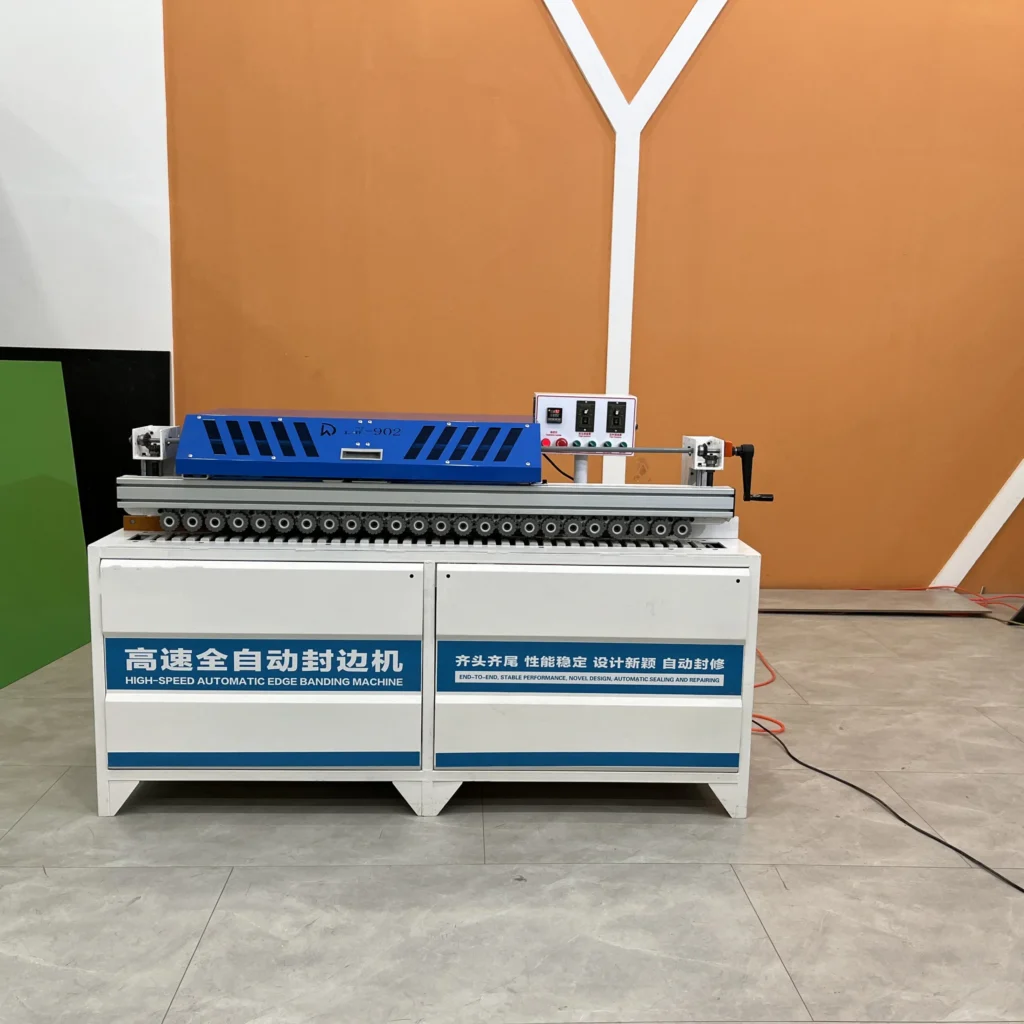
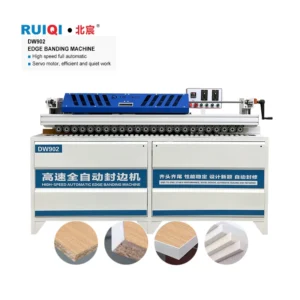
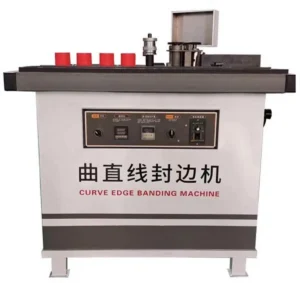
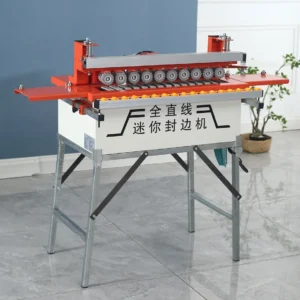
Voltage-Agnostic Build — Every linear edge bander leaves our Ningjin facility with a factory test record tied to the buyer’s confirmed local grid, preventing the kind of frequency mismatch that once left a Dubai cabinet line idle for weeks.
Technical Specifications
| Parameter |
Value |
| Product Type |
Automatic Edge Banding Machine |
| Voltage |
220V (configurable from 110V to 440V on request) |
| Total Power |
3300W |
| Overall Dimensions (L×W×H) |
1750×600×1120 mm |
| Net Weight |
240KG |
| Edge Banding Type |
Linear Edge Banding Machine |
| Edge Band Height Range |
0–50 mm |
| Edge Band Thickness Range |
0.3–3 mm |
| Glue Pot Capacity |
4000 ml |
| Gluing Method |
Double-sided gluing |
| Trimming Stations |
Double high-speed trimming motors (up and down) |
| Polishing Stations |
Up and down two polishing motors |
| Edge Strip Cutting |
Pneumatically controlled |
| Pressure Beam |
Integrated pressure beam with double rows of pressure wheels |
| Conveyor Belt |
Silicone material |
| Temperature Control |
Intelligent temperature control |
| Control System |
Independent operating platform (basis to be confirmed) |
| Feed Speed |
(basis to be confirmed) |
| Panel Thickness Range |
(basis to be confirmed) |
Application Suitability
| Application |
Material or Output |
| Custom cabinet door edge finishing |
MDF and particleboard with PVC or ABS edge banding |
| Small-batch wardrobe panel processing |
Plywood panels with veneer or melamine edge strips |
| Joinery workshop scale-up from manual trimming |
Solid wood panels up to 50 mm band height |
| Furniture component edge sealing |
MDF shelving and drawer fronts with 0.3–3 mm band thickness |
Why the Voltage Question Must Precede the Production Quote
We confirm local voltage and frequency before scheduling a single automatic edge banding machine factory order, because a mismatched motor burns out on day one, not day one hundred.
Years ago, I shipped an edge bander to a customer in the Middle East rated for 380V/50Hz. The local grid ran 410V/60Hz. The inverter failed within hours of commissioning, and the workshop floor filled with unprocessed panels while the entire line sat idle awaiting a transformer retrofit. [NEED_CITE: voltage and frequency standards by export market] That incident changed how we handle every order: we now request a photo of the buyer’s distribution cabinet before the production schedule is locked. An OEM partner evaluating an automatic edge banding machine factory should expect this level of electrical diligence as standard practice, not as an optional courtesy.

Manufacturing Depth Behind Each Unit
Distributors and OEM buyers evaluating an automatic edge banding machine factory need to see beyond the exterior housing. Our Ningjin facility covers the precision grinding of critical feed components in-house, and our cutting mechanisms carry proprietary patents that hold the edge trim to a verifiable tolerance. This matters when a distributor is committing to a regional model mix and needs confidence that each unit will perform identically across a production run. The 240KG net weight reflects cast iron and steel assemblies rather than lightweight alternatives, contributing to the vibration damping that keeps trimming motors aligned during extended shifts.
Component Sourcing Transparency for OEM Partners
OEM buyers deserve a clear answer on which parts originate on the factory floor versus which are sourced externally. [NEED_CITE: CE machinery directive requirements for industrial equipment] The integrated pressure beam, silicone conveyor belt, and pneumatic edge strip cutting assembly are built and tested in-house. Motors and electrical components come from established suppliers, with incoming material inspection as the first gate of our four-stage QC protocol. When a private-label partner requests custom branding, the specification tailoring extends to control panel language, electrical schematics printed in the target language, and documentation that carries the partner’s brand throughout the operator manual.
How Spec Choices Translate to Panel Quality
The 4000 ml glue pot with intelligent temperature control directly affects glue-line consistency across different banding materials. PVC requires a lower operating temperature than ABS, and the intelligent controller adjusts the heat profile to match, reducing the risk of glue starvation on long runs or glue seepage on thin 0.3 mm veneer. The double-sided gluing method coats both the panel edge and the banding strip simultaneously, which improves adhesion on porous MDF substrates where single-sided application can leave dry spots. Up and down dual polishing motors address a common complaint in furniture assembly: the visible haze left on the panel surface after trimming. With two motors working the top and bottom edges, the final surface is ready for inspection without a separate hand-polishing step. The pneumatically controlled edge strip cutting eliminates the ragged start-and-stop marks that manual feeding introduces, particularly noticeable on high-gloss ABS banding used in kitchen cabinetry.
What Happens When the Wrong Configuration Ships
A buyer who specifies a machine without confirming panel thickness range often discovers the incompatibility only when the first batch of thick plywood panels fails to feed under the pressure beam. [NEED_CITE: woodworking machinery tolerance standards for panel processing] Entry-level units sold into production volumes they were never designed for show premature bearing wear, and the trimming motors lose alignment long before the manufacturer’s expected service interval. For distributors, the reputational cost compounds when local furniture factories blame the brand rather than the configuration mismatch. Edge banding quality that varies across substrates—visible glue lines on MDF but clean joints on particleboard—usually traces back to a glue pot and temperature system that was never matched to the buyer’s actual material mix.
Why Sourcing This Machine From Our Factory Floor Makes Sense
Our facility handles everything from single-unit custom orders through to large production runs for distributor inventories. Voltage customization from 110V to 440V is standard, not an upcharge, and every unit ships with a voltage confirmation sheet signed off against the buyer’s grid specification. The four-stage QC process—covering incoming material, in-process checks, finished product inspection, and pre-shipment verification—generates documentation that OEM partners can present to their own customers as proof of build integrity. Factory visits are welcomed and encouraged, so a distributor can walk the production floor, inspect precision-ground components, and watch a test run on their own sample panels before committing to a container load. Our engineering team delivers a formal configuration proposal within 24 hours of receiving an inquiry, which keeps the procurement timeline moving for buyers who are comparing multiple sources. [NEED_CITE: ISO 9001 quality management system requirements for machinery manufacturing]
Documentation & Verification
- CE declaration of conformity specific to this linear edge banding model
- ISO 9001 certificate covering the Ningjin manufacturing facility
- Factory test record using buyer-specified panel material and edge band thickness
- Electrical schematic with confirmed voltage and wiring diagram per order
- Operation and maintenance manual printed in the buyer’s agreed language
- Spare parts list with itemized part numbers for trimming motors and glue pot components
Installation, Commissioning & Support
- Requires a dedicated 220V circuit rated for 3300W total power draw with grounded connection
- 1750×600 mm footprint fits standard workshop layouts; verify aisle clearance for panel feeding
- Silicone conveyor belt inspection and tension adjustment included in commissioning protocol
- Intelligent temperature controller calibrated to buyer’s specified PVC or ABS banding material on first run
- Pneumatic cutting system requires connection to workshop compressed air supply at specified pressure
- Double high-speed trimming motors aligned and test-run on sample panels before handover
Requesting a Configuration Proposal
Send us your primary panel substrate and typical edge banding material, along with the local voltage and frequency at your installation site. Let us know the control panel language your operators require and whether you need OEM branding on the machine housing and documentation. If you are evaluating a regional distributor model mix, share the range of panel thicknesses and production volumes across your target customers so our engineers can recommend the right configuration tier.
Frequently Asked Questions
Q: What can be customized under an OEM or private-label agreement?
A: Logo placement, machine color, voltage from 110V to 440V, control panel language, and specification tailoring are all available. We also produce branded operation manuals, packaging markings, and customs documentation under the partner’s brand identity, with every customization item confirmed in writing before production begins.
Q: Which components are manufactured in-house versus sourced externally?
A: The pressure beam assembly, pneumatic cutting mechanism, and precision-ground feed components are built in our Ningjin facility. Motors, inverters, and electrical elements come from vetted suppliers and undergo incoming material inspection as the first stage of our QC protocol before assembly begins.
Q: What QC records accompany the machine at shipment?
A: Every unit ships with a factory test record documenting performance on the buyer’s specified material, a voltage confirmation sheet, an electrical schematic, and a signed pre-shipment verification report. These records trace the machine through all four QC stages from incoming material to final dispatch.
Q: How does the factory support distributors planning a regional product lineup?
A: We work with distributors to map local market demand—panel types, voltage standards, and workshop sizes—against our model range. Our engineering team recommends a model mix that covers entry-level through full-function tiers, backed by spare parts inventory and technical training for the distributor’s service team.