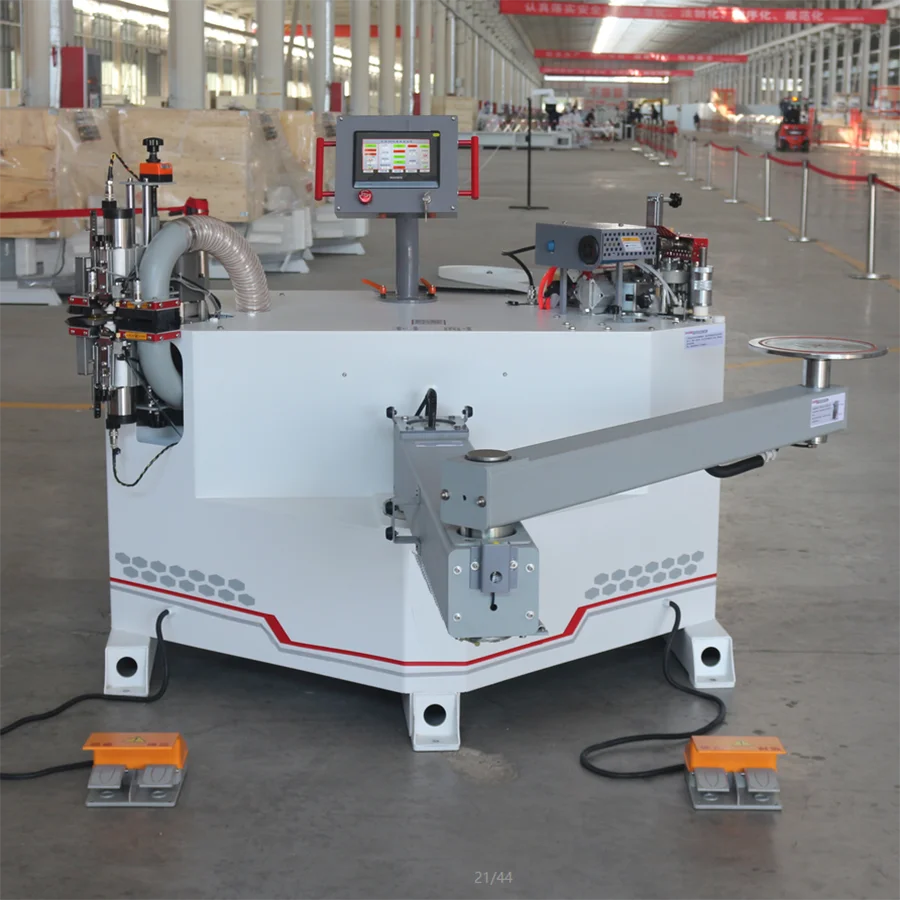
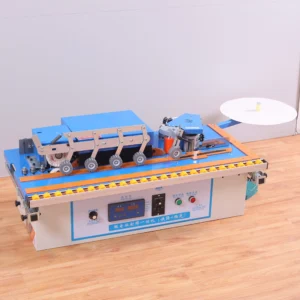
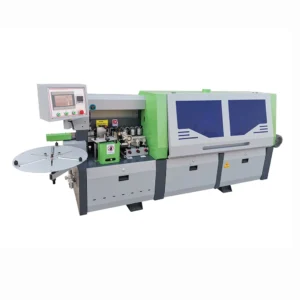
Precision-ground mechanisms — ZDS-700 curved edge banding machines leave the factory with laser-verified docking records, giving OEM partners documented accuracy before the crate is sealed.
Technical Specifications
| Parameter |
Value |
| Model |
ZDS-700 |
| Product Type |
Automatic Curved Edge Banding and Trimming Machine |
| Voltage & Frequency |
380V/50HZ |
| Rated Power |
6KW |
| Control System |
PLC HIU-XP, Touch Screen Industry IT7000 |
| Frequency Transformer |
MD200 2.2KW |
| Laser Displacement Sensor |
1030 |
| Edge Banding Motor |
220V 400W Servo Motor |
| Trimming Profiling Motor |
220V 60W Single-phase Motor |
| Trimming High-speed Motor |
220V 400Hz 24000rpm |
| Air Pressure Requirement |
0.6–0.8Mpa |
| Glue Pot Operating Temperature |
110–210°C (source value — verify against manufacturer catalog) |
| Thickness of Strips |
0.5–3mm |
| Width of Strips |
14–70mm |
| Edge Banding Speed |
0–22m/min |
| Docking Error |
±0.3mm |
| Glue Pot Capacity |
2600ml |
| Touch Screen Data Storage |
20 form data sets |
| Overall Dimensions |
1550×1440×1350mm |
| Net Weight |
451kg |
Application Suitability
| Application |
Material or Output |
| Curved furniture panel edge banding |
MDF, particleboard, plywood with shaped contours |
| Custom cabinet door profiling |
PVC and veneer strips 0.5–3mm thick |
| Irregular-shaped table and desk components |
Solid wood panels with U-profile or radius edges |
| Small-batch custom furniture production |
Both PUR and EVA adhesive compatible |
Why Tolerance Claims Fail When Panels Reach Assembly
Laser-guided docking replaces manual cutting guesswork with measurable, documented accuracy.
I once watched a batch of curved table legs come off a competitor’s machine with visible glue lines and uneven trimming. The supplier had quoted ±0.5mm on paper, but no test record accompanied the shipment. The furniture factory discovered the discrepancy only when legs failed to mate with pre-drilled aprons on the assembly floor. With the ZDS-700, the laser displacement sensor reads the panel edge in real time, and every unit ships with a factory test record showing actual docking deviation. That piece of paper matters more than any brochure claim [NEED_CITE: woodworking machinery tolerance verification standards].
For OEM partners and importers evaluating a curved edge banding machine factory, this documentation gap is where warranty disputes begin. A machine that cannot prove its tolerance before crating will cost you credibility with your own downstream buyers.

Servo-Driven Feed That Tracks the Curve
The 400W servo motor on the ZDS-700 responds to contour changes without the lag typical of stepper-driven systems. As the panel moves through at up to 22m/min, the feed mechanism adjusts pressure and speed to match the radius, preventing strip lift on tight inside curves. The frequency transformer modulates output smoothly across the full speed range.
Glue Pot Design for Mixed Adhesive Runs
The 2600ml one-piece molded glue pot maintains stable temperature across its full volume. Whether you run EVA for standard PVC banding or switch to PUR for moisture-resistant applications, the thickened pot wall reduces heat loss during prolonged idle periods between batches. This matters in workshops that alternate between materials throughout a shift [NEED_CITE: PUR vs EVA adhesive temperature management in edge banding].
Reading the Numbers That Actually Matter
The ±0.3mm docking error is achieved through the laser displacement sensor working in tandem with the PLC control loop. Unlike mechanical limit switches that trigger at a fixed point, the sensor reads actual panel position continuously, so docking cuts occur at the precise edge location regardless of minor feed variation. The 24000rpm trimming motor ensures clean profiling on both PVC and veneer strips without tear-out, which directly affects the visual quality your furniture buyer sees. Air pressure at 0.6–0.8Mpa drives the pneumatic actuators for strip clamping and cutter engagement — insufficient pressure causes chatter marks on the trimmed edge. The 20 form data sets stored on the touch screen let operators recall saved profiles for repeat jobs without recalibrating from scratch.
The Cost of Skipping Voltage Confirmation
Machines quoted without confirming local voltage and frequency arrive at the dock unusable. I have seen workshops in regions with 220V/60Hz grids receive 380V/50Hz equipment because the purchase order never specified electrical requirements. The ZDS-700 electrical schematic and voltage confirmation sheet prevent this, but only if the conversation happens before production begins. OEM partners distributing across multiple markets must map each territory’s electrical standard to the correct build configuration [NEED_CITE: voltage and frequency standards by export market].
Why Source From This Production Floor
In-house manufacturing means the cutting mechanisms and precision-ground components are built under one roof, not assembled from third-party sub-assemblies. Four-stage quality control covers incoming material inspection, in-process checks during assembly, finished product testing, and pre-shipment verification with formal documentation. OEM logo application, control panel language customization, and specification tailoring are handled on the same production line rather than outsourced after build. Every ZDS-700 leaves with a factory test record specific to your panel thickness and strip material. CE declaration of conformity and ISO 9001 certification back the documentation package as standard.
Documentation & Verification
- Factory test record showing ±0.3mm docking accuracy on your specified panel thickness
- CE declaration of conformity and ISO 9001 certificate included in shipment
- Electrical schematic with voltage and frequency confirmation matched to destination market
- Operation and maintenance manual in agreed language with spare parts list
- Packing photographs documenting machine condition before crating
Installation, Commissioning & Support
- KD packing requires on-site assembly using included manual or video guidance for the 451kg unit
- Dedicated 380V circuit required to support the 6KW rated power draw at startup
- Air compressor supplying 0.6–0.8Mpa must connect to the integrated 2L storage tank
- Glue pot temperature calibration to match your specific PVC or veneer strip material
- 4 automatic cleaning devices with spray system reduce daily maintenance intervals
- Enlarged dust suction port with air pump connects to workshop extraction system
What We Need to Configure Your Machine
To prepare an accurate quotation and build specification, share the panel materials and thicknesses you run most frequently, the edge banding strip type and dimensions, and your local voltage and frequency standard. If you are evaluating this as an OEM line for distribution, indicate target markets and any private label requirements including logo placement and control panel language. Sample processing tests on your actual materials can be arranged before order commitment.
Frequently Asked Questions
Q: How is the ±0.3mm docking tolerance verified before the machine ships?
A: Each ZDS-700 undergoes a pre-shipment test run using panels matching your specified thickness and strip material. The laser displacement sensor logs actual docking deviation, and a signed factory test record accompanies the shipment. This record shows measured values, not just pass or fail status, so your receiving team can verify on arrival.
Q: Can the machine be built to local voltage requirements outside 380V/50Hz?
A: Yes. Voltage from 110V to 440V and various frequency options are configurable during production. The electrical schematic and voltage confirmation sheet are finalized before build begins, ensuring the machine matches your facility’s power supply. This step prevents the common problem of equipment arriving electrically incompatible with the destination workshop.
Q: What does OEM and private label customization include?
A: Customization covers logo application on the machine body, control panel language in your market’s language, color specification, and parameter tailoring to your product range. All modifications are completed on the production line, not applied after assembly. Touch screen interface elements can also be adapted to match your brand terminology.
Q: How does the glue pot handle switching between PUR and EVA adhesives?
A: The 2600ml thickened one-piece molded pot maintains temperature stability across the 110–210°C range. When switching adhesives, the cleaning cycle flushes residual material through the 4 automatic cleaning devices. Operators store separate temperature profiles in the 20 available form data sets for quick changeover between adhesive types.
Q: What technical support is available after installation for distributor service teams?
A: Distributors receive electrical schematics, component-level documentation, and spare parts lists to support their own service operations. Video guidance covers assembly, commissioning, and common fault diagnosis. Remote technical consultation is available during installation, and critical spare parts can be ordered directly against the machine’s build record for exact component matching.