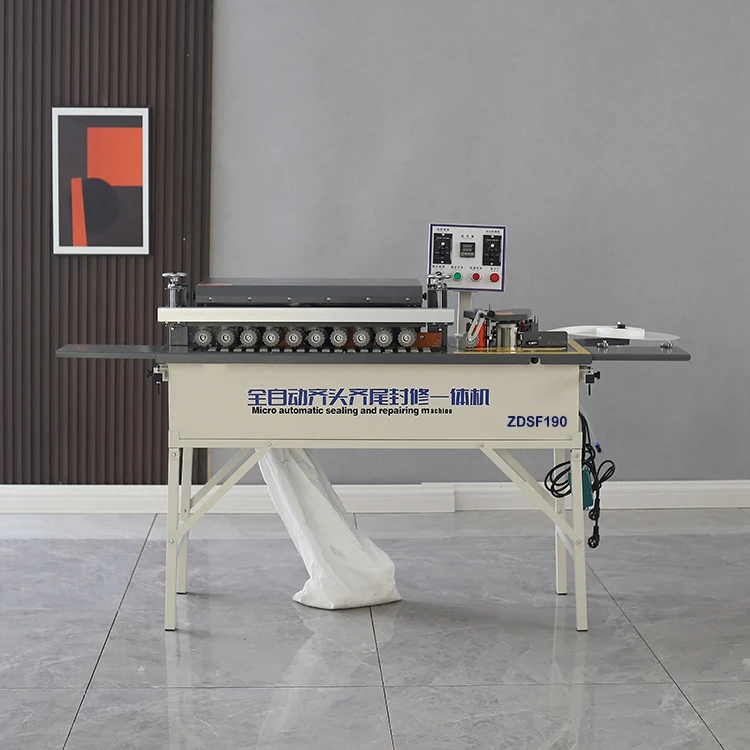
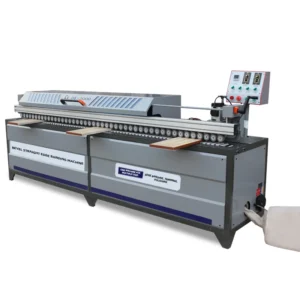
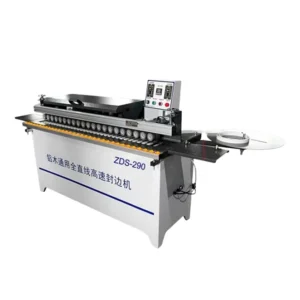
Precision-Verified Build — Every ZDSF190 unit undergoes a four-stage QC protocol with pre-shipment testing on your specified panel thickness and edge banding material before it leaves our Shandong facility.
Technical Specifications
| Parameter |
Value |
| Model |
ZDSF190 |
| Product Type |
Small Automatic Edge Banding Machine |
| Function Sequence |
Automatic plate feeding, Gluing, End cutting, Trimming, Vacuuming, Polishing |
| Voltage |
220V |
| Rated Power |
4 kW |
| Heating Power |
800 W |
| Trimming Power |
800 W × 2 |
| Polishing Power |
180 W × 2 |
| Suction Power |
1200 W |
| Transmission Power |
120 W |
| Belt Power |
25 W |
| Working Speed |
0–7 m/min |
| Panel Thickness Range |
10–50 mm |
| Strip Thickness |
0.5–2.5 mm |
| Glue Pot Capacity |
1000 ml |
| Rated Air Pressure |
0.6–0.8 MPa |
| Trimming Tool |
Imported brand 4-blade alloy arc knife |
| Dust Collection Efficiency |
99% (basis not stated in source) |
| Overall Dimensions |
1900 × 560 × 1300 mm |
| Net Weight |
105 kg |
| Operation Mode |
Straight and curved edge banding |
Application Suitability
| Application |
Material or Output |
| Custom cabinet door edge finishing |
MDF panels 10–50 mm with PVC or veneer banding |
| Small-batch furniture production |
Particleboard shelves and carcass components |
| Curved panel trim work |
Plywood radius cuts with 0.5–2.5 mm melamine strips |
| Joinery workshop scale-up |
Solid wood panels transitioning from hand-edge finishing |
| Carpenter shop prototyping |
Mixed substrate short runs with frequent material changes |
Why the Voltage Question Should Come Before the Price on Any Edge Banding Machine Factory Order
Confirming your workshop’s electrical supply prevents a machine that literally cannot start on arrival.
I spent years on the assembly floor before moving to equipment configuration, and the most frustrating calls I have taken are from buyers who received a 380V three-phase machine when their shop only has single-phase 220V. The ZDSF190 runs on 220V single-phase power, which aligns with the electrical infrastructure in most small workshops and carpentry shops. Yet I still ask every buyer to send me a photo of their breaker panel and confirm local frequency before I finalize any quotation. An Edge Banding Machine factory order that skips this step turns into a costly return or an on-site transformer purchase that nobody budgeted for [NEED_CITE: voltage and frequency standards by export market].

Compact Footprint Without Sacrificing the Full Edge Banding Sequence
The ZDSF190 packs plate feeding, gluing, end cutting, trimming, vacuuming, and polishing into a 1900 × 560 mm footprint. For a joinery workshop moving away from manual edge application, this means the entire Edge Banding Machine factory configuration fits against a single wall while still leaving room for material staging. The 105 kg net weight also means two people can reposition the unit when the shop floor layout needs to change for a different project run.
Dual Straight-and-Curved Capability in One Pass
Most entry-level banders force a choice between straight trimming and curved profile work. The ZDSF190 handles both within the same function sequence, using the imported 4-blade alloy arc knife for trimming and dedicated polishing motors for final surface finish. This flexibility matters when a cabinet maker takes on a curved reception desk or radius shelving unit mid-week and cannot afford to wait for a separate machine to arrive.
What the Specification Numbers Mean for Daily Production
The 10–50 mm panel thickness range covers the vast majority of substrates a small workshop encounters, from thin 10 mm MDF drawer sides up to 50 mm solid-wood countertop slabs. The 0–7 m/min variable feed speed lets operators dial back for delicate curved sections or push closer to the upper range on long straight runs. Glue pot capacity at 1000 ml is sufficient for a full day of intermittent use without constant refilling, and the 800 W heating element brings the pot to working temperature on typical EVA hot-melt adhesives. The 0.6–0.8 MPa air pressure requirement means a standard small workshop compressor can supply the pneumatic circuits without a dedicated air system [NEED_CITE: pneumatic pressure requirements for light industrial woodworking machinery].
The Real Cost of Skipping a Panel Material Conversation
Last year a customer ordered a compact bander after testing on standard particleboard. When the machine arrived at his shop, he was running high-density MDF, and the glue temperature, feed rate, and trim depth all needed adjustment. Four days of on-site tuning later, the machine finally produced clean edges. That experience is why I now insist on knowing the exact substrate, thickness range, and edge strip material before I confirm any Edge Banding Machine factory build. The trimming knives and glue settings calibrated for particleboard will leave visible glue lines or chipped edges on denser MDF if the parameters are not reset [NEED_CITE: substrate density effects on edge banding adhesion and trim quality].
What Building In-House Means for Your Order
Our Shandong facility handles machining, assembly, and four-stage quality verification under one roof, so the ZDSF190 you receive carries factory test records specific to your panel specifications. Patented cutting mechanisms in the trim station hold tolerances that are verifiable on your own test panels before crating. Voltage customization from 110V to 440V is configured during production rather than adapted with external transformers after the fact. Every unit ships with multilingual control panels matched to your operator’s language, which eliminates the commissioning delay that happens when the person running the machine cannot read the interface.
Documentation & Verification
- CE declaration of conformity covering the ZDSF190 electrical and mechanical safety scope
- Factory test record run on your specified panel thickness and edge strip material
- Electrical schematic confirming 220V wiring or your requested custom voltage configuration
- Operation manual translated into the language your floor operators actually read
- Spare parts list with OEM part numbers for trimming knives, polishing pads, and glue pot components
Installation, Commissioning & Support
- Confirm a dedicated 220V circuit rated above 4 kW to prevent breaker trips during heating cycles
- Reserve a 1900 × 560 mm floor zone plus operator clearance on the feed and discharge sides
- Machine ships fully assembled; connect power, air supply at 0.6–0.8 MPa, and the dust collector duct
- First-run tuning includes glue temperature, feed speed, and trim depth set to your actual panel stock
- Operator training covers straight and curved mode switching plus 4-blade knife replacement procedure
- Routine maintenance schedule addresses glue pot cleaning, polishing pad inspection, and air filter checks
What to Prepare Before Requesting a Quotation
Send me the exact panel materials you process—MDF, particleboard, plywood, or solid wood—along with the thickness range and edge strip type you plan to use. Confirm your workshop voltage and frequency, and let me know the control panel language your operators need. If you are replacing a manual process and want to see a sample edge finish before committing, I can arrange a test run on your material and ship the samples for your review.
Frequently Asked Questions
Q: What panel thickness and edge strip specifications can the ZDSF190 handle?
A: The machine processes panels from 10 mm to 50 mm thick and applies edge strips between 0.5 mm and 2.5 mm. This covers standard MDF, particleboard, plywood, and solid wood panels with PVC, melamine, or veneer banding materials commonly used in small-scale custom furniture and cabinet production.
Q: How does the 220V single-phase configuration compare to industrial three-phase alternatives?
A: The 220V setup suits workshops without three-phase power infrastructure, which is typical for joinery shops and small carpentry operations. While three-phase machines offer higher motor capacity for continuous production lines, the 4 kW total rated power on this model provides adequate throughput for batch work and prototyping at small scale.
Q: What upgrade path exists when production volume grows beyond this entry-level model?
A: The manufacturer offers a full range from compact units to full-function pre-milling edge banders within one product family. When your daily output consistently exceeds what a single-operator compact machine can handle, the next tier adds automated feed systems, additional trimming stations, and higher feed speeds without changing your equipment supplier.
Q: Can the control panel language be customized for non-English operators?
A: Yes. Multilingual control panels are configured during production based on the language you specify at the quotation stage. The operation and maintenance manual is also translated into your chosen language so that floor operators and maintenance staff can follow setup and troubleshooting procedures independently.
Q: What OEM branding and private label options are available for distributors?
A: The factory supports custom logo application, private label packaging, and specification adjustments for distributor partners. Voltage, control panel language, and cosmetic configuration can all be tailored to match your regional market requirements, backed by the same four-stage quality control applied to every production run.