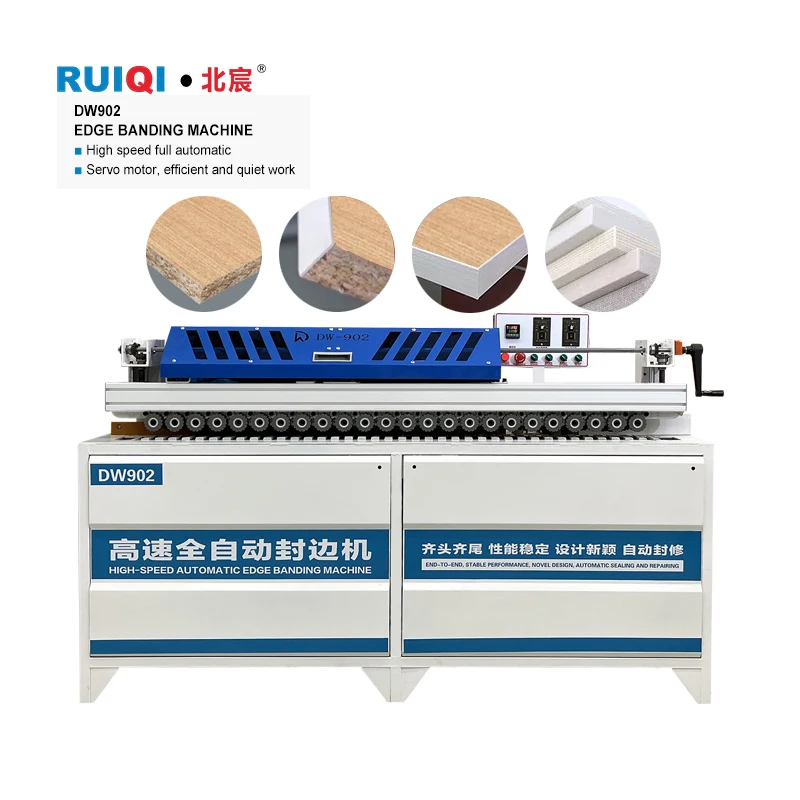
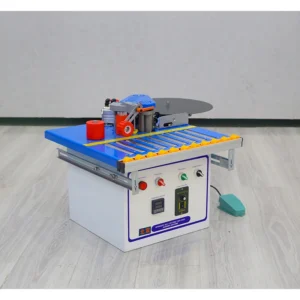
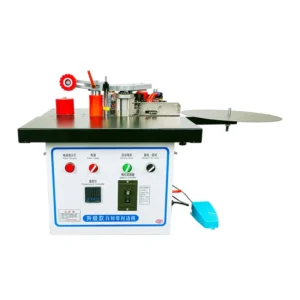
Built In-House With Patented Mechanisms — every DW902 automatic edge banding machine is assembled, tested, and verified on our own factory floor before crating, ensuring tolerance claims hold up at your customer’s assembly bench.
Technical Specifications
| Parameter |
Value |
| Model |
DW902 |
| Product Type |
Automatic Edge Banding Machine |
| Rated Power |
4000W |
| Voltage & Frequency |
220V / 380V / customization (confirm 50Hz or 60Hz) |
| Control System |
PLC Control |
| Overall Dimensions (L×W×H) |
175 × 87 × 112 cm |
| Net Weight |
240 kg |
| Minimum Sheet Length |
25 cm |
| Minimum Sheet Width |
10 cm |
| Edge Banding Height |
Up to 5 cm |
| Edge Banding Thickness |
0.3–3 mm |
| Trimming Unit |
800W × 2 @ 24,000 r/min |
| Polishing Unit |
380W × 2 |
| Edge Unit |
140W |
| Vacuum Unit |
550W |
| Glue Pot Capacity |
4000 ml |
| Working Stations |
Trimming, polishing, automatic trimming, scraping |
| Air Supply Requirement |
0.5–0.8 MPa |
| Certification |
CE |
| Language Options |
Chinese / English standard; Spanish and other languages available |
| Plug Options |
EU / USA / AU / UK |
Application Suitability
| Application |
Material or Output |
| Straight-line panel edge banding |
MDF, particleboard, plywood |
| Cabinet and furniture production |
Solid wood board, ecological board |
| Home decoration panel finishing |
PVC edge banding material |
| Medium to large-scale manufacturing |
Batch runs of cabinet doors, shelving, and carcass panels |
| OEM and private-label equipment supply |
Branded machine configurations for regional distribution |
Why the Voltage Question Comes Before the Price on an Automatic Edge Banding Machine
Confirm local voltage and frequency before the purchase order is signed, not after the crate arrives.
An automatic edge banding machine factory ships equipment across dozens of export markets every year, and grid standards are not uniform. A workshop running on 380V three-phase cannot accept a 415V motor without rewiring, and a 60Hz control transformer will behave differently on a 50Hz supply. I once watched a customer’s electrician wait weeks for a transformer swap because the voltage was assumed rather than confirmed at the quotation stage. That delay is entirely preventable with a locked electrical specification sheet [NEED_CITE: voltage and frequency standards by export market]. Every order for the DW902 begins with a written voltage and frequency confirmation that is then reflected on the motor nameplate, control cabinet label, and wiring schematic.
Component Sourcing and Precision Assembly Under One Roof
When you evaluate an OEM edge banding machine, the depth of in-house manufacturing determines how reliably specifications are held across production runs. The DW902 is assembled from precision-ground components with multi-stage inspection at each station — from the 800W trimming motors running at 24,000 r/min to the 380W polishing units that finish the edge profile. An automatic edge banding machine factory that controls its own cutting mechanism patents can hold tighter tolerances than one sourcing sub-assemblies from multiple vendors and simply bolting them together on a shared frame.
OEM and Private-Label Configuration Without Compromise
Distributors importing woodworking machinery need more than a logo swap. The DW902 supports full private-label customization: control panel language can be set to Spanish, English-only, or other target-market languages before the machine leaves the factory, so the operator reads native instructions on day one. Voltage is configurable across 220V and 380V with regional plug options (EU, USA, AU, UK) hardwired to match local socket standards. The OEM edge banding machine configuration extends to documentation — operation manuals, spare parts lists, and electrical schematics are produced in the agreed language, not translated after arrival [NEED_CITE: CE machinery directive requirements for industrial equipment].
How the DW902 Specifications Translate on the Shop Floor
The 4000 ml glue pot capacity allows extended production runs between refills, which matters when a furniture factory is pushing batches of cabinet carcasses through a single shift. The four working stations — trimming, polishing, automatic trimming, and scraping — cover the full sequence from rough cut to finished edge, so operators do not need to pass panels through a secondary machine for cleanup. Trimming motors at 24,000 r/min provide the spindle speed necessary for a clean cut on PVC banding without chipping the substrate edge. The minimum sheet dimensions of 25 cm length and 10 cm width mean small offcuts and narrow drawer fronts can be edged without manual clamping jigs, expanding the range of jobs one machine can handle.

What Happens When the Configuration Is Chosen Blindly
A panel processing plant that selects an edge bander based on feed speed alone, without matching glue pot temperature to the PVC or veneer thickness being applied, will see inconsistent adhesion across different substrates. Panels that leave the factory floor with visible glue lines fail at the assembly bench, and the tolerance problem surfaces only when cabinet boxes will not square. Machines ordered without confirming local frequency can run trimming motors at the wrong speed, producing a rough edge that no amount of polishing cleans up. These are not manufacturing defects — they are configuration errors that a proper pre-order engineering review prevents [NEED_CITE: edge banding adhesion failure modes on MDF and particleboard].
Manufacturing Depth That Distributors Can Verify
Every DW902 undergoes four-stage quality control: incoming material inspection, in-process assembly checks, finished product testing, and pre-shipment verification with a documented test record. The proprietary cutting mechanism patents are not licensed from a third party — they are developed and manufactured in-house, which means replacement parts remain available for the machine’s full service life. An OEM edge banding machine built this way gives distributors confidence that private-label units shipped to different territories will perform identically. Factory visits are welcomed so buyers can observe assembly, QC checkpoints, and the pre-shipment test run on their own sample panels before authorizing shipment.
Documentation & Verification
- CE declaration of conformity cross-referenced to the DW902 model scope
- Electrical schematic with confirmed voltage, frequency, and plug type printed on every page
- Factory test record showing edge quality on your specified panel thickness and material
- Operation and maintenance manual written in the agreed language, not auto-translated
- Spare parts list with OEM part numbers for trimmer blades, polishing wheels, and glue pot seals
Installation, Commissioning & Support
- Dedicated 380V or 220V circuit required; confirm amperage against the 4000W rated power draw
- Air compressor delivering 0.5–0.8 MPa must be connected before the first test run
- Machine arrives fully assembled in a wooden crate — no on-site frame bolting required
- PLC control panel language verified at commissioning to match operator proficiency
- Trimming and polishing motor speeds checked against PVC and veneer banding material on day one
Requesting an OEM Quotation
To configure the DW902 for your market, share the target grid voltage and frequency, the primary panel materials you or your customers process (MDF, particleboard, plywood, or solid wood), and the edge banding thickness range most common in your region. Let us know the preferred control panel language and whether you require private-label branding on the machine body and documentation. If you need a sample panel test or a factory visit before placing the order, specify the substrate and banding material so we prepare the correct setup.
Frequently Asked Questions
Q: What can be customized under an OEM or private-label agreement?
A: The DW902 supports custom logo placement on the machine body, voltage and frequency matching to your market, regional plug types, control panel language selection, and translated documentation. Color options and specific electrical configurations are confirmed during the quotation phase based on order requirements.
Q: Can I send sample panels for a factory test before ordering?
A: Yes. Send your MDF, particleboard, or plywood samples along with the PVC or veneer banding material you use. We run them through the DW902 at our facility, document the edge quality and trimming results, and share the test record so you can evaluate output before committing to a production order.
Q: What spare parts should a distributor stock locally?
A: We recommend stocking trimmer blades for the 800W units, polishing wheels, glue pot seals, and scraping blades based on your projected service call volume. A recommended spare parts list with part numbers and suggested quantities is provided with every distributor agreement to minimize downtime for your customers.
Q: Do you provide technical training for distributor service teams?
A: Distributor partners receive maintenance documentation, electrical schematics, and troubleshooting guides for the DW902. On-site or factory-based training sessions can be arranged so your technicians understand station adjustment, motor replacement, and PLC diagnostics specific to this automatic edge banding machine model.
Q: How is the glue temperature matched to different banding materials?
A: PVC, veneer, and melamine banding each require a different glue pot temperature range for optimal adhesion. During configuration, we confirm the primary banding material and set the DW902 glue pot operating parameters accordingly, then verify bond strength on your sample panels during the pre-shipment test.