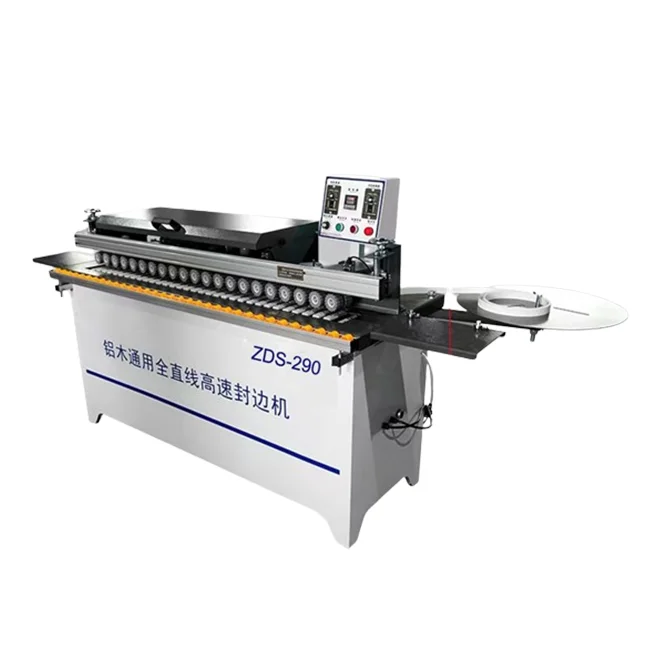
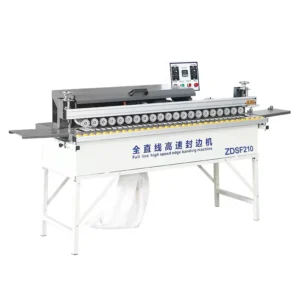
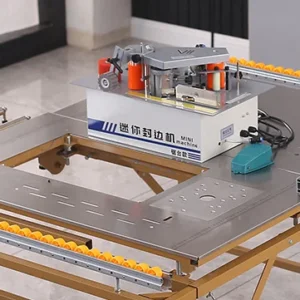
Automatic MDF Board Edge Banding Machine – Factory Direct
In-house precision grinding — every ZDS290 pressure beam is machined to flatness tolerance before assembly, eliminating the vibration-induced chatter marks common on welded steel beams.
Technical Specifications
| Parameter |
Value |
| Model |
ZDS290 |
| Product Type |
Automatic Edge Banding Machine |
| Rated Voltage |
220V |
| Rated Power |
4165W |
| Conveying Power |
180W |
| Trimming Power |
800W × 2 |
| Polishing Power |
180W × 2 |
| Vacuuming Power |
1200W |
| Glue Pot Heating Power |
800W |
| Edge Banding Speed |
6 m/min (basis not stated in source) |
| Air Supply Requirement |
0.6–0.8 MPa |
| Overall Dimensions (L×W×H) |
150×57×96 cm |
| Strip Thickness Range |
0.5–2.5 mm |
| Sheet Thickness Range |
10–50 mm |
| Glue Pot Capacity |
1000 ml |
| Glue Pot Heating Time |
5–10 min |
| Pressure Beam |
Integrated thickened aluminum alloy |
| Pressure Wheel |
Double-row inclined pressure wheel |
| Board Thickness Display |
Digital display |
| Pressure Beam Height Adjustment |
Hand-crank wheel |
| Glue Application System |
Imitation glue pot with concave-convex gum wheel design |
| Secondary Processing |
Secondary scraping and cleaning included |
| Warranty |
1 year |
Application Suitability
| Application |
Material or Output |
| Cabinet door edge finishing |
MDF panels with PVC or melamine strips (0.5–2.5 mm) |
| Custom furniture carcass production |
Particleboard with veneer or PVC edge banding |
| Small-batch plywood joinery |
Plywood sheets with solid wood or veneer strips |
| Workshop transition from manual to semi-automated |
Straight-line panels across MDF, plywood, and particleboard substrates |
Why Voltage Confirmation Must Precede Every Shipment
No Edge Banding Machine manufacturer should dispatch a unit without a signed electrical schematic confirming local grid compatibility.
In my years coordinating factory installations across the Middle East, I have seen fully loaded automatic edge banders sit idle on workshop floors for weeks because the voltage and frequency stamped on the nameplate did not match the local supply. A machine wired for 380V/50Hz will not start its main motor on a 415V network, and swapping a transformer after the fact risks damaging control boards that were never rated for the higher input [NEED_CITE: voltage and frequency standards by export market]. The ZDS290 ships with confirmed voltage configuration documented in the electrical schematic, and every wiring diagram is signed off before the crate leaves our loading bay.

Component Sourcing and Assembly Integrity
The ZDS290 pressure beam uses an integrated thickened aluminum alloy section rather than a bolted-together mild steel assembly. This material choice delivers thermal stability across long production shifts, preventing the beam from warping as ambient workshop temperatures climb during summer months. Our sourcing team qualifies each aluminum extrusion batch against flatness and hardness specifications before it enters the machining cell.
The double-row inclined pressure wheel carriage is ground and fitted on our own assembly line, not outsourced to a third-party sub-contractor. Bearing preload is set with torque-controlled tooling, and the digital board thickness display is calibrated against gauge blocks at three points across the 10–50 mm sheet range. Every Edge Banding Machine manufacturer claims tight tolerances — the difference here is that each calibration is recorded on the factory test sheet packed with the machine.
How the Glue System Holds Up Under Continuous Operation
The concave-convex gum wheel design in the ZDS290 glue pot addresses a recurring complaint from workshops running mixed PVC and veneer stock: uneven adhesive laydown that shows as visible glue lines on lighter substrates. The wheel profile distributes hot-melt adhesive across the strip width more uniformly than a flat roller, reducing the operator’s need to constantly adjust glue flow by hand [NEED_CITE: hot-melt adhesive application methods in panel edge banding].
With a 1000 ml glue pot and 800W heating element, the system reaches operating temperature within five to ten minutes from cold start. The secondary scraping and cleaning station downstream of the trimming units removes residual adhesive squeeze-out before it can cool and harden, which is where most visible edge defects originate on machines lacking this stage.
Reading the Specs That Actually Matter on the Shop Floor
The 0.6–0.8 MPa air supply requirement is typical for pneumatic pressure zones on compact edge banders, but it means the workshop compressor must be sized to sustain that pressure at the machine inlet, not just at the tank. Undersized compressors cause the pressure wheels to lose contact force intermittently, producing banding that lifts at the leading edge.
The 6 m/min feed speed sits at the conservative end for this machine class, which favors edge finish quality over raw throughput. For a small to mid-scale panel shop running MDF and particleboard, this pace allows the trimming and polishing stations to complete each cut cleanly without the chatter that higher feed speeds introduce on thinner substrates.
The hand-crank pressure beam height adjustment and digital board thickness display together mean that changeover between 10 mm shelving stock and 50 mm worktop panels is a manual operation taking seconds, with the digital readout eliminating the guesswork that leads to crushed edges or insufficient clamping force.
The Hidden Cost of Skipping Pre-Shipment Verification
When an edge bander arrives at a job site without a documented test run on the buyer’s actual panel stock, the first production shift becomes a commissioning exercise. Operators discover that the trimming cutters need repositioning for a specific melamine thickness, or that the polishing wheels leave swirl marks on a particular veneer species. These adjustments are routine on the factory floor with the correct tooling to hand — but disruptive when they surface after the machine has been bolted into a production line with downstream stations already scheduled [NEED_CITE: edge banding commissioning challenges in distributed workshops].
What Our Manufacturing Process Brings to Your Floor
The ZDS290 is assembled on a dedicated line where each station has a defined QC checkpoint, from incoming material inspection through in-process dimensional verification, finished product testing, and pre-shipment running under load. Our four-stage quality control protocol means that no unit ships without completing a documented test cycle on panel stock matching the buyer’s specified substrate and strip material.
We hold proprietary patents on cutting mechanisms used in our edge bander family, and the ZDS290 benefits from the same precision-ground component standards applied across our full product range. Voltage customization from 110V to 440V is configured during assembly, not retrofitted post-production, so every electrical component from the main contactor to the control transformer is rated for the target grid from day one.
OEM partners commissioning private-label runs receive custom logo application, color matching, and multilingual control panel overlays integrated into the build schedule — not applied as afterthoughts once the base machine is complete.
Documentation & Verification
- CE declaration of conformity covering the ZDS290 mechanical and electrical safety scope
- ISO 9001 certificate available for supply chain audit and compliance filing
- Factory test record showing edge banding output on buyer-specified panel thickness and strip material
- Electrical schematic with confirmed voltage, frequency, and circuit protection values for the destination market
- Operation and maintenance manual written in the agreed language with illustrated adjustment procedures
- Spare parts list with OEM part numbers for trimming cutters, polishing wheels, gum wheel, and pneumatic seals
Installation, Commissioning & Support
- Requires a dedicated 220V single-phase circuit with appropriate breaker sizing for the 4165W rated load
- Compressed air line must deliver sustained 0.6–0.8 MPa at the machine inlet with inline moisture filtration
- Overall footprint of 150×57×96 cm allows placement against a workshop wall with access clearance on the feed side
- First-run commissioning includes pressure wheel alignment and trimming cutter positioning for the specified strip thickness
- Glue pot heating element and thermostat calibration verified on site during initial startup before production handover
- Digital board thickness display recalibrated against gauge blocks at installation to account for transit-induced shift
Before You Request a Quotation
Tell us the panel substrates you run most frequently — MDF, particleboard, plywood, or a mix — along with the edge banding materials and strip thicknesses in your current specifications. Confirm your workshop voltage and frequency, and let us know if your operators need the control interface in a specific language. If you are evaluating this Edge Banding Machine manufacturer for an OEM or distributor arrangement, share your target market and annual volume estimate so we can structure the configuration and documentation package accordingly.
Frequently Asked Questions
Q: What OEM and private-label options are available for the ZDS290?
A: We configure custom logos, machine color, voltage from 110V to 440V, and multilingual control panel overlays during the assembly phase. Single-unit orders are accepted, and larger production runs benefit from consolidated tooling setup. Specification tailoring covers pressure wheel configuration and glue pot capacity to match your panel processing requirements.
Q: How do you verify manufacturing quality before the machine ships?
A: Each ZDS290 passes through four QC stages: incoming material inspection, in-process dimensional checks during assembly, finished product functional testing, and a pre-shipment running test on panel stock matching your specifications. Every test result is recorded on a factory test sheet that ships with the machine.
Q: Can I visit the factory to inspect the production line?
A: Factory visits are welcome at our Ningjin, Shandong facility. You can observe the assembly line, precision grinding stations, and QC checkpoints in operation. We recommend scheduling a visit during the build window of your order so you can witness the pre-shipment test on your specified substrates.
Q: What documentation accompanies each ZDS290 shipment?
A: Every unit ships with a CE declaration of conformity, ISO 9001 certificate reference, machine specification sheet, electrical schematic with confirmed voltage, operation manual in your chosen language, spare parts list with OEM part numbers, and packing photographs for customs and receiving inspection.
Q: What is the lead time from order confirmation to dispatch?
A: Standard production runs follow typical multi-week lead times depending on customization scope and current order volume. OEM runs with private-label configuration require additional time for logo tooling and control panel overlay production. We provide a confirmed dispatch date at order confirmation.