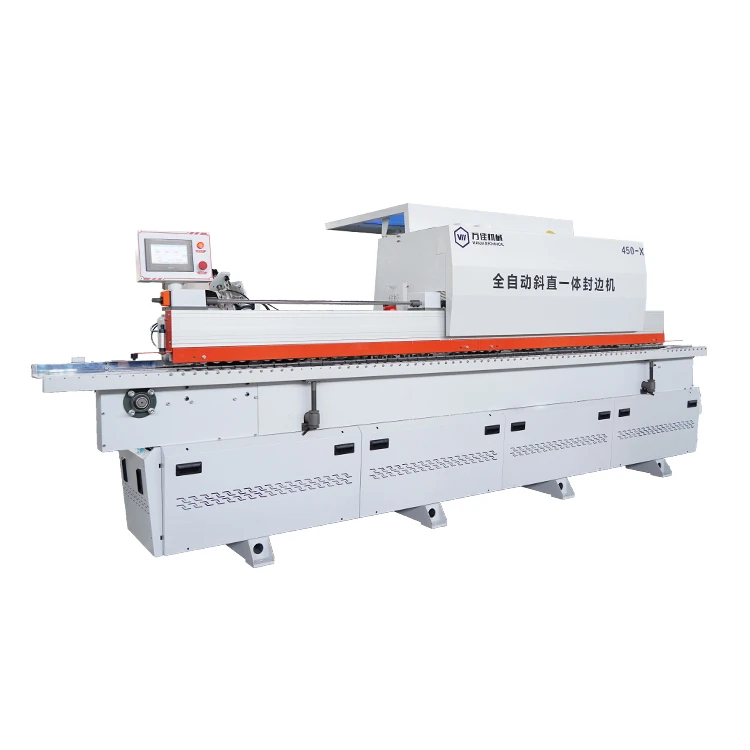
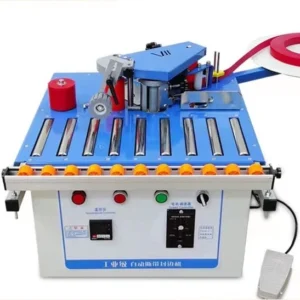
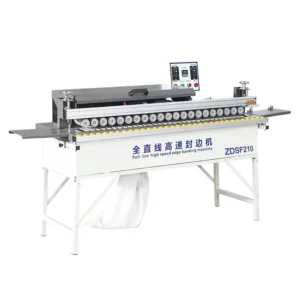
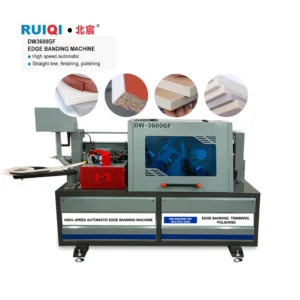
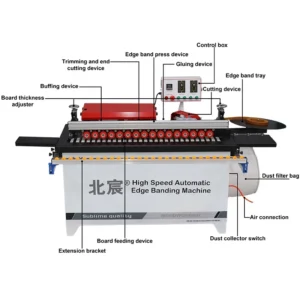
Proprietary Cutting Mechanism — Tolerance claims verified through a four-stage QC process, backed by pre-shipment test records that distributors can present to their own customers with confidence.
Technical Specifications
| Parameter |
Value |
| Product Type |
Automatic Edge Banding Machine with Pre-Milling and Corner Trimming |
| Overall Dimensions |
4350 × 920 × 1650 mm |
| Total Power |
17.5 kW |
| Voltage & Frequency |
380V / three-phase five-wire / 50Hz (configurable 110V–440V) |
| Conveying Motor |
380V 2.2 kW with frequency converter |
| Feed Speed |
0–12 m/min (variable speed, inclined straight edge) |
| Air Source Pressure |
0.6–0.8 MPa |
| Lifting Motor |
380V 0.25 kW with inverter |
| Dust Extraction Port |
100 mm diameter |
| Polishing Motor |
380V 0.37 kW × 2 |
| Selection Motor |
380V 4 kW |
| Milling Motor B |
380V 3.5 kW |
| Trimming Motor |
380V 0.75 kW × 2 |
| End Trimming Motor |
380V 0.37 kW × 2 |
| Slotted Motor |
220V 0.8 kW |
| Glue Pot Capacity |
2000 ml |
| Glue Pot Heating Power |
1.2 kW |
| Glue Pot Operating Temperature |
150–170°C |
| Heat Gun Power |
2 kW |
| Edge Strip Width |
20–50 mm |
| Edge Banding Thickness |
Up to 1.2 mm (PVC, material dependent) |
| Panel Thickness Range |
18 / 22 / 25 mm |
| Minimum Sheet Width |
>100 mm |
| Minimum Sheet Length |
>250 mm |
| Control System |
PLC / Xinjie Industrial Touch Screen |
| Inverter |
Xinjie Industrial Inverter |
| Air Storage Tank |
5 L |
Application Suitability
| Application |
Material or Output |
| Custom cabinet door and carcass edge finishing |
MDF and particleboard with PVC edge banding |
| Curved and slanted panel edge processing |
Plywood and shaped furniture components |
| High-volume panel board edging for furniture factories |
MDF, particleboard and plywood panels with pre-milled edges |
| Joinery workshop transition from manual to automated edging |
Solid wood panels and PVC-banded substrates |
Why Voltage Verification Must Happen Before the Purchase Order
An Automatic Edge Banding Machine OEM factory that confirms your local electrical standards before production eliminates the most expensive mistake in cross-border machinery procurement.
I once watched a container arrive at a buyer’s workshop only to find the three-phase supply didn’t match what was on the machine’s nameplate. The distributor had to bring in a transformer, add complexity to the electrical room, and absorb the downtime while the unit sat idle on the floor [NEED_CITE: voltage and frequency standards by export market]. That scenario repeats far more often than it should. Our configuration process locks in voltage from 110V to 440V at the quotation stage, and the electrical schematic ships with the documentation package so the buyer’s electrician can prepare the circuit before the machine arrives.
How the Manufacturing Floor Builds This Machine
Every unit begins on the assembly line where precision-ground components are fitted under controlled conditions. The cutting mechanism that defines this edge bander is covered by proprietary patents, and the tolerance is measured and recorded at multiple checkpoints rather than simply stated on a brochure. As someone who has worked through the assembly process here for years, I know that ±0.02mm isn’t a marketing figure — it comes from the grinding discipline and the fixture accuracy on the line.
What OEM Partners Actually Receive Beyond the Logo
Private label scope extends well past a sticker on the enclosure. Distributors evaluating an Automatic Edge Banding Machine OEM factory need to understand that customization covers control panel language, color scheme on the housing, voltage and frequency matching, and specification tuning for the regional market’s common panel thicknesses [NEED_CITE: CE machinery directive requirements for industrial equipment]. The Xinjie industrial PLC touch screen can display operator instructions in the language your customers actually read, which matters when your service team is training a furniture factory’s crew on commissioning day.
Reading the Spec Sheet Against Real Workshop Demands
The 17.5 kW total power draw tells a distributor what electrical infrastructure a customer’s workshop needs before installation. Panel thickness options at 18, 22, and 25 mm cover the standard board stock used in cabinet and furniture production across most markets, meaning the same machine SKU can serve multiple customer segments. The 0–12 m/min variable feed speed, managed through the Xinjie inverter, lets operators slow down for curved or slanted edges where precision matters more than throughput. The glue pot operating range of 150–170°C is matched to PVC edge banding adhesives, and the 2000 ml capacity keeps the pot from cycling on and off during continuous runs — a detail that directly affects edge adhesion consistency. Dust extraction through a 100 mm port connects to a central collection system, keeping the polishing and scraping stations clear of residue that would otherwise degrade edge finish quality.

The Hidden Cost of Skipping the Sample Test
I learned this the hard way when a pre-milling edge bander I sent to a Middle East customer produced rough trim lines on their PVC stock. The edge banding they used locally was 0.3 mm thicker than what we ran during factory testing, and the cutter engagement wasn’t set for it. They sent me video of the result, and I rebuilt the tool path overnight. Now every order I handle requires the buyer to send their actual board samples and edge banding rolls before we ship. Distributors who skip this step absorb the cost of field adjustments and lose credibility with their end customers [NEED_CITE: edge banding material thickness variation across regional suppliers].
What Sets This Build Apart from Catalog Claims
The patented cutting mechanism isn’t borrowed or licensed — it is developed and manufactured on this floor, which means spare parts and cutter replacements stay in the supply chain. The four-stage QC process — incoming material, in-process, finished assembly, and pre-shipment verification — produces a test record that accompanies every machine, so the distributor has documentation to stand behind. Voltage and language customization are treated as standard configuration work rather than special requests. The full station lineup from pre-milling through corner rounding, scraping, slotting, and polishing means your customers don’t need secondary finishing stations. And the engineer-led quotation process delivers a formal configuration proposal within one working day of receiving the inquiry.
Documentation & Verification
- CE declaration of conformity matching the machine’s declared specifications
- ISO 9001 certificate covering the manufacturing and quality management process
- Electrical schematic with confirmed voltage and frequency for destination market
- Factory test record run on buyer-supplied panel and edge banding samples
- Operation and maintenance manual in the operator’s working language
- Spare parts list with OEM part numbers for long-term supply
Installation, Commissioning & Support
- 4350 × 920 mm footprint requires a level concrete floor with clear access on both sides for panel feeding and edge inspection
- 17.5 kW total load needs a dedicated three-phase circuit matching the confirmed voltage and frequency specification
- Machine ships with protective crating and arrives requiring dust extraction hose and air supply connection at 0.6–0.8 MPa
- First startup includes PLC parameter loading for the buyer’s specific panel thickness range of 18, 22, or 25 mm
- Operator training covers Xinjie touch screen navigation, glue pot temperature management, and feed speed adjustment
- Spare cutter sets and polishing wheels included based on the configured station lineup
Before You Request a Quotation
Tell us the panel substrates and edge banding materials your customers process most frequently, along with the thicknesses they run. Confirm the local voltage and frequency at the installation site, and the preferred language for the PLC touch screen interface. If you are evaluating this as a private label product for your regional market, let us know the branding scope and any specification adjustments your customer base requires so we can build the proposal around your actual sales territory.
Frequently Asked Questions
Q: What is included in the OEM and private label customization scope?
A: Customization covers logo placement and color scheme on the housing, control panel language configuration on the Xinjie touch screen, voltage and frequency matched to the destination market, and specification tuning such as panel thickness range or edge banding material type. Each distributor receives a formal configuration document before production begins.
Q: How is the ±0.02mm tolerance verified before the machine leaves the factory?
A: The four-stage QC process measures tolerance at incoming material inspection, during assembly, at finished product testing, and again during pre-shipment verification. A factory test record is generated using the buyer’s own panel and edge banding samples, and this document ships with the machine.
Q: What manufacturing depth does the factory maintain on critical components?
A: The cutting mechanism is built on a proprietary patented design, manufactured and precision-ground in-house. The PLC, inverter, and touch screen are sourced from Xinjie as specified industrial components, and all sub-assemblies are fitted and tested on the production floor rather than outsourced.
Q: What spare parts and technical support are available for distributors?
A: A spare parts list with OEM part numbers ships with every machine, covering cutters, polishing wheels, and wear components for the configured stations. Technical training is available for the distributor’s service team, covering PLC parameter adjustment, tool path modification, and routine maintenance procedures.
Q: Can the machine be configured for both straight and curved edge banding?
A: Yes. The variable feed speed from 0–12 m/min and the inclined straight edge conveying system allow operators to reduce speed for curved and slanted panel edges. The full station sequence handles end trimming, rough and fine trimming, corner rounding, scraping, and polishing across both geometries.