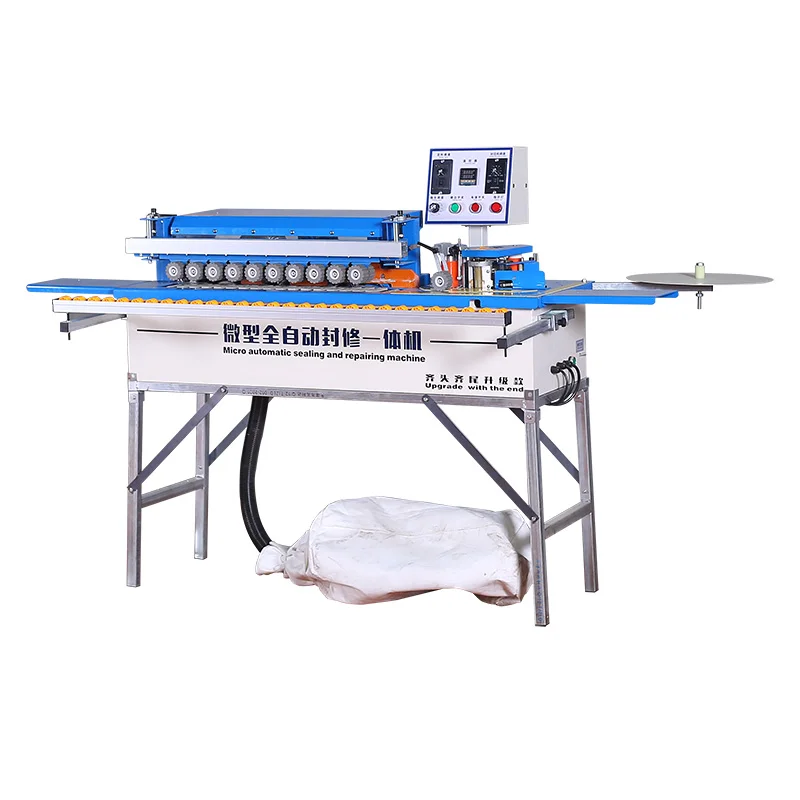
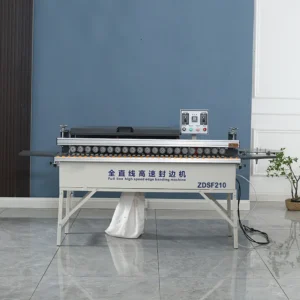
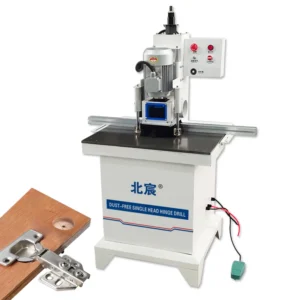
Precision Manufacturing Depth — In-house grinding, assembly, and four-stage verification on every edge banding unit leaving our Ningjin facility, built for distributors who need verifiable quality across repeated OEM orders.
Technical Specifications
| Parameter |
Value |
| Product Type |
Automatic Edge Banding Machine |
| Voltage |
220V (configurable 110V–440V) |
| Rated Power |
4000W |
| Feed Speed |
0–6 m/min |
| Glue Pot Capacity |
1000 ml |
| Panel Thickness Range |
10–60 mm |
| Edge Banding Thickness Range |
0.5–3 mm PVC |
| Overall Dimensions (L×W×H) |
120×54×72 cm |
| Control System |
Independent function control panel |
| Gluing Device |
Rotatable 180° for curved edge banding |
| Polishing Motors |
Two 180W motors, cross polishing up and down |
| Edge Trimming Motors |
Two 800W motors, trimming up and down with dust suction |
| Feeding System |
Double-row rubber pressure wheels |
| Functions |
Auto feeding, double-sided gluing, head/tail cutting, trimming, vacuuming, polishing, curved & straight dual purpose |
Application Suitability
| Application |
Material or Output |
| Cabinet door and carcass edge finishing |
MDF and particleboard with 0.5–3 mm PVC banding |
| Custom furniture panel edging |
Plywood panels up to 60 mm thickness |
| Small-batch curved component banding |
Solid wood and shaped MDF with PVC strip |
| Workshop-scale joinery production |
Melamine-faced board and veneer substrates |
Why Tolerance Claims Mean Nothing Without Pre-Shipment Proof
Claimed tolerances only matter when they are measured, recorded, and shipped with the machine.
I have watched importers receive automatic edge banding machine factory orders where the stated accuracy looked solid on paper, yet panels coming off the line showed visible glue lines and uneven trimming from day one. The root cause was never the design — it was the absence of any verification step between final assembly and the crate closing. Distributors then face warranty claims from their own customers, damaging territory reputation before the first year is out [NEED_CITE: quality verification standards for woodworking machinery exports]. Without documented pre-shipment testing tied to your specific panel thickness range, a tolerance figure is just marketing copy.

How Our Build Process Secures Dimensional Accuracy
Every unit in this product family passes through a four-stage quality protocol — incoming material inspection, in-process assembly checks, finished product testing, and pre-shipment verification under actual running conditions. The trimming motors, rated at 800W each, are aligned against precision-ground reference surfaces so that cut depth holds consistent across the full 10–60 mm panel thickness range. This is the stage where most variance enters the system, and it is where our inspection time is concentrated.
OEM Configuration Built Into the Production Flow
Private label partners receive more than a logo swap. Voltage is wound to your market’s standard — from 110V single-phase to 440V three-phase — before the electrical cabinet is closed, not rewired after the fact. Control panel overlays are printed in the operator’s working language, and the independent function control layout remains identical across units so your service team trains once and services every market [NEED_CITE: OEM machinery labelling and safety marking requirements].
What the Spec Sheet Actually Tells You
The 0–6 m/min feed speed range keeps this automatic edge banding machine factory configuration relevant for both one-off custom panels and short production runs, where constant high-speed feed would cause trimming chatter on shorter workpieces. The 1000 ml glue pot is sized for PVC banding between 0.5 and 3 mm — large enough to maintain stable temperature through a full shift, small enough that glue degradation from prolonged idle heating is reduced. The 180-degree rotatable gluing device is the feature that separates straight-only machines from dual-purpose ones: curved components do not require a second workstation or manual repositioning. Double-row rubber pressure wheels distribute clamping force across the panel face, reducing the edge lift that single-row systems produce on warped MDF stock.
The Real Cost of Skipping Electrical Verification
Shipping a machine without confirming the destination site’s voltage and frequency is the single most preventable cause of dead-on-arrival equipment. I once handled a replacement order for a distributor whose customer in the Middle East waited three weeks for a transformer because the original unit was wound for the wrong grid standard — the entire workshop stood idle. When a private label partner orders fifty units across different territories, one unchecked electrical spec becomes fifty separate field problems, each carrying freight cost and reputational damage [NEED_CITE: voltage and frequency standards by export market].
Why Distributors Source This Range From Our Facility
Our Ningjin plant controls the full manufacturing sequence, from component grinding to final assembly, which means private label specifications are embedded at the build stage rather than applied afterward. The patented cutting mechanisms used across this product family deliver verified dimensional accuracy that your technical team can audit during factory visits. Four-stage quality verification with documented records accompanies every shipment, so your after-sales team has traceable data when field questions arise. We support order volumes from single evaluation units through to container-load production runs, with lead times that remain stable because component supply is managed in-house rather than subcontracted.
Documentation & Verification
- CE declaration of conformity matched to the shipped machine configuration
- ISO 9001 quality management certificate covering the production facility
- Factory test record run on your specified panel thickness and PVC banding grade
- Electrical schematic with confirmed voltage, frequency, and circuit protection ratings
- Operation and maintenance manual printed in your chosen operator language
Installation, Commissioning & Support
- Dedicated 220V circuit (or confirmed local voltage) with appropriate breaker for 4000W rated draw
- Compact 120×54×72 cm footprint fits standard workshop bays without floor reinforcement
- Double-row rubber pressure wheels inspected and tension-set during on-site commissioning
- Glue pot temperature and feed speed calibrated to your PVC banding stock on first run
- Polishing and trimming motor alignment verified against sample panels before operator handover
Before You Request a Quotation
Tell us the panel substrates you process most frequently, the PVC banding thickness range you stock, and the daily volume your workshop handles. Confirm your local voltage and frequency standard, the preferred control panel language, and whether your existing dust extraction system will connect to the built-in suction ports — this lets us configure the unit correctly before production begins.
Frequently Asked Questions
Q: How is edge trimming tolerance verified before the machine ships?
A: Each unit runs test panels through the full trimming and polishing sequence during pre-shipment verification. Cut depth and edge finish are measured against reference gauges, and results are recorded in a factory test document that ships with the machine. This record gives your service team a baseline for future maintenance calibration.
Q: What OEM customization is available beyond logo placement?
A: Voltage winding is configured to your market standard from 110V to 440V during manufacturing, control panels are printed in your chosen language, and exterior colour and branding are applied at the paint stage. Electrical schematics reflect the as-built configuration, not a generic template, so your technical team receives accurate documentation for field service.
Q: Can you support private label orders with mixed specifications?
A: Yes. A single production run can include units wound for different voltages or labelled for different end markets, provided the configuration schedule is confirmed before the order enters the assembly stage. This allows distributors serving multiple territories to consolidate shipments while meeting each market’s electrical and labelling requirements.
Q: What quality control stages are applied during manufacturing?
A: Incoming raw materials and purchased components are inspected first. Assembly is checked at defined in-process hold points. Completed machines undergo functional testing under load. A final pre-shipment verification run uses your specified panel and banding materials, with results documented before crating.